
Long video · 11 min · 10 oddities
The Secret Purpose of 10 Things You Use Every Day
Ten everyday details that look like decoration or mistakes, from the dots on a windshield and the arrow by your fuel gauge to the hole in an airplane window and the tiny pocket on your jeans, each explained by the job it really does. The page goes further than the video: what the patents and standards say, which popular explanations are wrong, and why four very similar holes do four unrelated jobs.
Published · Last verified · 12 chapters
Playing loads the video from YouTube (Google), which may set cookies.
In this video
Each of these ten details was put there by someone solving a specific problem: glue that sunlight breaks down, drivers soaked at the wrong side of the pump, children inhaling pen caps, thieves shaving silver off coins. Most of those problems are invisible today precisely because the fix works.
Below, each chapter gets the mechanism in plain terms, a detail or two the video had no time for, and a link to the full researched article. After the ten, two sections compare them: what the four holes in the video actually have in common (very little), and which details a rule demands, which are company habit, and which are leftovers from a job that no longer exists.
At a glance
| Object | What you notice | Its real job | Since |
|---|---|---|---|
| Windshield dots | A black border that breaks up into shrinking dots | Hides and UV-shields the glue bead; the dots stop the hotter black band warping the glass | Common from the 1980s, with glued-in windshields |
| Fuel gauge arrow | A small triangle beside the pump icon | Points to the side of the car with the fuel door | 1989 Ford Escort and Mercury Tracer |
| Pen cap hole | A hole through the closed tip of the cap | Lets some air past a cap stuck in a child's airway | Biro Bic patent filing 1988; BS 7272 in 1990; ISO 11540 in 1993 |
| Toothpaste squares | A colored square on the crimped end | An eye mark that a sensor uses to line the tube up before sealing | Already in use when Colgate filed a patent to hide it in 1967 |
| Hexagonal pencils | Six flat sides instead of a round barrel | Stops rolling, gives the fingers flats, fits more pencils per slat | No agreed date; linked to machine-made pencils |
| Cracker holes | A neat grid of pinholes | Pins the dough layers together and lets steam out | Docking pins in cracker machines by 1872 |
| Padlock hole | A small hole in the base | Drains rain and grit from the deep shackle bore | Described in a 1989 padlock patent |
| Coin ridges | Fine grooves around the rim | Exposed clipping; today they help tell coins apart by touch | English machine-made coins, 1662 |
| Airplane window hole | A pinhole in one of the panes | Vents the gap so the outer pane takes the load and the middle pane stays a spare | Rounded windows since the Comet 1XB |
| Jeans watch pocket | A tiny pocket above the right front pocket | Held a pocket watch | Levi's 1873 waist overalls; watch pockets in breeches by the 1680s |
What are the black dots on a windshield for?
The black border, the frit, isn't paint in the usual sense. It's an enamel of pigment and finely ground glass, printed on while the windshield is still flat and then fused into its surface in the bending furnace, at somewhere around 600 to 740 °C. Once fired, it's part of the glass.
Its solid stretch sits right over the polyurethane bead that bonds the windshield to the car. From outside, you can't see the glue, and ultraviolet light can't reach it and weaken it. That bond is a safety part: in the US, FMVSS 212 requires a set share of the windshield's edge to stay attached in a frontal crash test, at least half on each side for cars with airbags.
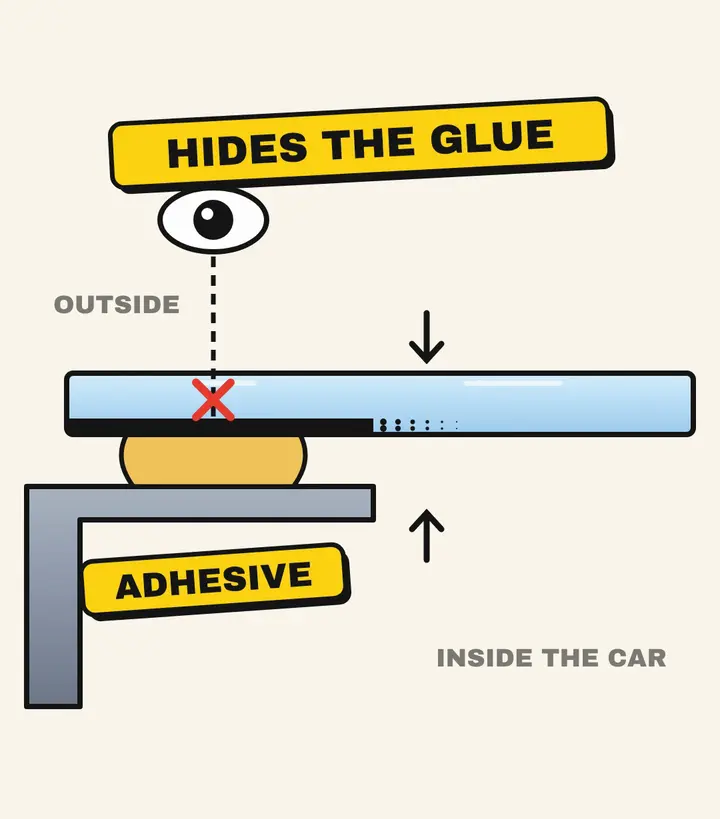
The dots deal with a side effect. Black enamel runs hotter in the furnace than clear glass, and a hard edge would leave a strip of warped glass the industry calls a burn line. Rows of ever-smaller dots act like a newspaper halftone, easing the change in temperature across a wider band. Read the full windshield article.
Which side is my fuel door on?
Read the triangle as a map of the car, not of the driver. It means the car's left or right, so a left arrow is the driver's side in the US and the passenger side in the UK, Japan or Australia.
Ignore the hose on the pump picture. The US standard for dashboard symbols, FMVSS 101, draws the fuel gauge icon with its hose on the right no matter where the filler is, and it has no entry for the arrow at all. That makes the arrow a carmaker's choice rather than a legal requirement.
Jim Moylan's 1986 memo at Ford didn't even propose an arrow. His sketch was a tiny top-down car with an oversized fuel door; the triangle was the simplified version that reached the 1989 Escort and Mercury Tracer. Mercedes-Benz arguably got there first, with a triangle-shaped low-fuel lamp on the 1976 W123 that pointed toward its filler. Who deserves the credit is covered in the fuel gauge arrow article.
Why is there a hole in a pen cap?
A cap is shaped like a stopper. The narrow closed end goes in first, slips past the vocal cords, and the wide open end stops it coming back out. Drill through the closed end and the stopper becomes a short tube. In 1988 Biro Bic cited research that even a 5 mm² passage can keep someone breathing while help arrives; its own design used a hole at least 3 mm across.
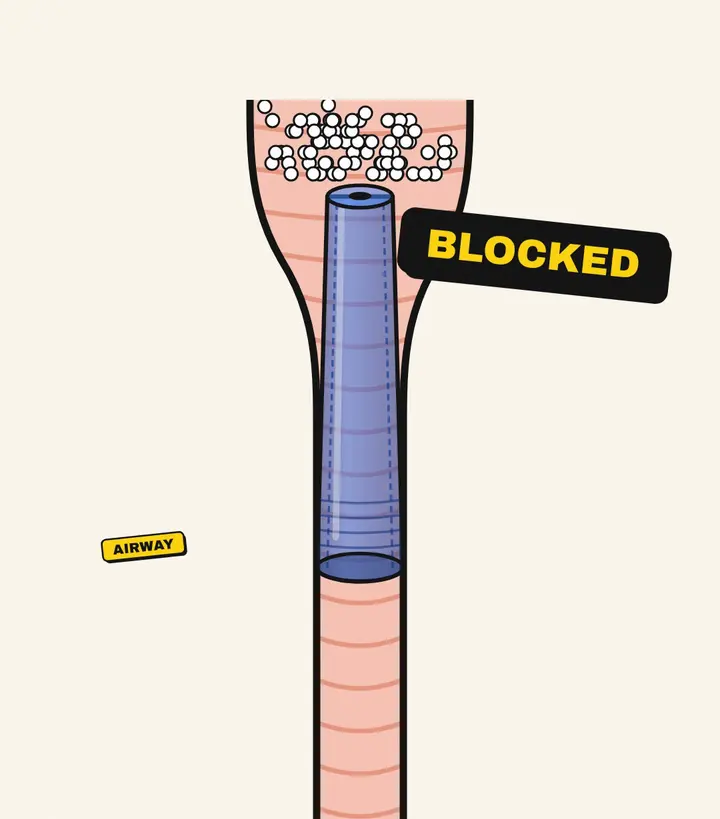
ISO 11540 is specific about who it protects. It covers writing and marking instruments likely to be used by children up to 14, sets requirements for cap size, vent area, air flow and marking, and leaves out pens meant for adults, such as expensive fountain pens. Hospital data back up the age range: a hospital in Beijing treated 34 children for inhaled pen caps between 1997 and 2007, all aged 6 to 14.
The hole buys time and nothing more. Every one of those caps still had to be removed by doctors. More in why pen caps have a hole.
What do the colored squares on toothpaste tubes mean?
The square is an eye mark, and its reader is the filling machine. Empty tubes reach the line already printed, closed at the nozzle end and open at the other. A motor spins each tube in its holder while an electric eye watches for the mark. When the mark comes round, the spinning stops, so the flat seal lands in the same spot relative to the artwork every time. A tube whose mark never appears gets flagged and rejected further down the line.
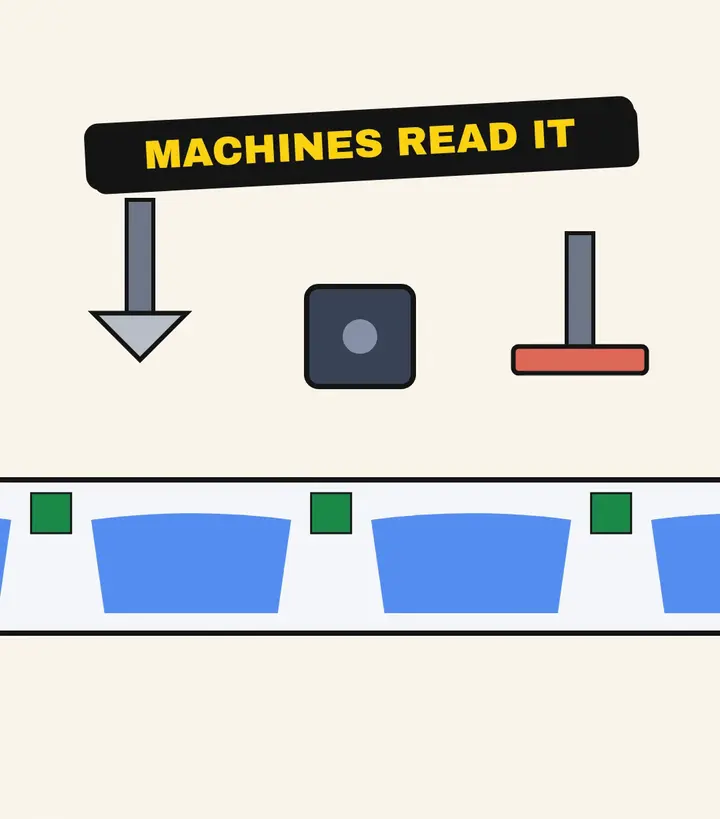
The color only has to stand out. Sensor makers describe their devices as reading a change in grayscale against the background, and an operator teaches a new mark with a button press. The classic eye mark is black, the very color the viral chart says means "chemicals only". If you want to know what's in the paste, US tubes and boxes carry a Drug Facts panel. The full story: what the squares on toothpaste tubes mean.
Why are most pencils six-sided?
Faber-Castell gives the plainest answer: wood-cased pencils changed from round to hexagonal or triangular because round ones kept rolling off tables. The flats also help the thumb, index and middle finger that hold a pencil, which is why the company now recommends three-sided pencils for beginners.
The factory reason holds up but is modest. A pencil starts as a glued sandwich of two grooved wooden slats, which a machine cuts into individual pencils. CalCedar's CEO put the gain at about nine hexagonal pencils from a slat that would give eight round ones. The geometry fits: measured across its flats, a hexagon is only about 87% as wide as it is from corner to corner.
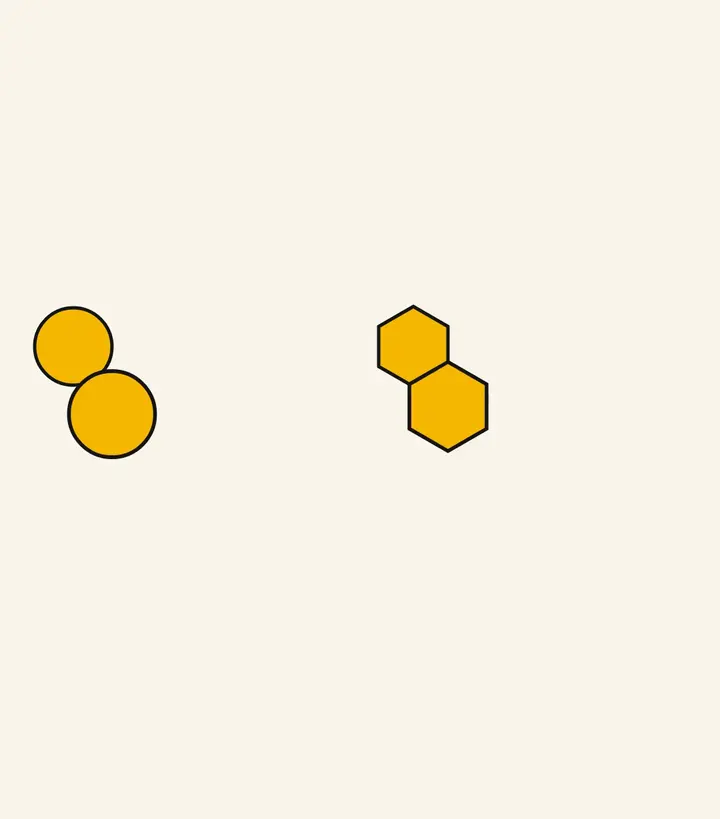
On round colored pencils, the video repeats a common explanation: artists turn them as they shade. We couldn't find a source for that reason. The documented case for a round barrel comes from Faber-Castell: stenographers turned their pencils so the lead wouldn't wear blunt on one side. Details in why pencils are hexagonal.
Why do crackers have holes in them?
Docking does two jobs, and the less famous one comes first. As thin dough heats, its surface dries into a skin that traps the steam inside, and the top and bottom faces get pushed apart. A blunt docking pin presses the upper layer onto the lower one and bonds them at that spot. Tom Lehmann of the American Institute of Baking compared it to spot welding.
That's why many docking holes aren't really holes. Hold a Club-style cracker up to a light and most of them are closed at the bottom by a thin film of crust. Steam does escape too, but the pins decide where the dough may rise and by how much.
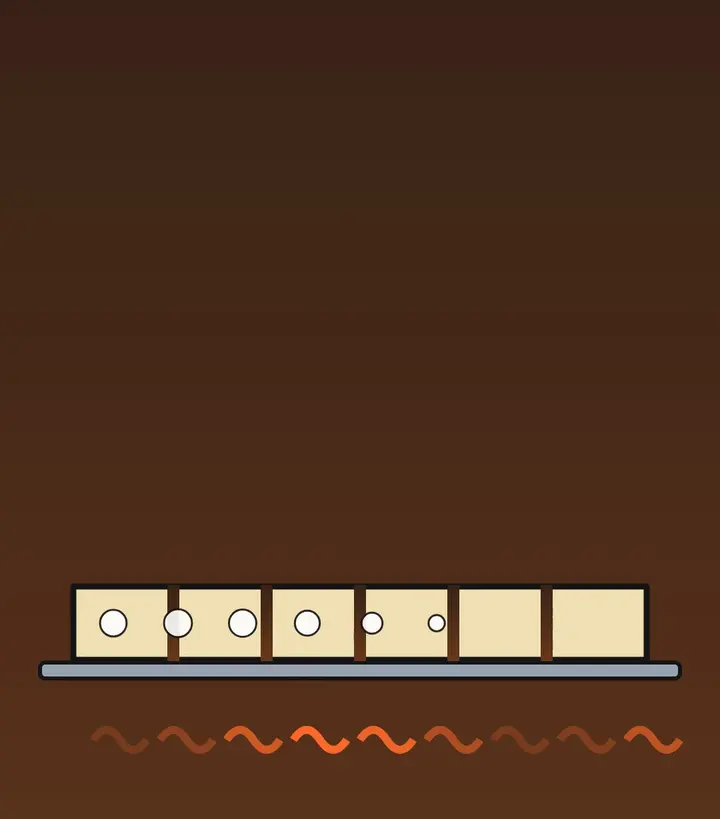
Layered crackers need it most. A classic soda cracker is folded 6 to 8 times before cutting and gets a nine-hole grid. The step is old: an 1872 cracker-machine patent already passed the dough under pricking pins. Read why crackers have holes.
What is the small hole on the bottom of a padlock?
On many padlocks the shackle's two legs differ in length, so one leg sits in a deep, blind bore inside the body. Rain running down the shackle ends up at the bottom of that bore. Padlock patents put the drain exactly there: a straight passage from the end of the long shackle hole out through the base, described as an exit for liquids and debris alike.
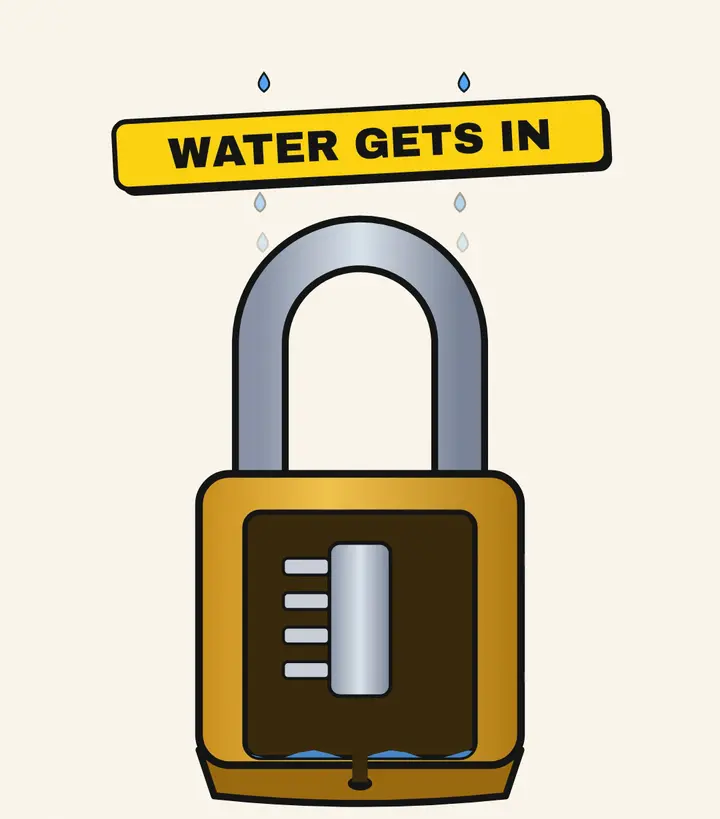
Trapped water rusts the parts or freezes them solid. One patent for a battery-heated padlock still kept three drain holes, so the ice it melted had somewhere to go. Even Master Lock's elastomer covers, designed to seal a safety padlock's shackle and keyway, list two drain holes of their own.
The hole isn't the place for oil. Master Lock tells owners to lubricate the keyway and the shackle every 3 to 6 months, and none of the manufacturer guides we checked mention the bottom hole. More in why padlocks have a tiny hole.
Why do coins have ridged edges?
A pattern that should run unbroken around the rim makes any shaving obvious. In England that protection came with machinery, decades before Isaac Newton. The Royal Mint Museum dates milled and lettered edges to horse-drawn rolling mills and screw presses at the Tower of London, with the new gold coins in production from February 1662. Newton arrived in 1696 and, once a three-year recoinage was done, made hunting down clippers and counterfeiters his main job. Some coins carried words on the rim instead, DECUS ET TUTAMEN, "an ornament and a safeguard", a motto that came back on the British £1 coin in 1983.
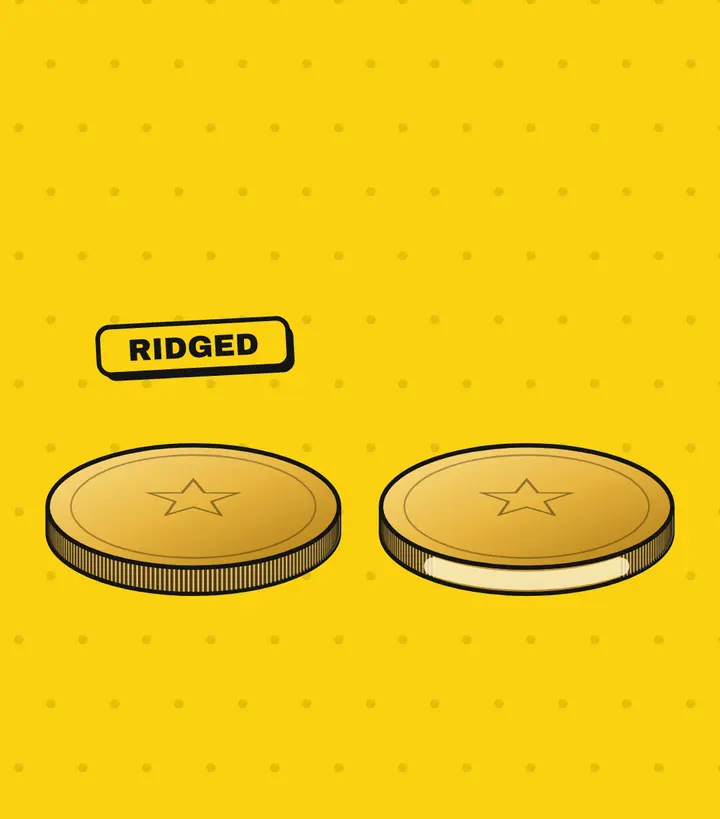
Nobody cuts the reeds afterwards. A collar around the blank shapes them in the same press stroke that stamps both faces. A quarter gets 119 and a dime 118, packed closer together on the dime's smaller rim. In 2000 the US Mint went the other way and gave the Golden Dollar a smooth edge, so fingers could tell it from a quarter. See why coins have ridges.
What is the tiny hole in an airplane window for?
The hole sits in the middle of the three layers and lets cabin air into the gap behind it. With equal pressure on both faces, the middle pane carries nothing and the outer pane takes the load. Either structural pane can carry the full pressure difference alone, as US rules require after any single failure.
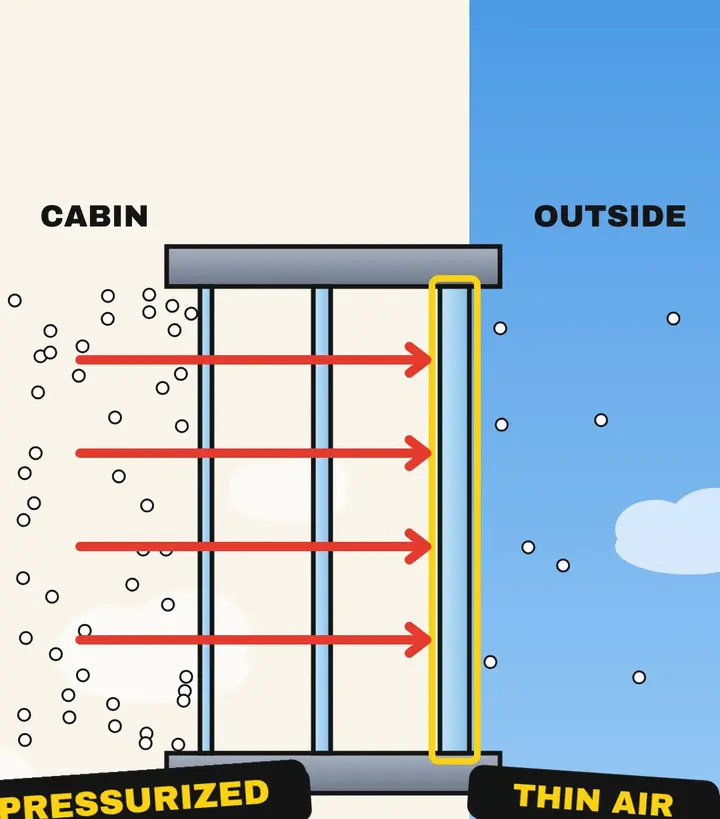
The side effect is moisture. Airbus notes that the outer pane is usually colder than −30 °C in flight, so humid cabin air drawn through the hole condenses there and can freeze.
The rounded corners have a grimmer origin. The 1955 Court of Inquiry into the Comet that broke up near Elba accepted that the first fracture happened near the rear of two small windows on top of the cabin that housed direction-finding aerials [1], windows the FAA describes as squarish [2]. It judged the likeliest starting point to be that window's starboard aft corner, where fatigue had begun at a countersunk bolt hole [1], and blamed high stress "around the corners of the windows and other cut-outs" [1]. More in why airplane windows have a tiny hole.
What is the small pocket in jeans for?
Levi Strauss & Co. lists a watch pocket among the features of its first riveted waist overalls in 1873, alongside a single back pocket, a cinch and suspender buttons. Levi's didn't invent it. The Victoria and Albert Museum holds a pair of 1680s breeches with a watch pocket on each side of the waistband.
What's striking is how firmly the pocket held on after its job disappeared. When metal was rationed during World War II, Levi's took the rivets off the watch pocket and kept the pocket itself; the rivets returned around 1947. The company's historian has also corrected a 1996 advert that called it the "fifth pocket". Counting by order of arrival, the fifth was the left back pocket, added around 1901. Read why jeans have a small pocket.
Four holes, four different jobs
The video has four small holes in it, and it's tempting to file them all as vents. They share a drill and very little else.
| Hole | What passes through | Which way | When it matters |
|---|---|---|---|
| Pen cap | Breath | In and out of the lungs | Only after a cap has been inhaled |
| Padlock base | Rainwater and grit | Out, pulled by gravity | Whenever it rains |
| Cracker | Steam, but mainly the pin pressing the layers together | Out, once | Only in the oven |
| Airplane middle pane | Cabin air | Both ways, most during climb and descent | Every flight |
Two of them are designed for a bad day. A cap with a hole behaves exactly like one without until somebody inhales it. The airplane hole is stranger still: its whole purpose is to make one pane do no work, so that a fresh, unstressed spare is waiting if the outer pane ever fails. Both work like insurance: you never see them doing anything while things go right.
The padlock hole is the only one that depends on gravity, which is why it has to be at the lowest point of the deep shackle bore. The cracker hole often isn't open at all; what matters is the press of the pin, and the opening is a by-product.
Every one of them also lets in something nobody wanted. The airplane hole admits the humid air that frosts the window. On a liquid-ink pen a vented cap would dry out the tip, which is why marker caps seal the nib inside an inner cup and vent around it, while ballpoint paste can live with a plain hole. In a pie shell, a runny filling such as quiche can seep into the docking holes and make the crust soggy, so some bakers skip them. The padlock is the odd one out: even locks built to keep water out, with sealed covers or marine-grade metals, still keep their drain. A hole always works both ways, and the design question is which way matters more.
Rules, habits and leftovers
Only three of the ten details exist to satisfy a safety rule, and none of those rules names the detail itself. Each sets a goal and leaves the method to the maker.
- A rule sets the goal. ISO 11540 asks caps on children's pens to limit the risk of asphyxiation, with requirements for size, vent area and air flow. US airliner rules ask windows to survive any single failure; the vented middle pane is how designers meet that. FMVSS 212 asks for the windshield to stay in place in a crash; the polyurethane bond is how modern cars meet it, and the frit protects the bond.
- Company habit. The fuel door arrow, the eye mark, the docking grid, the hexagonal barrel and the padlock drain are all choices. They spread because they're cheap and they work. When asked why cars don't simply get a fuel door on each side, a General Motors spokesman said the cost would far outweigh the convenience. A printed triangle costs almost nothing.
- History that stuck. The watch pocket and coin reeding both lost their original job, pocket watches in one case and precious metal in the other (US dimes and quarters lost their silver in 1965). Both survived by picking up a new one: carrying coins and tickets, and telling coins apart by touch.
Leftovers aren't sacred, though. The US Mint left the reeds off the Golden Dollar on purpose, and the euro goes further: the European Central Bank lists the coins' edges, along with their sizes and shapes, among the features that help people with low vision tell them apart. Once a leftover has a second job, designers start treating it as a feature again.
What people read into them
Two of the ten are signs that people misread. The color of the toothpaste square seems to mean something, and so does the side of the pump icon the hose is drawn on. Neither carries any information: the square's color only has to contrast with the tube, and the pump symbol is drawn the same way on every car.
Sources
Each oddity's full answer, linked above, lists the sources for that topic. Sources for anything said only on this page:
- 1.Civil Aircraft Accident: Report of the Court of Inquiry into the Accidents to Comet G-ALYP on 10th January, 1954 and Comet G-ALYY on 8th April, 1954 (C.A.P. 127). UK Ministry of Transport and Civil Aviation (HMSO, 1955), via the Federal Aviation AdministrationPrimary. Accessed October 9, 2026.
- 2.De Havilland DH-106 Comet 1 (Lessons Learned). Federal Aviation AdministrationPrimary. Accessed October 9, 2026.
Last verified: . Spotted an error? See our editorial policy and corrections.
Video transcript
Those black dots on the edge of your windshield? They're not decoration. Without them, the glue holding your windshield in would slowly cook in the sun. Today: ten things you touch every day that have a secret job. One of them is on every airplane window. One of them is probably in your pocket right now. And one exists because people used to shave their money. Let's start with the glass. Look closely at the edge of any windshield. There's a solid black band, and then it breaks apart into tiny dots. That band is called the frit. It's a ceramic paint, baked right into the glass when it's made. Most people think it's just there to look nice. It's not. Your windshield isn't bolted in. It's glued in, with a thick bead of urethane adhesive. And urethane hates sunlight. Years of UV would slowly break it down. The black band blocks that light, so the glue stays strong. So why the dots? When the glass is heated and bent into shape, the black band absorbs more heat than the clear glass around it. A hard edge would leave a line of stress and visible distortion. The dots fade from black to clear gradually, so the heat spreads out evenly. And there's one more spot most people never notice. Behind your rearview mirror, there's often a patch of dots. Some people call it the third visor. It fills the gap between your two sun visors, so the sun can't sneak through. Speaking of things in your car you've never really looked at… Look at your fuel gauge. Next to the little pump icon, there's probably a tiny triangle. That arrow tells you which side your fuel door is on. That's it. That's the whole secret. And yet most drivers have never noticed it. They lean out the window at the pump, or just guess. The idea is usually credited to a Ford designer named Jim Moylan. In 1986, on a rainy day, he pulled up to the pump on the wrong side. He got soaked. So he wrote a memo suggesting a small arrow on the gauge. Ford started putting it in its cars a few years later. Today it's in millions of cars, from almost every brand. It was never a law. Just a good idea that spread. So next time you rent a car, you don't have to guess. And while we're on tiny things that save you trouble… here's one that has saved lives. Look at the cap of a ballpoint pen. Many have a small hole in the top. You might think it keeps the ink from drying out. Or that it helps the pen breathe. The real reason is darker. People chew on pen caps. Kids especially. And sometimes, a cap gets inhaled and lodges in the airway. A solid cap would block the air completely. A cap with a hole lets some air through. Enough to keep breathing until help arrives. This isn't just a nice gesture from pen makers. There's an international safety standard for it: ISO eleven-five-forty. It sets a minimum amount of air that a cap must let through, if it's small enough to be swallowed. That's why the hole is there, even on the cheapest pens. Hold on to that one. Because later, we'll find another tiny hole, on an airplane window, that's also there to keep you safe. Quick thing. If you're enjoying this, there's a new video like it every week. Subscribing is the easiest way not to miss it. Okay. Next stop: your bathroom. Look at the bottom of your toothpaste tube. There's a small colored square on the seam. Maybe green. Maybe blue, red, or black. There's a popular claim online that the color tells you what's inside. Green means natural. Black means pure chemicals. It's completely false. That square is called an eye mark. Toothpaste tubes start out as one long printed sheet. A machine has to know exactly where to cut it, and where to seal it. A light sensor watches for that little square. When it spots it, the machine cuts and seals in exactly the right place. The color has nothing to do with the paste. It's simply chosen to stand out against the tube's design, so the sensor can see it easily. You'll find the same kind of mark on chip bags, candy wrappers, and all sorts of packaging. Once you know, you'll see them everywhere. Most wooden pencils have six sides. Not round. Hexagonal. The first reason is obvious once you think about it. Put a round pencil on a sloped desk, and it rolls right off. A hexagon stays put. The second reason is your hand. You hold a pencil with three fingers. Flat sides give each finger something to grip. The third reason is the factory. Pencils are made by sandwiching the lead between strips of wood, then cutting them apart. Hexagons sit edge to edge with very little gap, so less wood goes to waste. But here's the odd part. Colored pencils are often round. One common explanation: artists turn them constantly while shading, and a round barrel turns more smoothly in the fingers. Same object. Different job. Different shape. Grab a cracker, and you'll see a neat pattern of tiny holes. They're not decoration either. Bakers call this docking. Cracker dough is thin and flat. In a hot oven, the water inside turns to steam. With nowhere to go, that steam pushes up big bubbles. You'd get crackers that are puffy in some spots, and burnt in others. The holes give the steam a way out. So the cracker bakes flat, crisp, and even. There's even a tool for it: a roller covered in spikes, called a docker. Pizza makers use it too, so the base doesn't balloon in the oven. Coming up in a couple of minutes: why people used to shave their coins. But first, another hole that's there to let something out. Flip a padlock over. On the bottom, next to the keyhole, there's often a tiny hole. It's not a second keyhole. And it's not for some secret master key. It's a drain. Padlocks live outside. Rain gets in. And water trapped inside a lock does two bad things. It rusts the parts. And when it freezes, it can lock the mechanism solid. The drain hole lets that water escape. You'll hear it's a spot for oil, too. But lock makers say to oil the keyhole and the shackle. This hole has one job: letting water out. That's why outdoor padlocks are usually hung with the keyhole facing down. Gravity does the rest. Run your thumb along the edge of a quarter, or a dime. Those ridges are called reeding. And they started as a defense against theft. Centuries ago, coins were made of real gold and silver. Their value was the metal itself. So people would shave or clip tiny slivers off the edges. Collect enough slivers, melt them down, and you had free silver. Then spend the coin like nothing happened. Ridged edges made that obvious. If the ridges were worn away or cut, the coin had been tampered with. In England, machine-made coins with milled edges took over in the sixteen hundreds. And Isaac Newton, yes, that Newton, later ran the Royal Mint, and personally hunted down clippers and counterfeiters. Today, American dimes and quarters contain no silver at all. So why keep the ridges? Partly tradition. But they also help. A dime and a penny are close in size. One is ridged, one is smooth. You can tell them apart without looking. And so can people who can't see. Now, remember that tiny hole we promised you? Next time you fly, look closely at your window. Near the bottom, there's a small hole in one of the panes. It looks like a manufacturing flaw. It's not. An airplane window isn't one sheet. It's usually three. The inner one, the one you can touch, is just a scratch pane. It protects the real windows from fingers and bags. Behind it are two structural panes. The outer pane carries the pressure difference between the cabin and the thin air outside. The middle pane is a backup, in case the outer one ever fails. The little hole, called a breather hole, sits in that middle pane. It lets air pass between the cabin and the gap behind it. So in normal flight, the outer pane takes the load, and the backup stays ready. That same hole lets a little cabin air into the gap. And cabin air carries moisture. On a long, cold flight it can freeze on the outer pane. That's the frost you sometimes see inside your window. And notice the shape. Airplane windows always have rounded corners. Sharp corners concentrate stress. Engineers learned that the hard way in the 1950s. The first jet airliner, the de Havilland Comet, suffered a series of crashes, and investigators traced one of them to a crack that started at the corner of an opening in the fuselage. Rounded corners spread the stress out, so the plane's skin doesn't crack. And finally, the one that might be on you right now. That tiny pocket inside the front pocket of your jeans. Too small for a phone. Too small for a wallet. So what's it for? A watch. In 1873, Levi Strauss and a tailor named Jacob Davis patented work pants reinforced with metal rivets. They were made for miners, cowboys, and railroad workers. Back then, people didn't wear watches on their wrists. They carried pocket watches. And a pocket watch loose in a regular pocket gets scratched, crushed, or lost. So the pants had a small pocket, just for the watch. Here's the twist. Those early jeans had only one back pocket. The second one was added in 1901. That's when the classic five-pocket jean was born. Pocket watches disappeared. The little pocket stayed. Today people use it for coins, lighters, guitar picks, or nothing at all. It's been there for over 150 years. On almost every pair. Including yours. So, which one did you already know? Tell us in the comments. And if there's an everyday object that's always bugged you, write it down there too. It might be the next one we explain. There's a new one of these every week. See you in the next one.


