
Why do airplane windows have a tiny hole?
Short answer
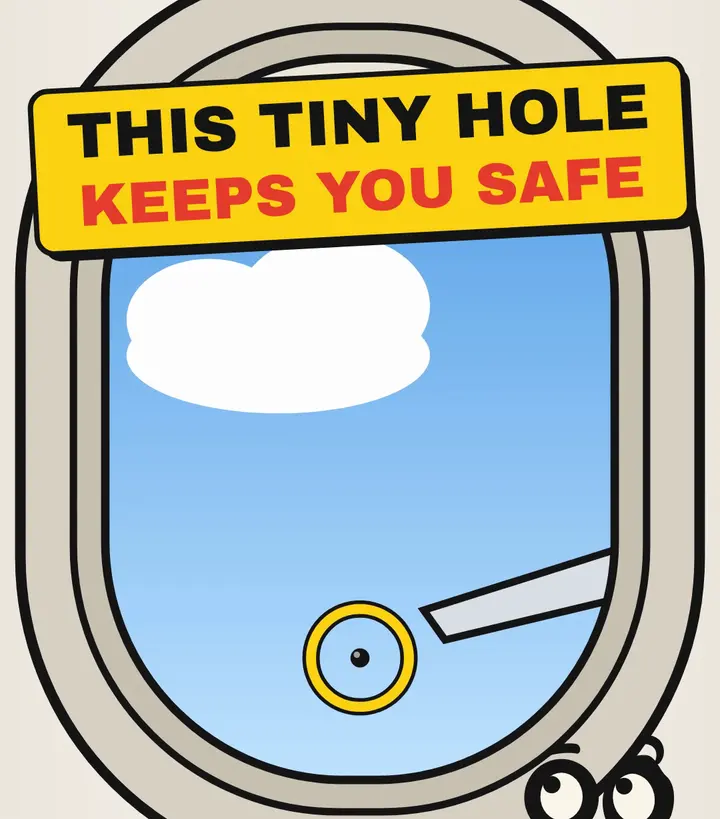
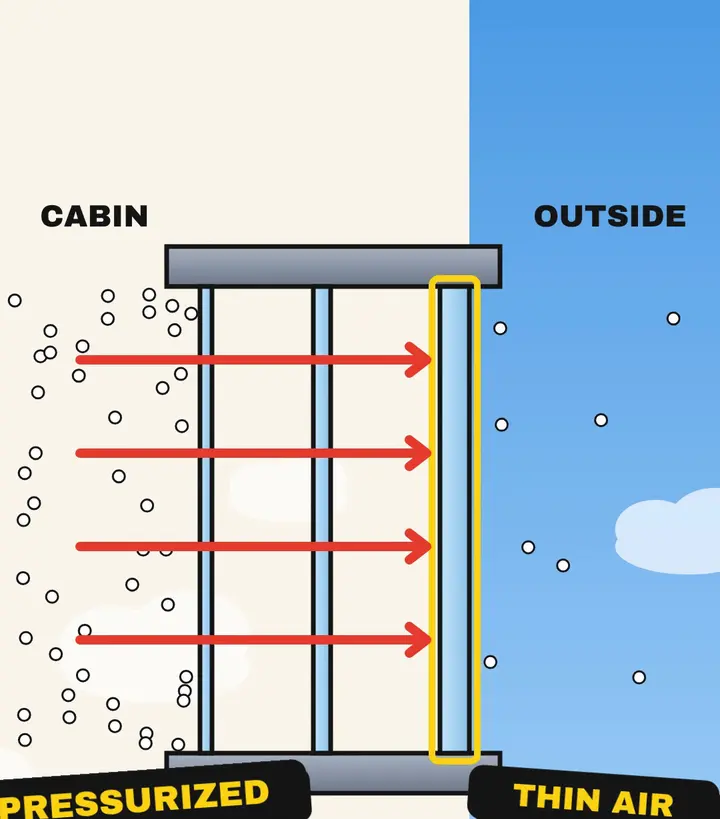
The tiny hole is a breather or vent hole in the middle pane of a cabin window. It lets cabin air into the gap behind that pane, so the outer pane carries the pressure difference while the middle pane stays unloaded as a backup, ready if the outer one fails. The pane you can touch is only a scratch guard.
Published · Last verified · 8 sources
The pinhole is a deliberate vent, usually called a breather hole or vent hole. It is drilled through the middle layer of the window so that cabin air fills the narrow gap behind it. With the same pressure on both of its faces, the middle pane carries nothing in normal flight, and the whole push of the pressurized cabin falls on the outer pane. The middle one is not a weak spare, though: describing the cabin windows of an Airbus A321, UK accident investigators note that each of the two structural panes can carry the full pressure difference across the fuselage, "providing redundancy if either pane should fail" [1].
What are the layers in a plane window?
The Air Accidents Investigation Branch (AAIB) gives a clear description of a modern window in its report on an A321 that lost several panes in 2023 [1]:
- Outer pane. Stretched acrylic, mounted flush with the skin of the fuselage.
- Inner pane. Also stretched acrylic, with the vent hole through it. This is the one most explainers call the middle pane.
- Scratch pane. A third, thin sheet fixed to the cabin trim. It is "the windowpane that passengers can touch," it is sacrificial, and it "does not form part of the load bearing structure."

The two structural panes slot into a rubber seal with no glue or sealant, and the whole assembly is clamped against the window frame by a metal retainer, six eyebolts and six nuts. On the A321 a pane measures about 346 by 250 millimetres [1]. That is why the names can be confusing: Airbus and the AAIB count the drilled pane as the "inner" one because the scratch pane belongs to the cabin wall, not to the window. From a passenger seat you see three layers, and the hole is in the middle of them.
Why should only one pane take the load?
Because the rules ask for a window that still holds after something breaks. The U.S. certification standard for airliners says cabin windows must withstand the maximum pressure differential, combined with aerodynamic and temperature effects, "after any single failure in the installation or associated systems" [2]. The same rule tells designers to account for "continuous and cyclic pressurization loadings": every flight inflates the fuselage and every landing lets it down again.
A vented middle pane sits outside that cycle. Boeing describes the breather hole as designed "to equalize pressure in cavity" between the two structural panes as cabin pressure changes [5], and an Airbus patent says the exchange of air through it matters most during climb and descent [6]. Without the hole, the air sealed between the panes would push on both of them, and you would no longer have one working pane and one untouched spare.
The FAA treats a backup that can't do its job as an unsafe condition. In 2022 it ordered checks of certain replacement passenger windows made by NORDAM for Embraer E170 and E190 jets, after the inner pane was found unable "to meet maximum operating pressure." The agency's reasoning: without a fail-safe design, "a complete failure of the outer window pane could result in possible serious injury to a passenger near the window due to rapid decompression" [4].
How much pressure is on the outer pane?
Airliners are not pressurized to sea level. U.S. certification rules require a cabin pressure altitude of no more than 8,000 feet in normal operation [3], so at cruise the air inside is roughly what you would breathe in a high mountain town, while the air outside is far thinner. The outer pane holds back that difference on every flight. If a failure that is obvious to the crew does occur, the window rule lets them reduce the pressure difference, as long as the cabin stays at or below a 15,000-foot equivalent [2].
For scale, the FAA puts the normal working pressure difference of the de Havilland Comet, the first pressurized civilian jet transport, at about 8.25 pounds per square inch [7].
Does the hole stop windows fogging?
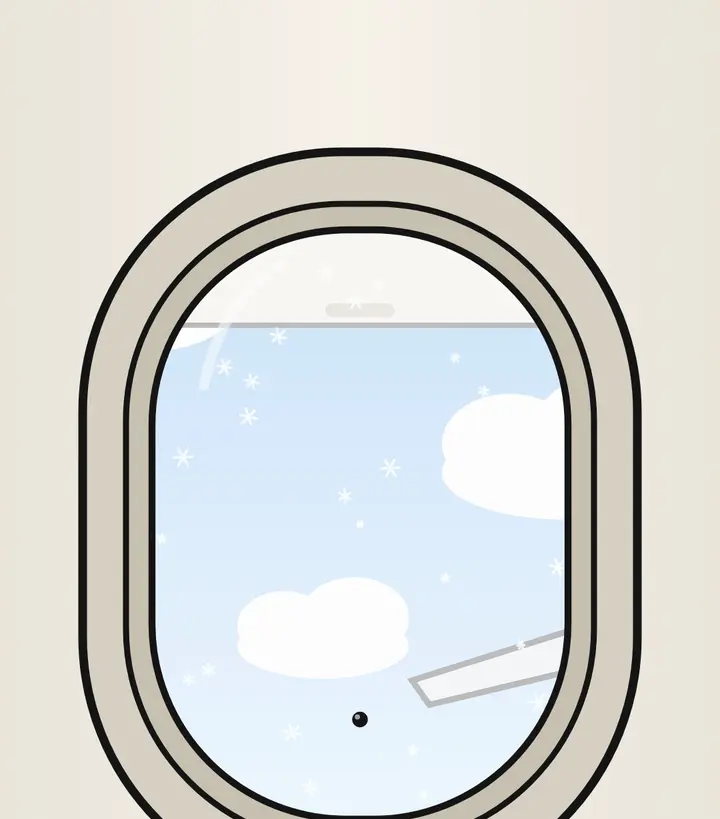
Popular explainers say it helps. TIME, citing airline pilot Mark Vanhoenacker, says the hole "releases moisture from the gap between the inner and outer panes, allowing the window to remain mostly fog-free" [8].
The manufacturers' own patents describe the same air path from the other side. Airbus writes that the outer pane is generally colder than −30 °C in flight, so "even the smallest amount of water vapor" in cabin air that flows through the vent will condense on it. Full flights, busy galleys and long sectors make the cabin more humid, and the condensation can freeze into frost or ice that melts into droplets, or even puddles, on the way down [6]. Boeing found that vibration makes air pulse in and out of the hole, carrying "unintended moist cabin air" into the window, and lab tests confirmed it [5]. Both companies patented fixes: Airbus a tube chilled by the fuselage skin so that only dried air reaches the gap, Boeing a small damper at the hole that lets slow air through but blocks the pulses.
What happens when a pane does fail?
The A321 that the AAIB investigated had been lit by film lights for hours the day before, and the heat warped and shrank its acrylic panes. On the next flight a window seal was seen flapping in the airflow as the jet climbed, and the crew turned back. After landing, three outer panes, two inner panes and two seals were missing [1].
Every scratch pane stayed in place, so there was "no direct, unrestricted aperture" between the cabin and the outside. The report found no sign of pressurization trouble: whatever air leaked out stayed "within the capacity of the pressurisation system" [1]. The aircraft climbed no higher than about 14,500 feet, well below normal cruising levels.
Why are airplane windows rounded?
The rounded shape is a lesson from the Comet, whose windows had squarish corners. FAA's case study of the accidents explains that stress "cannot smoothly flow around the abrupt corners," so it piled up there and fatigued the metal [7].
January 10, 1954
Comet G-ALYP breaks up while climbing through 27,000 feet and falls into the sea near Elba, Italy [7].March 23, 1954
Comets fly again after a large modification program, without a confirmed cause [7].April 8, 1954
Comet G-ALYY breaks up climbing through 35,000 feet near Naples [7].1954
Investigators put Comet G-ALYU in a water tank and pressurize it over and over. After 1,230 real flights and 1,830 tank "flights," the fuselage splits at the corner of a squarish forward escape hatch window [7].Later
The Comet 1XB is the first version with oval rather than squarish windows. The Comet returns to airline service four years later as the Comet 4 [7].
Modern airplane windows are round or oval instead, and as the FAA puts it, stress "flows freely around the curved edges with minimal build up" [7]. Glass on the ground has its own small puzzles; the black dots on a car windshield are another detail that looks decorative and is really doing a job.
Sources
- 1.AAIB investigation to Airbus A321-253NX, G-OATW (final report, PDF). Air Accidents Investigation Branch (UK)Primary. Accessed October 8, 2026.
- 2.14 CFR 25.775: Windshields and windows. U.S. Federal Aviation Administration, via eCFRPrimary. Accessed October 8, 2026.
- 3.14 CFR 25.841: Pressurized cabins. U.S. Federal Aviation Administration, via eCFRPrimary. Accessed October 8, 2026.
- 4.Airworthiness Directives; Embraer S.A. Airplanes (AD 2022-16-01). Federal Aviation Administration, Federal RegisterPrimary. Accessed October 8, 2026.
- 5.US Patent 7,267,302: Window airflow damper. The Boeing Company, via Google PatentsPrimary. Accessed October 8, 2026.
- 6.US Patent 5,884,865: Non-fogging aircraft window arrangement. Airbus Operations GmbH, via Google PatentsPrimary. Accessed October 8, 2026.
- 7.De Havilland DH-106 Comet 1 (Lessons Learned). Federal Aviation AdministrationPrimary. Accessed October 8, 2026.
- 8.Here's the Perfectly Logical Reason Airplane Windows Have Holes. TIME. Accessed October 8, 2026.
Last verified: . Spotted an error? See our editorial policy and corrections.
Video transcript
That tiny hole in your airplane window is there to keep you safe. Most airplane windows have three layers. The outer pane carries the pressure difference between the cabin and the thin air outside. The middle pane is a backup, and the tiny hole is in that one. It lets air pass through, so the outer pane takes the load and the backup stays ready if it's ever needed. It also lets moisture escape, which helps keep the window from fogging or frosting up. So next time you fly, look for that tiny hole in your airplane window.


