
Why do new tires have rubber hairs?
Short answer
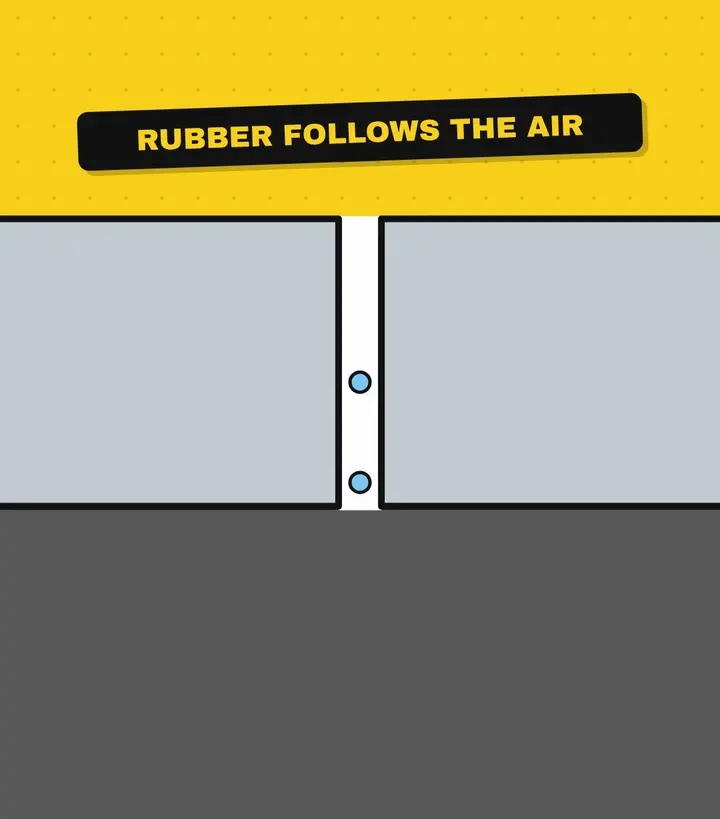
The rubber hairs on new tires are vent spews, leftovers from molding. A tire is cured by pressing soft rubber against a hot mold, and tiny vent holes let trapped air escape. A little rubber follows the air into each hole and cures there. They do nothing on the road and can be left on or pulled off.
Published · Last verified · 12 sources
Playing loads the video from YouTube (Google), which may set cookies. Cookie policy
 Also in the long video · 3:14Your Car Is Full of Hidden Features. Here's What They Actually Do
The hairs are threads of rubber that squeezed into the air vents of the mold the tire was shaped in, then cured there. Tire makers call them vent spews [1] [2]. Once the tire has left the factory they have no job [2]. On the tread they rub off against the road. On the sidewall they never touch it, which is why a tire can still look hairy after months of driving [9].
What are the hairs on new tires called?
Bridgestone, in an article on its truck-tire site about how tires are cured, says "the technical term for them is 'vent spews'" [1]. Toyo Tires uses the same name and lists a few others: sprue nubs, tyre nibs, gate marks and nippers [2].
Patents are less tidy. A Dunlop Tyres patent calls them "spue-pips" [3], a Bridgestone application calls them "sprues" [5], and a BF Goodrich patent notes that the trade used one word, "vents", for both the holes and the hairs [4].
How do the hairs get there?
A tire starts out "green": every layer is pressed together but nothing is cured [8], and there is no tread pattern yet [1]. The green tire goes into a mold that will give it the tread and the lettering on the sidewall [8]. Segments of the mold close in from outside while a rubber bladder inflates inside the tire and pushes it outward [1]. The mold is heated, usually by electricity or high-pressure steam, and the heat vulcanizes the rubber and bonds the parts of the tire to each other [1].
The U.S. Tire Manufacturers Association says a passenger or light-truck tire is heated to more than 300°F (about 150°C) for 12 to 15 minutes, and that very large tires can take up to a day [8]. Bridgestone puts most truck tire sizes at "a bit less than an hour" [1]. A 1986 BF Goodrich patent describes filling the bladder with steam at 1,379 to 1,724 kPa, roughly 200 to 250 psi, for about 15 minutes [4].
Air is what gets in the way. Heat thins the rubber at the surface of the tire so that it flows under the pressure, and pockets of air can be caught between the green tire and the hot mold surface [3].
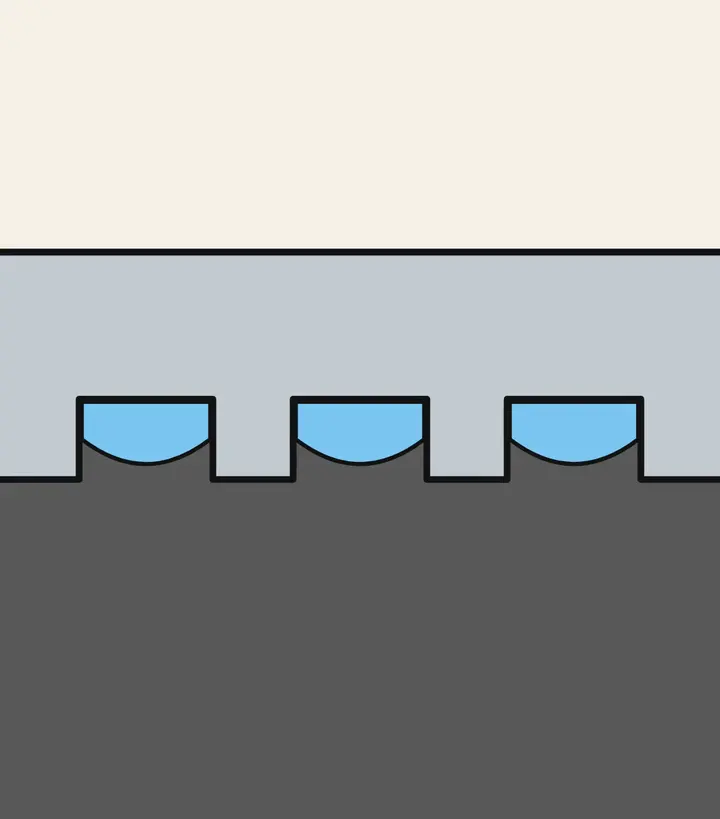
Where a pocket of air sits, the rubber can't completely fill the detail of the mold [1]. Patents call the flaw "lightness" [5], or a "light" tire with a blemished surface [4]. The cure is to give the air a way out. Bakers do the same thing with the docking holes in crackers, which let steam out so the dough bakes flat.
A vent is a small hole drilled through the mold wall, often fitted with a narrow tube called an insert vent [3]. A Bridgestone patent application gives typical vent hole diameters of 0.062 to 0.125 inch, about 1.6 to 3.2 mm [5]. The air goes out first. Then rubber starts to flow in behind it [3].
A hair that breaks is the factory's problem. If one snaps off and stays in its hole, that vent is blocked, the blockage may not be spotted straight away, and later tires from the same mold can come out badly [3]. Molds are expensive to get wrong: Bridgestone has written that a truck-tire mold "may easily cost 60 to 80 thousand dollars", and that every tread pattern and size needs its own [1].
The thin raised lines on some new tires come from the same step. Bridgestone calls them flashing: a thin line or flap of rubber where the mold segments touch each other [1].
Do the hairs help with grip or noise?
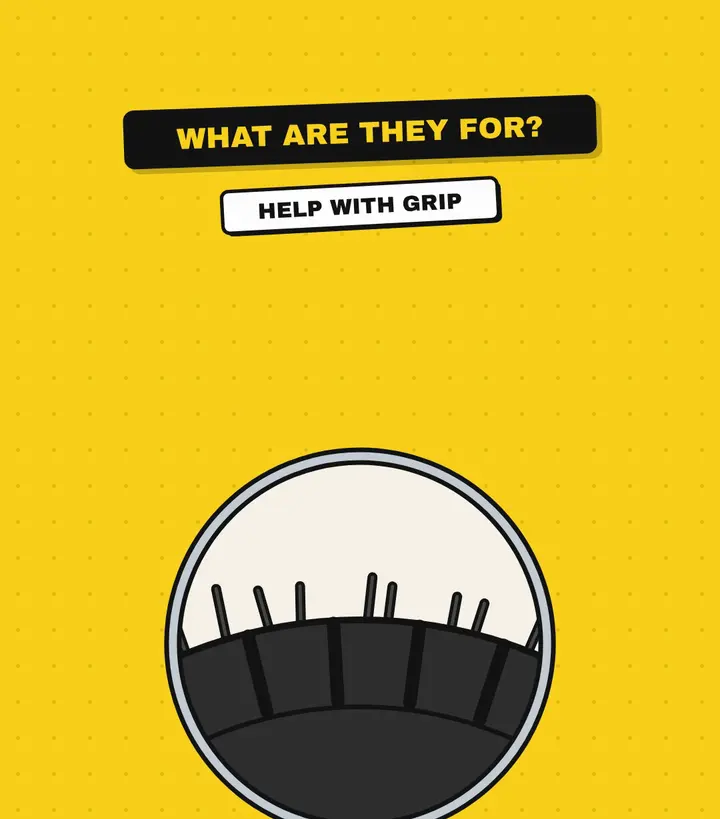
No. "Vent spews have no functional purpose post-manufacturing," says Steve Burke, technical manager at Toyo Tires in Australia [2]. Motor1 reaches the same answer: they don't improve traction or cut road noise, they aren't part of the tread the engineers designed, and there's no reason to wait for them to go before driving normally on a new set [9].
Should you remove the hairs?
You can, and you don't need to. "It really doesn't matter," Burke says, and "there is no practical reason to remove them". If they bother you, his advice is to avoid scissors and blades and pull them off by hand. Many show-car owners, he adds, shave or clip theirs [2]. Motor1 notes that picking them off won't improve grip, handling, fuel economy or tire life [9].
Do rubber hairs mean a tire is new?
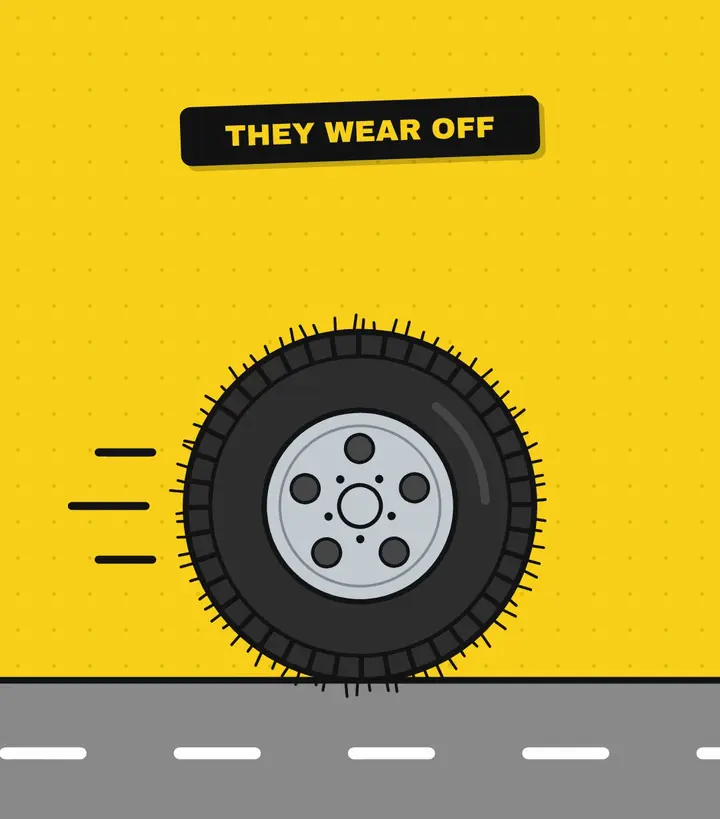
Hairs on the tread
Hairs on the sidewall
None of the sources we read puts a number of miles or days on it.
The thing that does tell you a tire's age is also on the sidewall. U.S. rules require a tire identification number of 13 symbols on one sidewall of each new tire. Its last group is a date code of four digits: two for the week, then two for the year. The regulation's own example is 0109, "the first full calendar week of 2009" [10]. NHTSA says to look on both sides of the tire, because the number may be on only one. It also notes that some vehicle and tire makers recommend replacing tires that are six to 10 years old, however much tread is left [11].
Do all new tires have hairs?
No, and there are three reasons a new tire might have few or none.
Some are trimmed. Toyo says the spews on its tread faces are mostly shaved off [2], and Motor1 says some makers trim certain spews where a cleaner look matters while others leave them as they come out of the mold [9].
Some shapes trap less air. Hannah Ferle, a road and race product manager at Continental, told Escape Collective that a smaller mold with a simpler shape, with no sharp edges or knobs, has far fewer places for air to be caught. "That's why you typically see these 'rubber hairs' only on tyres with complex profiles," she wrote [12]. She was talking about bicycle tires, where a slick road tire often shows only faint venting lines and a knobby mountain bike tire can come out bristling [12].
Some vents close themselves. Engineers have been working on other ways to get the air out for more than a century.
1912
Raymond B. Price applies for a U.S. patent on curing tires under vacuum, to draw out the trapped air that made rubber "blow or become porous". It is granted in 1918 [7].1963
A British patent describes a one-piece valve that sits in the vent and is pushed shut by the expanding tire [6].1982
Russell W. Carter patents vent valves held open by a coil spring until the tire itself presses them closed, flush with the mold, for a sidewall with no pins [6].1986
BF Goodrich patents a mold with no vent holes at all. The air is pumped out through a vacuum line just before the mold fully closes [4].1999
Dunlop Tyres patents a simpler "spueless vent" with its spring built into the body [3].2016
A Bridgestone application describes a vent with a rubbery insert that lets air pass, then blocks the hole before a sprue can form [5].
By the patents' own account, these ideas were slow to catch on. The 1986 patent says earlier proposals "generally failed to meet with commercial success" [4], and the 1999 one says spring-valve vents had "not found wide utility" because they were complicated and expensive [3].
Sources
- 1.If a tire's not sick, why must it be "cured"? (Real Answers magazine, vol. 9, issue 2), archived copy. Bridgestone Americas Tire Operations, via the Internet ArchivePrimary. Accessed October 11, 2026.
- 2.Why do my tyres have hairs?. Toyo Tires AustraliaPrimary. Accessed October 11, 2026.
- 3.US Patent 5,939,101: Mold vents (Dunlop Tyres Ltd, granted 1999). U.S. Patent and Trademark Office, via Google PatentsPrimary. Accessed October 11, 2026.
- 4.US Patent 4,573,894: Apparatus for ventless tire molding (BF Goodrich, granted 1986). U.S. Patent and Trademark Office, via Google PatentsPrimary. Accessed October 11, 2026.
- 5.US Patent Application 2016/0325516 A1: Tire mold vent (Bridgestone Americas Tire Operations, published 2016). U.S. Patent and Trademark Office, via Google PatentsPrimary. Accessed October 11, 2026.
- 6.US Patent 4,347,212: Method for forming a tire (Russell W. Carter, granted 1982). U.S. Patent and Trademark Office, via Google PatentsPrimary. Accessed October 11, 2026.
- 7.US Patent 1,276,411: Treatment of tires (Raymond B. Price, granted 1918). U.S. Patent and Trademark Office, via Google PatentsPrimary. Accessed October 11, 2026.
- 8.How a Tire Is Made. U.S. Tire Manufacturers Association. Accessed October 11, 2026.
- 9.What Are Those Little Rubber Hairs On New Tires?. Motor1 (Dan Mihalascu). Accessed October 11, 2026.
- 10.49 CFR 574.5: Tire identification requirements. U.S. National Highway Traffic Safety Administration, via eCFRPrimary. Accessed October 11, 2026.
- 11.Tires (TireWise), archived copy. U.S. National Highway Traffic Safety Administration, via the Internet ArchivePrimary. Accessed October 11, 2026.
- 12.Tyre hairs: Ride till bald or trim them?. Escape Collective (Dave Rome). Accessed October 11, 2026.
Last verified: . Spotted an error? See our editorial policy and corrections.
Video transcript
These rubber hairs on every new tire do absolutely nothing. They don't help with grip. They don't reduce noise. They're leftovers. Tires are made by pressing hot rubber into a mold. Air gets trapped between the rubber and the mold, so the mold has tiny vent holes to let it escape. Some rubber follows the air out and hardens into those little hairs. They're called vent spews. They wear off after a few drives. And until they do,


