
What is the button on a seat belt for?
Short answer
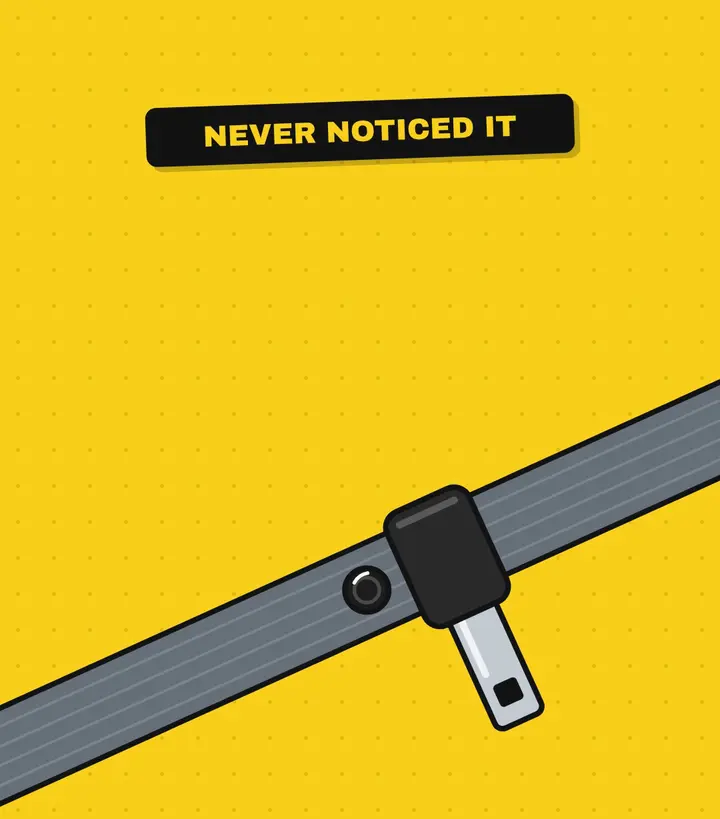
The plastic button on a seat belt is a stop for the latch plate, the metal tongue that slides along the webbing. When you unbuckle, the button keeps the latch plate from sliding down toward the floor, so it stays within reach. The belt still works without it, but the tongue gets hard to find.
Published · Last verified · 13 sources
Playing loads the video from YouTube (Google), which may set cookies. Cookie policy
 Also in the long video · 2:26Your Car Is Full of Hidden Features. Here's What They Actually Do
The button is a stop for the latch plate, the sliding metal part you push into the buckle. Once the belt winds back into its reel, the latch plate is free to travel down the webbing, and the button is simply too big to pass through the latch plate's slot [1] [6]. A patent from the belt supplier Breed Automotive Technology puts the purpose bluntly: the stop is there to keep the tongue from "falling all the way to the floor" [6]. Two things the Short had no room for: the button isn't stitched on, and the spot where it sits is a measured compromise.
What is the button actually called?
There is no single name. Autoliv's patent says "web stops, also known as web stop buttons" [1]. Takata calls it a "tongue plate stopper" [5], Breed a "tongue stop" [6], Mitsubishi a "stopper button" [2] and Ford a "latch plate stop" [8]. Safe Ride News, which writes for child car seat technicians, uses "latchplate stops" and notes that carmakers use a variety of names [12]. SlashGear gives the technical name as "seat belt buckle button stop" [13], a phrase that appears in none of the patents or service documents we read.
The part it holds is often called the buckle, but that isn't quite right. The U.S. standard for seat belt assemblies defines the buckle as "a quick release connector" and refers to the tongue that is inserted into it [10]. The crash protection standard calls the sliding part the "latchplate" [9]. So the latch plate, or tongue, rides on the webbing, and the buckle is the receiver fixed to the car [1].
What happens to a belt with no button?
When you unbuckle, the spare webbing is wound into the retractor and the tongue "tends to slide down the webbing" [6]. Where it ends up depends on the car: on the floor [7], "where it is difficult to reach" [2], under the seat cushion [12], or in the gap between the seat and the door [13].
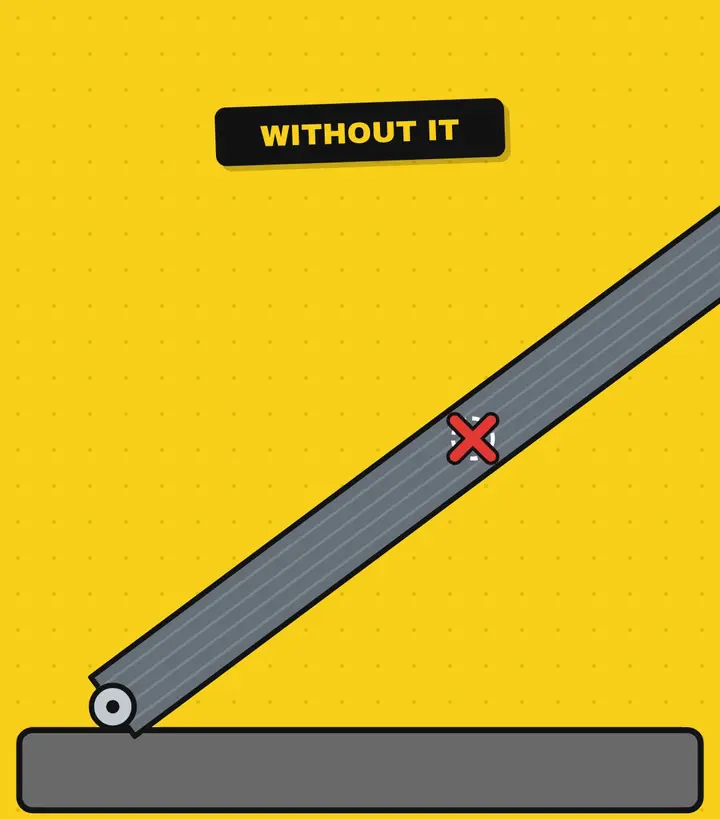
Autoliv's patent lists what follows: a latch plate that has wandered off is hard to find, which can put people off using the belt at all, and the webbing is more likely to get knotted or tangled with whatever is around it [1]. Safe Ride News says the sliding latch plate was a problem that contributed to people not buckling up in cars built before the feature existed [12].
How is the button attached?
It isn't sewn. A web stop is two end pieces joined by a crosspiece that passes through the webbing, one piece on each side of the belt. The end pieces are often disk-shaped with rounded outer faces, so the stop looks like a small flat-topped mound [1].
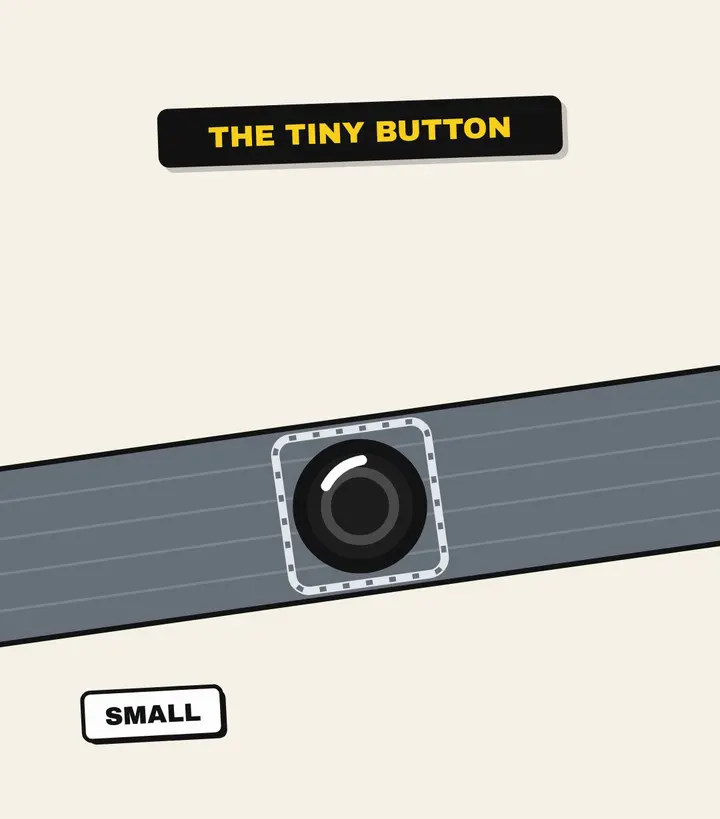
Mitsubishi's repair procedure shows how the halves go together. The male half, which has a spike, is pushed through from the back of the belt, the female half goes on the front, and a small C-clamp squeezes them until they click. The finished button should be between 6.5 and 7.2 mm thick [2].
Takata's 1991 design starts from a complaint about earlier buttons held by a single needle: the whole weight of the tongue hangs on the few cross threads under that needle, pulls them tight and pinches the edges of the webbing. Its answer was rings of small pins, five or more and preferably ten to twenty, that bite into the weave and spread the load [5]. It is hardware pinned through fabric, like the copper rivets on a pair of jeans, except that this one carries very little load [3].
When did seat belts get the button?
The oldest description we found is a German utility model filed on 6 October 1975 by Repa Feinstanzwerk of Alfdorf [3]. It sets out the problem on belts that reel themselves in: the tongue has to slide freely, yet after the belt winds up it should sit where the wearer can easily grab it. The markers already in use were separate pieces held on the belt by friction. Repa proposed a double button pushed through the belt and snapped together like a press stud. It was to be cheap, easy to fit and free of sharp edges [3].
1975
Repa files its snap-together double button. Because the part carries so little load, the filing recommends moulded plastic to keep the cost down, and adds that metal, or even horn, would also do [3].1980
The French firm Dauphinoise describes what was wrong with the older sliding bar: the tongue's weight slowly dragged it down the belt, and the owner had to push it back up from time to time. Its fix is a plastic rivet fixed through the strap [4].1991
Takata adds its rings of pins [5].2000
Breed moves the stop off the webbing and into the tongue's slot, as a bump that only presses on the belt when the tongue hangs vertically [7].2001
2019
Ford files a stop made from a heart-shaped loop of webbing, to cushion a latch plate that rattles when driving off-road [8].
Why do some belts have a second button higher up?
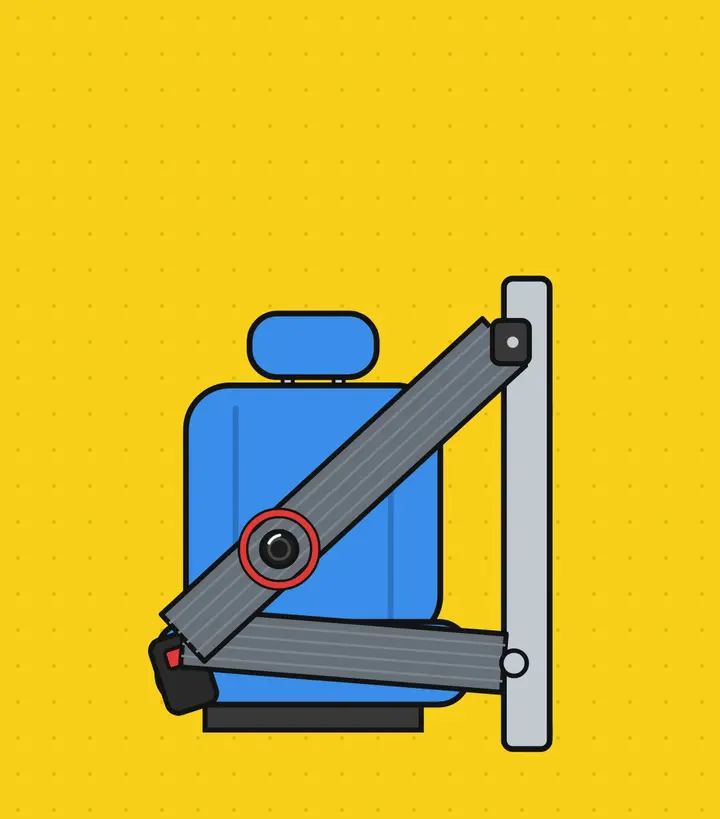
To fence the latch plate in from both sides. Autoliv's patent says a web stop is often placed "both above and beneath the latch plate", so that the plate can move freely between the two and no further. Its drawing shows a stop above the latch plate, on the part of the belt that crosses the torso [1]. SlashGear also mentions a possible twin on the shoulder strap, and says the stop keeps the latch from getting stuck "at either the top or bottom" [13].
Does any safety rule require the button?
Not by name, in the three rule texts we searched. The U.S. standard for seat belt assemblies never mentions it: "stop" turns up only in test procedures, and "button" only in the phrase "push button-release buckles" [10]. The UN regulation is the same, with "button" used only for the buckle release [11].
The crash protection standard does care about the result. For the front outboard seats of the vehicles it covers, the latch plate must sit inside the reach of a test dummy's arm "in its normal stowed position" [9]. The rule says where the plate has to hang and leaves the method to the carmaker. A button is one way to get there. In that respect it resembles the arrow next to the fuel gauge, another small helper that no standard spells out.
Why does it matter where the button sits?
What if the button breaks off?
It happens. Mitsubishi's bulletin of February 2017 says some owners of 2013 to 2015 Outlander Sport and RVR models may report a broken button, and that the cause may be "a great amount of stress on the tongue stopper when handling the seat belt" [2]. The repair is a genuine replacement button at the original location, with 0.2 hours of labour allowed per side [2].
Safe Ride News advises against improvising. Altering a seat belt can damage it, so owners shouldn't make a homemade stop or try to remove the one that came with the car [12]. Mitsubishi, for its part, tells dealers to order only the genuine button [2].
Do all belts use a plastic button?
Plastic button
Sewn webbing stop
Where the stop sits also differs a great deal from one model to the next, and even between belts in the same vehicle [12].
Sources
- 1.US 6,568,709 B2: Breakaway web stop for seat belts (filed 2001, granted 2003). Autoliv ASP Inc., via Google PatentsPrimary. Accessed October 11, 2026.
- 2.Technical Service Bulletin TSB-17-52A-001: Front Seat Belt Stopper Button Installation (February 2017, PDF). Mitsubishi Motors North America, filed with the U.S. National Highway Traffic Safety AdministrationPrimary. Accessed October 11, 2026.
- 3.DE 7531666 U: Limiting or marking device for sliding lock parts on seat belts (German utility model, filed 1975; German text with machine translation). Repa Feinstanzwerk GmbH, via Google PatentsPrimary. Accessed October 11, 2026.
- 4.FR 2 479 005 A3: Bolt stop for a retractor seat belt (filed 1980; French text with machine translation). Dauphinoise, via Google PatentsPrimary. Accessed October 11, 2026.
- 5.US 5,173,997: Tongue plate stopper (granted 1992). Takata Corporation, via Google PatentsPrimary. Accessed October 11, 2026.
- 6.EP 1 253 052 A1: Safety belt webbing with tongue stop (published 2002). Breed Automotive Technology, via Google PatentsPrimary. Accessed October 11, 2026.
- 7.US 6,405,412 B1: Seatbelt buckle tongue (granted 2002). Breed Automotive Technology, via Google PatentsPrimary. Accessed October 11, 2026.
- 8.US 11,124,151 B2: Vehicle seat belt assembly having lofted latch plate stop (granted 2021). Ford Global Technologies, via Google PatentsPrimary. Accessed October 11, 2026.
- 9.49 CFR 571.208, Standard No. 208: Occupant crash protection (S7.4.4, Latchplate access). U.S. National Highway Traffic Safety Administration, via eCFRPrimary. Accessed October 11, 2026.
- 10.49 CFR 571.209, Standard No. 209: Seat belt assemblies. U.S. National Highway Traffic Safety Administration, via eCFRPrimary. Accessed October 11, 2026.
- 11.UN Regulation No 16: Safety-belts and restraint systems (text up to Supplement 1 to the 06 series of amendments, 2011). UN Economic Commission for Europe, as published in the Official Journal of the European Union (EUR-Lex)Primary. Accessed October 11, 2026.
- 12.Ask Katrina: What Is This, and Why Does It Always Interfere With CR Installation?. Safe Ride News (Katrina Rose). Accessed October 11, 2026.
- 13.What Is That Little Button On Your Car's Seat Belts For?. SlashGear (Daniel Trock). Accessed October 11, 2026.
Last verified: . Spotted an error? See our editorial policy and corrections.
Video transcript
This tiny button on your seatbelt has exactly one job. You've probably never noticed it. A little plastic stud, sewn right into the belt. Without it, every time you unbuckle, the metal buckle would slide all the way down the belt and end up stuck between the seat and the door. You'd be fishing for it every single time. The button stops it right where your hand can reach. Some belts even have a second one higher up. Small, cheap, and completely forgotten. Just like


