
Why do jeans have a small pocket?
Short answer
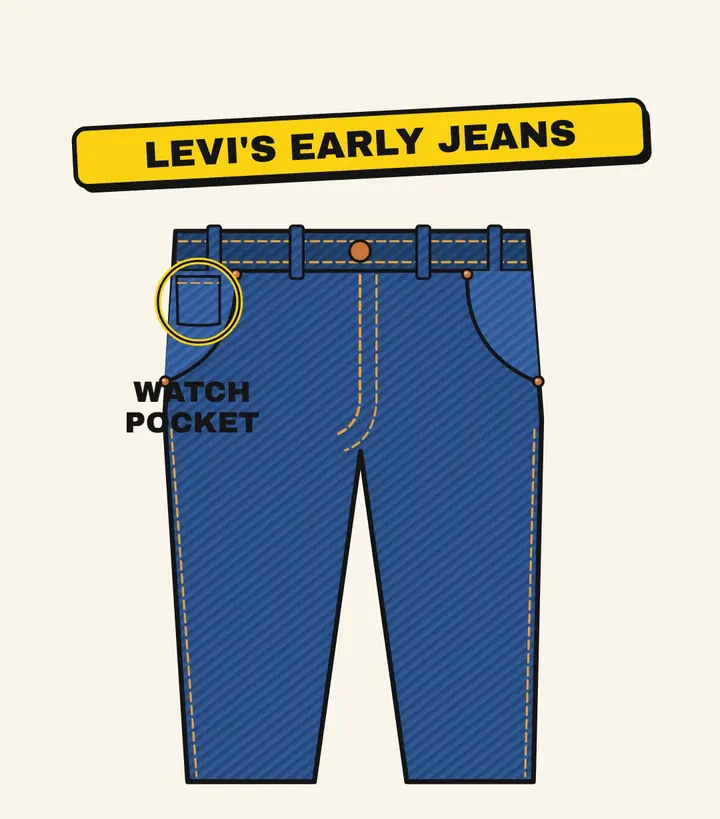
The small pocket on the front right of jeans is a watch pocket. Levi Strauss & Co. says it was part of its first riveted waist overalls in 1873, made to hold a pocket watch, a common accessory at the time. Watches moved to wrists, but the pocket stayed, and today it carries coins, tickets and other small things.
Published · Last verified · 9 sources
That small pouch tucked above the right front pocket is a watch pocket. Levi Strauss & Co., which made the first riveted blue jeans, describes it as a place "intended to store a pocket watch — a typical possession during the late 1800s" [1]. Wristwatches later took over that job, but by then the pocket was part of what a pair of jeans looks like, and it never left.
Why a watch needed its own pocket
In the 19th century a working man's watch was a pocket watch: a round case on a chain, too valuable to drop and too bulky to rattle around loose with keys and coins. A snug, shallow pocket right at the waistband kept it in one place, easy to reach, and away from the rest of the load.
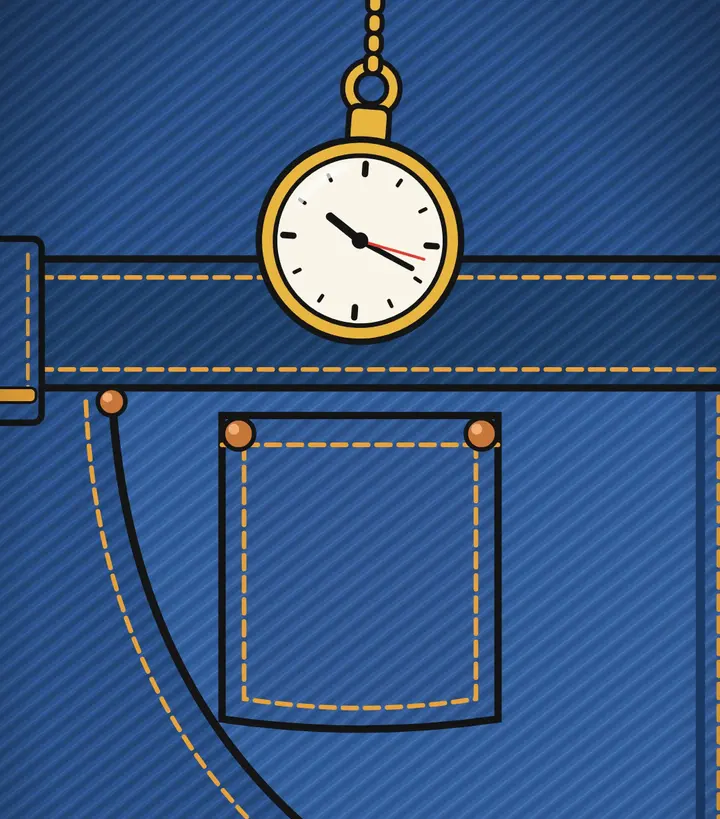
The idea is far older than denim. The Victoria and Albert Museum holds a man's coat and breeches from the 1680s with "a watch pocket in the waistband on each side," each closed with a silk loop and button [5]. A pair of breeches from the 1790s in the same collection has a single watch pocket in the right waistband [6], the same side jeans use today. When Levi's added a little pocket to its work pants, it was borrowing a feature tailors had used for about two centuries.
What the 1873 originals looked like
Levi Strauss & Co. dates its first riveted "waist overalls", the garment that later became the 501, to 1873. The company's own history lists their features: "one back pocket with the Arcuate stitching design, a watch pocket, a cinch, suspender buttons and a rivet in the crotch" [2]. That makes four pockets in total: two at the front, the small one above the right front pocket, and a single pocket on the back. All four were reinforced with copper rivets [1].
The rivets are why those pants existed at all. Jacob W. Davis of Reno, Nevada, patented the idea and assigned it to himself and Levi Strauss & Co.: U.S. Patent 139,121, granted on May 20, 1873 [3]. The National Archives summarizes the invention as "the employment of a metal rivet or eyelet at each edge of the pocket opening to prevent the ripping of the seam at those points." Davis had been using rivets on horse-blanket straps before he tried them on pockets [9]. The patent is about pocket corners in general; it doesn't mention a watch pocket.
How the pocket survived 150 years of changes
1873
Riveted waist overalls go on sale with a watch pocket and one back pocket [2].c. 1890
Lot numbers are assigned and "501" becomes the name of the copper-riveted waist overalls. The company says it doesn't know why that number was chosen [2].c. 1901
A second back pocket is added, probably "due to consumer requests or changes in men's fashions" [2].1937
The back pockets are sewn to cover their rivets, after customers complained they scratched furniture and saddles [2].World War II
To save metal under War Production Board rules, the crotch rivet, the cinch and the watch pocket rivets are removed. The pocket itself stays [2].c. 1947
The post-war 501 puts the rivets back on the watch pocket [2].
Through all of that, the small pocket was never the part being cut. Even when metal was rationed, Levi's took the rivets off it and kept the pocket.
So which one is the fifth pocket?
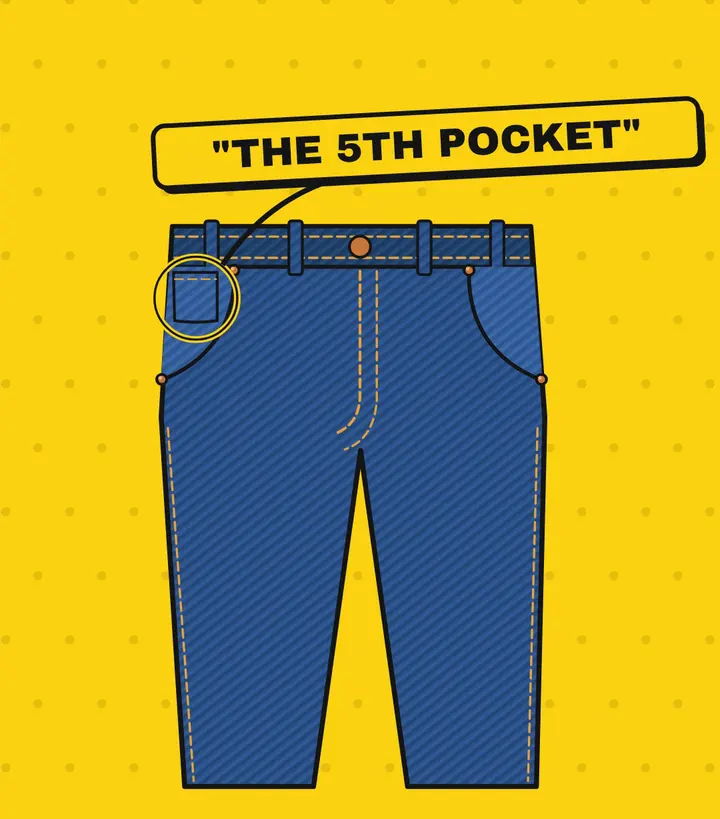
In 1996 a Levi's 501 TV ad called Pool Boy ended with the line "The Fifth Pocket, Overlooked Since 1873." The company's historian, Tracey Panek, later set the record straight: "That tiny pocket is not the fifth pocket" [4]. Counting in the order they appeared, the watch pocket was one of the original four. The fifth was the left back pocket, added around 1901 [2].
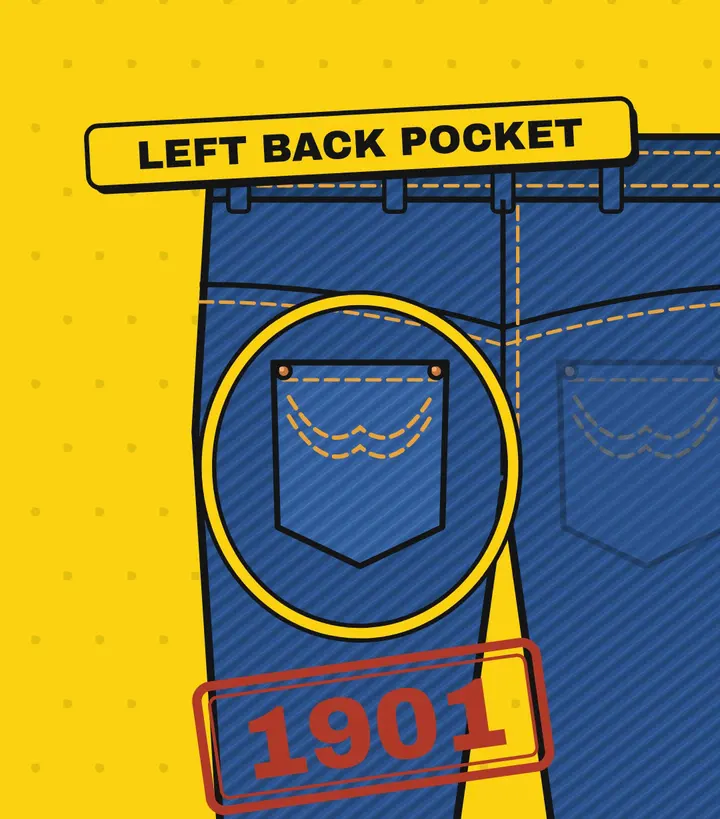
1873 waist overalls
A five-pocket jean today
Myths and nicknames
Because it outlived its original job, the pocket picked up a lot of names. Levi Strauss & Co. lists "frontier pocket, condom pocket, coin pocket, match pocket and ticket pocket" [7]. Those names describe what people later carried in it, not why it was made.
What it's good for now
Coins (whose ridged edges have their own anti-theft story), a folded ticket, a key, a guitar pick, earbuds: anything small enough to get lost in a full-size pocket. Levi Strauss & Co. adds one more reason people like it: it is "loved by denimheads for the faded and worn nature it takes on over time" [7].
Sources
- 1.Pockets Full of History. Levi Strauss & Co. (Unzipped)Primary. Accessed October 8, 2026.
- 2.History of the Levi's 501 Jeans (PDF). Levi Strauss & Co.Primary. Accessed October 8, 2026.
- 3.US Patent 139,121: Improvement in Fastening Pocket-Openings. U.S. Patent Office, via Google PatentsPrimary. Accessed October 8, 2026.
- 4.The Story Behind the Official Fifth Pocket. Levi Strauss & Co. (Tracey Panek, company historian)Primary. Accessed October 8, 2026.
- 5.Coat and Breeches, 1680s (O13921). Victoria and Albert MuseumPrimary. Accessed October 8, 2026.
- 6.Breeches, 1790–1800 (O75637). Victoria and Albert MuseumPrimary. Accessed October 8, 2026.
- 7.Those Oft-Forgotten Pant Parts. Levi Strauss & Co. (Unzipped)Primary. Accessed October 8, 2026.
- 8.What That Little Pocket on Your Jeans Was Actually Made For. Mental Floss. Accessed October 8, 2026.
- 9.Forever in Blue Jeans…and in Court. U.S. National Archives (Pieces of History)Primary. Accessed October 8, 2026.
Last verified: . Spotted an error? See our editorial policy and corrections.
Video transcript
Why do jeans have this tiny pocket? It looks useless, but it once had a very specific job. It was made for a pocket watch. Levi's early jeans already had this little compartment back in 1873. And here's the weird part: people call it the fifth pocket, but it wasn't the fifth one added. That was the left back pocket, introduced in 1901. So that tiny pocket is a little piece of history you're still wearing.


