
Why do coins have ridges?
Short answer
The ridges, called reeding, began as an anti-theft feature. When coins were made of gold and silver, people clipped or filed metal from the edges and still spent the coins at full value. A ridged edge made any trimming obvious. Everyday coins no longer contain precious metal, but the ridges stayed, and they help people tell coins apart by touch.
Published · Last verified · 13 sources
Coin ridges are a security feature that has outlived its threat. The U.S. Mint calls them reeding, "raised lines across the edge of a coin" [4], and explains that the dollar, half dollar, quarter and dime "were originally produced from precious metals (gold and silver)." The reeds were there "to make sure no one would alter the coins and try to file off the edges to retrieve some of the precious metals" [2]. A modern quarter has no silver in it at all, yet it still leaves the press with 119 of those little grooves [1].
What was coin clipping?
When a coin was worth the metal it contained, every sliver of that metal had value. Clipping was "a dishonest process whereby a small amount of gold or silver was shaved from the edges," as the Royal Mint Museum puts it [7]. The clipped coin went back into circulation at its full face value, and the clipper kept the shavings. Do that to enough coins and the scraps add up to real bullion.

The state took it personally. Coins carried the monarch's face, and in England any tampering with them, clipping included, counted as treason, with severe punishments [10].
How did ridges stop it?
A pattern that runs unbroken around the whole rim works like a tamper seal. On a coin with a plain edge, a little missing metal is easy to hide. On a coin whose edge is supposed to be grooved or lettered all the way round, a smooth or chewed patch gives the game away.
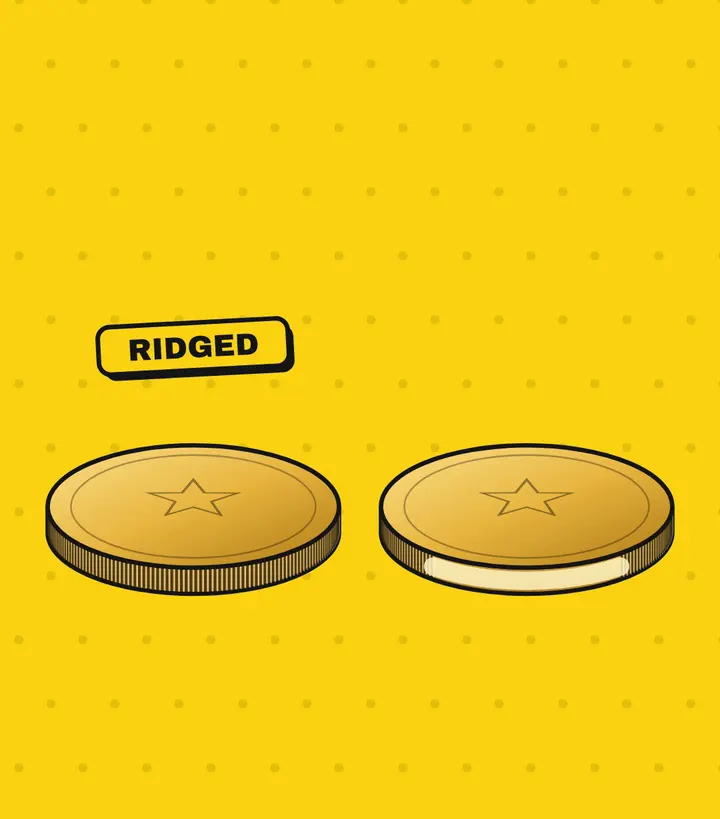
England got that protection when its mint switched from hammers to machines. The Royal Mint Museum describes how, in the early 1660s under Charles II, horse-drawn rolling mills, "edge marking machinery" and large screw presses were installed at the Tower of London. Machine-struck coins came out "thicker and more uniform", and the new process made room for "security features such as milling and edge lettering", which made coins harder to counterfeit and "prevented the coinage from being clipped" [7]. A Frenchman, Pierre Blondeau, supervised the machinery and personally operated the equipment that applied the lettering and milling. Production of the new gold coins began in February 1662 [7].
Some coins got words instead of grooves. The five-guinea piece, the crown and the half crown carried the edge inscription DECUS ET TUTAMEN, "an ornament and a safeguard", the safeguard being against exactly this kind of tampering. The same Latin phrase was reused on the British £1 coin introduced in 1983 [7].
Where does Isaac Newton fit in?
Newton arrived at the Royal Mint, then inside the Tower of London, as Warden in April 1696. The Mint was in the middle of a vast recoinage of "old silver coins dating back to the reign of Elizabeth I and beyond", which took three years. After that, his main job was "investigating and bringing to justice those who clipped and counterfeited the coin of the realm." He became Master of the Mint from Christmas Day 1699 and held the post until he died in 1727 [9].
1662
Machine-made coins with milled and lettered edges go into production at the Tower of London [7].1696
Isaac Newton becomes Warden of the Royal Mint during the recoinage of old silver [9].1792
A U.S. law sets American coins in gold, silver and copper [2].1965
The Coinage Act removes silver from circulating dimes and quarters and reduces it in half dollars [5].2000
The U.S. Golden Dollar is given a smooth edge so it can be told from the quarter by touch [12].
How are the ridges made?
Nobody cuts them in afterwards. In a modern coining press, the lower die pushes each blank "into a restraining collar" and against the upper die at around 60 tons of pressure. As both faces are stamped, the metal is squeezed outward into the collar and takes its shape, "plain or milled depending on the denomination" [8]. The U.S. Mint defines the collar as "a metal piece that restrains the expanding metal of a planchet during striking" [4]. So the reeds are formed in the same instant as the heads and tails, at up to 850 coins a minute [8].
The names vary. British sources say "milling" or a "milled" edge [7]; the U.S. Mint says "reeding" and lists four kinds of edge: "plain, reeded, lettered, or decorated" [3]. Its glossary calls the edge a coin's "third side" [4].
How many ridges are on a quarter?
The U.S. Mint publishes the count for every circulating coin [1]:
| Coin | Diameter | Edge |
|---|---|---|
| Cent (penny) | 19.05 mm | Plain |
| Nickel | 21.21 mm | Plain |
| Dime | 17.91 mm | 118 reeds |
| Quarter | 24.26 mm | 119 reeds |
| Half dollar | 30.61 mm | 150 reeds |
| Dollar | 26.49 mm | Lettered |
The dime and the quarter have almost the same number of reeds, but the dime's edge is much shorter. Working from those diameters, the dime's ridges sit about 0.48 mm apart and the quarter's about 0.64 mm, which is why a dime's edge feels finer under a thumbnail.

Why do dimes and quarters have ridges but pennies and nickels don't?
It comes down to what the coins were first made of. A 1792 law set American money in three metals: gold for the $10, $5 and $2.50 pieces; silver for the dollar, half dollar, quarter, dime and half dime; and copper for the cent and half cent [2]. The reeded coins are the descendants of the precious-metal ones. Pennies and nickels are mainly made of inexpensive metals, so, as Mental Floss puts it, the chances that anyone would tamper with them are low, and they make do with a plain edge [13].
The silver itself is long gone. Because of a silver shortage, the Coinage Act of 1965 removed silver from circulating dimes and quarters [5], and the last U.S. coin with any silver in it was the 1970 half dollar [6]. Today's dimes and quarters are a copper core between two layers of copper-nickel, and if you look at a quarter's edge you can see the copper showing through [6]. The reeding stayed even though there is nothing left worth shaving.
Do coin edges help blind people?
They do, and some currencies are designed around it. The euro is the clearest case. The European Central Bank lists "different sizes, shapes, colours and edges" among the features that help visually impaired people recognize euro coins, and gives each coin its own edge [11]:
- €2: letters engraved into a fine-milled edge
- €1: a fine-milled edge interrupted by three smooth sections
- 50 and 10 cent: larger indents all along the edge
- 20 cent: smooth, with seven indents
- 5 and 1 cent: smooth
- 2 cent: smooth, with a fine line engraved along the edge
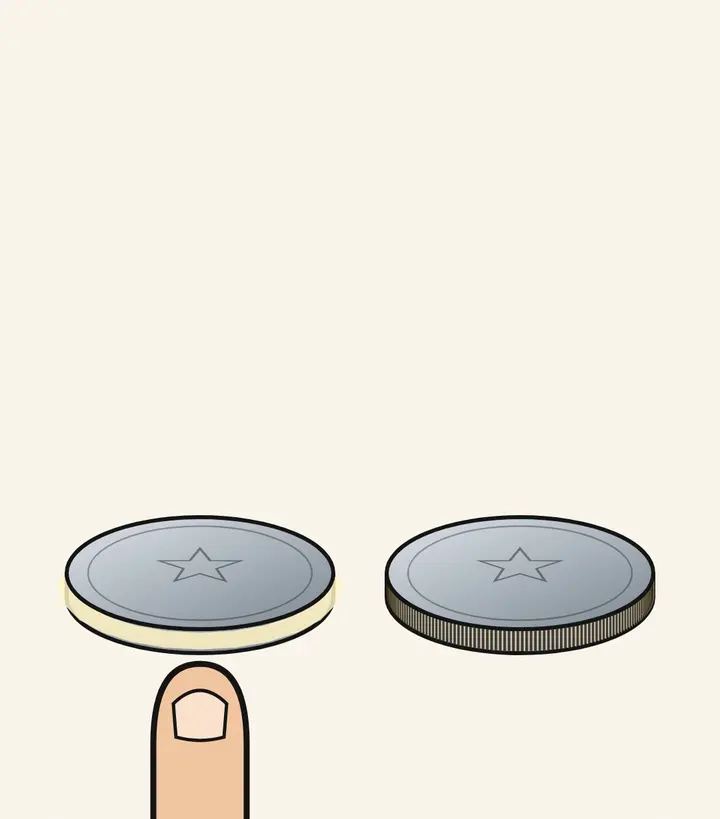
U.S. coins weren't given their edges with that in mind, but the difference still works under a fingertip. A dime is smaller than a penny (17.91 mm against 19.05 mm), yet only the dime is reeded [1]. If you're fishing change out of the small pocket on your jeans, the edge is often the quickest way to tell which coin is which.
Sources
- 1.Coin Specifications. United States MintPrimary. Accessed October 8, 2026.
- 2.Fun Facts (U.S. Mint for Kids), archived copy. United States Mint, via the Internet ArchivePrimary. Accessed October 8, 2026.
- 3.Parts of a Coin. United States Mint (Coin Classroom)Primary. Accessed October 8, 2026.
- 4.Coin Glossary. United States Mint (Coin Classroom)Primary. Accessed October 8, 2026.
- 5.History Timeline. United States Mint (Coin Classroom)Primary. Accessed October 8, 2026.
- 6.What Coins Are Made Of. United States Mint (Coin Classroom)Primary. Accessed October 8, 2026.
- 7.Charles II. The Royal Mint MuseumPrimary. Accessed October 8, 2026.
- 8.Making Money. The Royal Mint MuseumPrimary. Accessed October 8, 2026.
- 9.Isaac Newton, Warden and Master of the Royal Mint 1696-1727. The Royal Mint MuseumPrimary. Accessed October 8, 2026.
- 10.The Tower's Mint. Historic Royal Palaces. Accessed October 8, 2026.
- 11.Visually impaired people. European Central BankPrimary. Accessed October 8, 2026.
- 12.Mint and Wal-Mart Circulate Golden Dollar (press release, January 20, 2000). United States MintPrimary. Accessed October 8, 2026.
- 13.Why Do Coins Have Ridges?. Mental Floss. Accessed October 8, 2026.
Last verified: . Spotted an error? See our editorial policy and corrections.
Video transcript
People used to steal money without stealing any coins. Centuries ago, coins were made of real gold and silver. Thieves shaved tiny slivers off the edges and kept the metal. Ridged edges made that easy to spot, because a shaved coin lost its pattern. Today's coins aren't precious metal, but the ridges stayed. They even help people with low vision tell coins apart by touch. All because, centuries ago,


