
Why are objects in the mirror closer than they appear?
Short answer
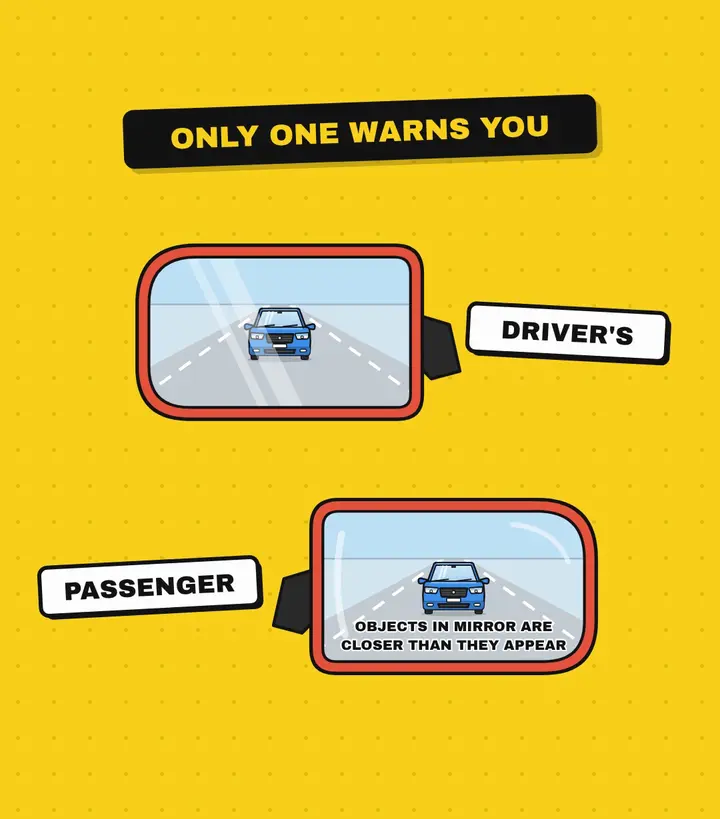
The passenger-side mirror on most US cars is convex. Its outward curve fits a wider stretch of road into the glass, but it also shrinks everything, and a smaller car reads as a more distant one. US safety rules have required the warning on those curved mirrors since 1982. The driver's outside mirror must be flat.
Published · Last verified · 12 sources
Playing loads the video from YouTube (Google), which may set cookies. Cookie policy
 Also in the long video · 4:58Your Car Is Full of Hidden Features. Here's What They Actually Do
The sentence is there because that mirror is curved. A convex mirror gives a wider field of view than a flat mirror of the same size [2], and it pays for that by making every car in it smaller. A smaller car looks like a more distant car. In the United States the exact words come from the federal safety standard for mirrors, FMVSS 111, which requires them on any convex mirror a carmaker fits to meet the passenger-side requirement [1]. The same standard requires a flat outside mirror for the driver, so only one side of the car carries the text [1].
Why does a curved mirror make things look farther away?
In a flat mirror, the image and the object are the same distance from the glass [6]. FMVSS 111 calls this "unit magnification": the image has the same angular height and width as the object would if you looked straight at it from the same distance [1].
A convex mirror bulges toward the viewer, and it can form only one kind of image: upright, smaller than the object, and virtual, meaning it sits behind the glass [6]. A spherical mirror's focal length is half its radius of curvature, and the image in a convex mirror always forms between the glass and that focal point [5]. US rules keep the radius of a passenger-side convex mirror between 889 and 1,651 mm [1], so the focal point is never more than about 83 cm behind the glass. However far back the other car is, its image is packed into that shallow space, and it has to shrink to fit.
The mirror equation, 1/dₒ + 1/dᵢ = 1/f, puts numbers on it [5]. This is our own arithmetic with that equation, not a figure from a source: with a 1,400 mm radius and a car 20 m behind, the image forms about 68 cm behind the glass and is roughly one-thirtieth of the car's real size.
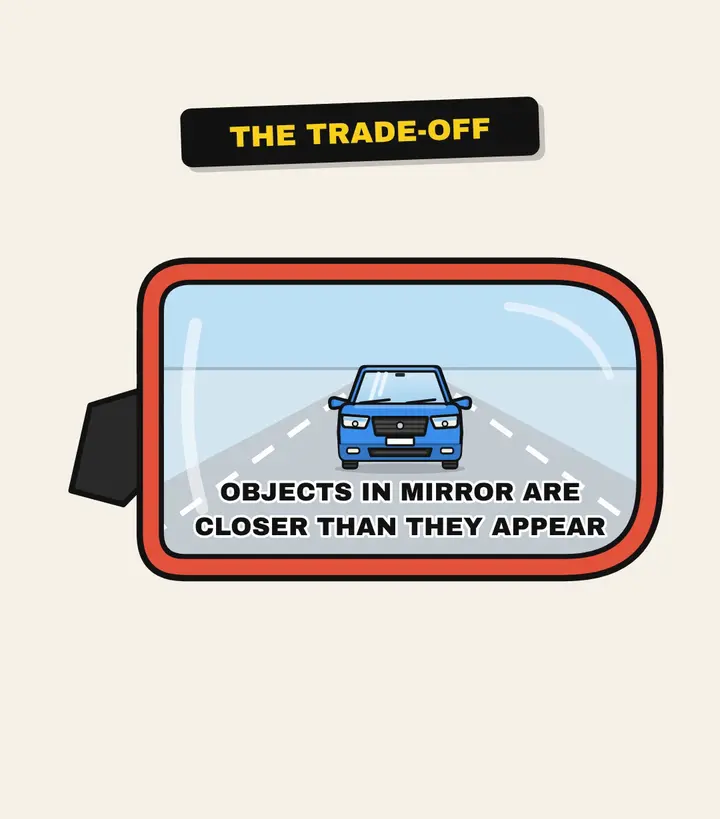
The shrinking is the point: because the image is smaller, a larger area fits in the mirror than a flat one would show [6]. It is also the cost. NHTSA, the US road safety regulator, writes that the image in a convex mirror is "both distorted and smaller" than in a flat one, so the object "appears farther away," and its speed is harder to judge too [3].
Why is it only the passenger-side mirror?
Because in the US that is the only place a carmaker may use a convex mirror to satisfy the standard. FMVSS 111 says each passenger car "shall have an outside mirror of unit magnification" on the driver's side, and an inside mirror of unit magnification too [1]. The inside mirror counts as flat even when it is the prismatic day-night kind, as long as one of its positions gives unit magnification [1]. That is the mirror with the tab underneath.
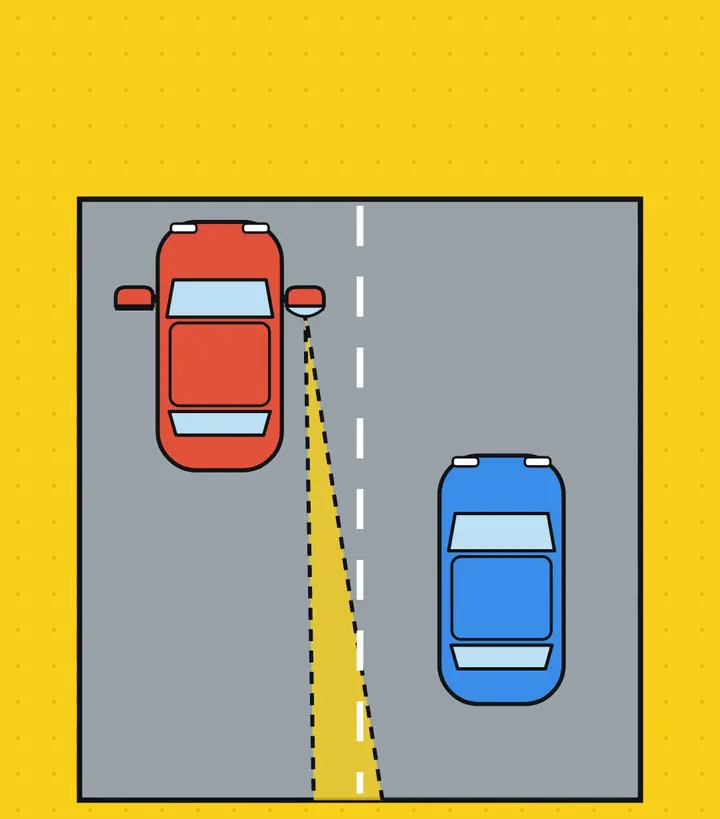
When NHTSA first allowed the curved mirror on the passenger side, it described the main benefit as "an expanded field of view of the right, rear quadrant area adjacent to the vehicle," so the driver has less need to turn around and look [2]. It accepted the distortion there because a flat mirror is still on hand: the inside mirror "provides the correct depth and speed perception," and a car spotted in the curved mirror can be judged in the flat one whenever it shows up there too [3].
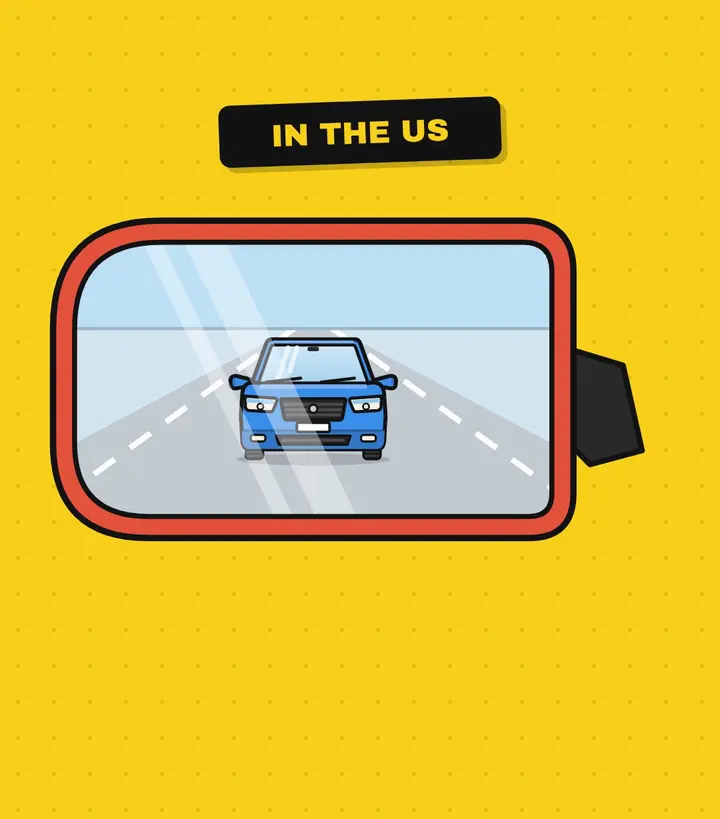
"Flat" applies to the part of the driver's mirror the standard requires. In a 2010 letter, NHTSA's chief counsel wrote that the rule "does not prohibit an additional curved or aspheric portion to expand the field of view beyond the required viewable area," while noting that mixing the two "could present visual confusion" [11].
Is the warning required by law?
In the US, yes, down to the size of the type. Each convex mirror used to meet the passenger-side requirement must be "permanently and indelibly marked at the lower edge of the mirror's reflective surface, in letters not less than 4.8 mm nor more than 6.4 mm high," with the words "Objects in Mirror Are Closer Than They Appear" [1]. The 1982 rule gave the same range in inches: 3/16 to 1/4 inch [2].
Two more limits come with it. The average radius of curvature has to fall between 889 and 1,651 mm, and no reading at ten test positions may differ from that average by more than 12.5 percent [1]. An even curve reduces the double vision, nausea and dizziness some drivers reported, NHTSA says, and a fixed range keeps mirrors on different vehicles alike [3].
Some carmakers argued that a line in the owner's manual would do, or that no warning was needed. NHTSA answered that words on the glass would be "a reminder to the driver with each use" and would reach drivers who never read the manual [2]. The requirement does not cover aftermarket mirrors, the agency added, or a convex mirror that isn't needed to meet the field-of-view rule [2].
1967
Standard No. 111 is issued for passenger cars. Only flat mirrors are allowed [3].1976
General Motors petitions NHTSA in May to allow convex mirrors on the passenger side, pointing to their wider view. The agency issues a first proposal in August [2].1978
A broader proposal sets a radius of 40 to 60 inches and an orange border [2].1980
A study for the agency by Vector Enterprises finds that a radius of 1,016 to 1,524 mm works best [3].1982
The final rule is published on 2 September and takes effect the same day, in time for 1983 models. It sets 35 to 65 inches and the etched words [2].2003
NHTSA asks for comments on allowing convex or aspheric mirrors on the driver's side as well [3].
Why don't European cars say it?
Because the rule used there never asks for it. UN Regulation No. 46, the United Nations mirror regulation that the EU publishes in its Official Journal, says the reflecting surface of a mirror "shall be either flat or spherically convex," and it draws no line between the driver's side and the passenger's. For main exterior mirrors the radius must be at least 1,200 mm, and an exterior mirror may have an additional aspherical part [4]. Its table of compulsory mirrors requires category M1 vehicles to have one main exterior mirror on each side [4]. The European Commission describes category M as vehicles carrying passengers [12].
The markings it requires are the maker's trade name and an approval mark: a circled E with a country number, an approval number and the mirror's class. The text has no warning sentence. Its one optical marking is for aspherical mirrors, where the change from the spherical to the aspherical part "has to be marked" [4]. NHTSA describes that as an etched line where the flatter section ends and the more curved outer section begins [3]. (We read the consolidated version published in the Official Journal in August 2014.)
United States
Europe
A study NHTSA commissioned from the Dutch institute TNO shows what that meant on the road. In its sample of European vehicles, 43 percent had a flat driver's mirror, 34 percent a convex one and 23 percent an aspherical one. On the passenger side, 92 percent were convex [3].
Would a curved driver's mirror be safer?
The crash data lean that way. An analysis of 1,062 lane-change crashes reported to Finnish insurers from 1987 to 1998 found that cars with convex or multiradius driver's mirrors had 22.9 percent fewer lane-change crashes toward the driver's side than cars with flat ones, a statistically significant drop [9]. A study of 3,038 lane-change accidents in Great Britain concluded that convex driver's mirrors "do not increase the risk" [10].
In 2003 NHTSA said research had led it to believe that non-flat mirrors on both sides would widen the view and remove blind spots. It also pointed to two studies it had commissioned, in which some drivers had difficulty making safe lane-change decisions with them [3]. The standard's text today still asks for unit magnification on the driver's side [1].
That makes this sentence the reverse of the arrow next to the fuel gauge, which appears on dashboards although no rule mentions it. These eight words are on the glass because a rule spells them out, letter height included.
Sources
- 1.49 CFR 571.111, Standard No. 111: Rear visibility. U.S. National Highway Traffic Safety Administration, via eCFRPrimary. Accessed October 11, 2026.
- 2.Federal Motor Vehicle Safety Standards; Rearview Mirror Systems, final rule, 47 FR 38698, 2 September 1982 (PDF of the whole day's issue, 49 MB; the rule starts on page 38698). U.S. National Highway Traffic Safety Administration, in the Federal Register, via GovInfoPrimary. Accessed October 11, 2026.
- 3.New Rearview Technology and Federal Motor Vehicle Safety Standard No. 111; Rearview Mirrors, request for comments, 68 FR 2993, 22 January 2003. U.S. National Highway Traffic Safety Administration, in the Federal Register, via GovInfoPrimary. Accessed October 11, 2026.
- 4.Regulation No 46 of the UNECE: devices for indirect vision and their installation (consolidated text, Official Journal L 237, 8 August 2014). United Nations Economic Commission for Europe, via EUR-LexPrimary. Accessed October 11, 2026.
- 5.University Physics Volume 3, section 2.2: Spherical Mirrors. OpenStax (Rice University). Accessed October 11, 2026.
- 6.College Physics 2e, section 25.7: Image Formation by Mirrors. OpenStax (Rice University). Accessed October 11, 2026.
- 7.Distance Perception in Driver-Side and Passenger-Side Convex Rearview Mirrors: Objects in Mirror Are More Complicated Than They Appear (Flannagan and others, UMTRI-97-32, 1997), abstract. University of Michigan Transportation Research Institute, via TRID (Transportation Research Board). Accessed October 11, 2026.
- 8.A Field Study of Distance Perception with Large-Radius Convex Rearview Mirrors (Flannagan and others, SAE Technical Paper 980916, 1998), abstract. Society of Automotive Engineers, via TRID (Transportation Research Board). Accessed October 11, 2026.
- 9.Effects of nonplanar driver-side mirrors on lane-change crashes (Luoma, Flannagan and Sivak, Transportation Human Factors, 2001), abstract. VTT Technical Research Centre of Finland, research portal. Accessed October 11, 2026.
- 10.Are Driver-Side Convex Mirrors Helpful or Harmful? (Schumann, Sivak and Flannagan, UMTRI-96-7, 1996), abstract. University of Michigan Transportation Research Institute, via TRID (Transportation Research Board). Accessed October 11, 2026.
- 11.Interpretation 09-002367 111, letter of the Chief Counsel on FMVSS No. 111, dated 1 June 2010 (archived copy). U.S. National Highway Traffic Safety Administration, via the Internet ArchivePrimary. Accessed October 11, 2026.
- 12.Vehicle categories. European CommissionPrimary. Accessed October 11, 2026.
Last verified: . Spotted an error? See our editorial policy and corrections.
Video transcript
One of your car's mirrors is lying to you. And it's the only one that warns you. The passenger-side mirror curves outward, like the back of a spoon. That curve squeezes a much wider view into the same small glass, so you see more of your blind spot. The trade-off: everything in it looks smaller, so it looks farther away. That's why it says objects are closer than they appear. In the US, the driver's mirror has to be flat, so it shows true distance. Which means only


