
Long video · 9 min · 8 oddities
Your Car Is Full of Hidden Features. Here's What They Actually Do
Eight details in and around your car, each explained by the job it really does: the hole that stops a gas pump, the tab that dims your rearview mirror, the button on your seat belt, the hairs on new tires, the holes under your doors, the warning on one side mirror, new car smell, and the headrest that supposedly breaks windows. This page adds what the patents, standards and studies say, including the places where they correct the video.
Published · Last verified · 10 chapters
Playing loads the video from YouTube (Google), which may set cookies. Cookie policy
In this video
Most of what is in this video was put there by an engineer with one narrow problem: fuel on the forecourt, headlights in the mirror, a latch plate on the floor, air in a mold, water in a door. A few of the fixes are over a century old on paper. One of the eight is not a feature at all but a by-product, one is a smell, and one is a rumour about a safety part.
Each chapter below gets the mechanism in plain terms, a detail or two the video had no time for, and a link to the full researched article. After the eight come three sections that only make sense with all of them side by side: what the three holes in the video have in common, which of these details a rule actually demands, and where the sources correct what the video says.
At a glance
| Detail | What you notice | Its real job | On record since |
|---|---|---|---|
| Gas pump shut-off | A small hole near the tip of the nozzle | Lets air in; when fuel covers it, suction trips the valve shut | A patent filed in 1924; on forecourts from the early 1950s |
| Rearview mirror tab | A tab under the inside mirror | Tilts a wedge of glass so you get its weak front reflection | Tilting two-surface mirrors filed in 1928; GM's wedge in 1941 |
| Seat belt button | A plastic button on the webbing | Keeps the latch plate from sliding down the belt | A German filing from 1975 |
| Tire hairs | Rubber hairs on the tread and sidewall | None on the road; they are plugs left by the mold's air vents | A by-product of vented molds |
| Door drain holes | Holes or slots along the bottom of the door | Let out the water that gets past the window seals | Called usual in a patent filed in 1956 |
| Mirror warning | A sentence on the passenger-side mirror | Tells you a convex mirror is shrinking what it shows | The US rule of 2 September 1982 |
| New car smell | The smell of a new cabin | Nothing; it is gas coming off the interior materials | Measured in studies since 1999 |
| Headrest | A head restraint that lifts out | Limits how far the head snaps back in a crash | A US standard in force since 1 January 1969 |
How does a gas pump know when to stop?
The pump never learns anything. All the sensing is done by the nozzle, and it is done with air. Just below the main valve the fuel passage narrows, and gasoline rushing through that throat lowers the pressure in a small chamber closed off by a flexible diaphragm. A thin tube joins the same chamber to a hole near the end of the spout. While the tank is filling, air comes in through the hole as fast as it is drawn out, and the diaphragm stays where it is.
Once fuel rises over the hole, the supply of air ends, the suction builds and the diaphragm lifts. It doesn't close the valve itself. In the design OPW patented, it pulls a pin that frees a set of balls, a plunger drops, and the hand lever loses its pivot. A spring then closes the valve while your hand is still squeezing.
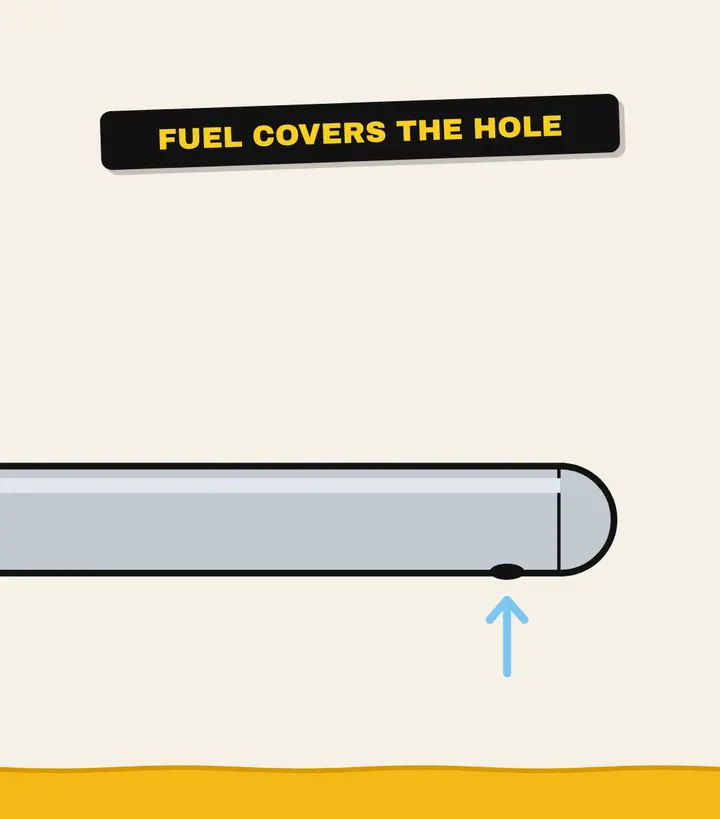
The nozzle has no way of knowing what covered the hole, which is why splashing fuel can make it click off early. Read how the nozzle works, and why not to top off.
What does the tab under the rearview mirror do?
The glass in a manual mirror is a wedge. Its front and back faces sit at an angle, about 3.5 degrees in General Motors' 1941 patent, and only the back is coated. Any pane of glass also reflects a little light off its bare front face, about 4 percent. Because the two faces aren't parallel, the two reflections leave in different directions, and the tab decides which one reaches your eyes.
By day you get the coating's bright image. Flip the tab and that image goes up to the ceiling, which is close to black at night, while the faint front-face image shows you the road behind.
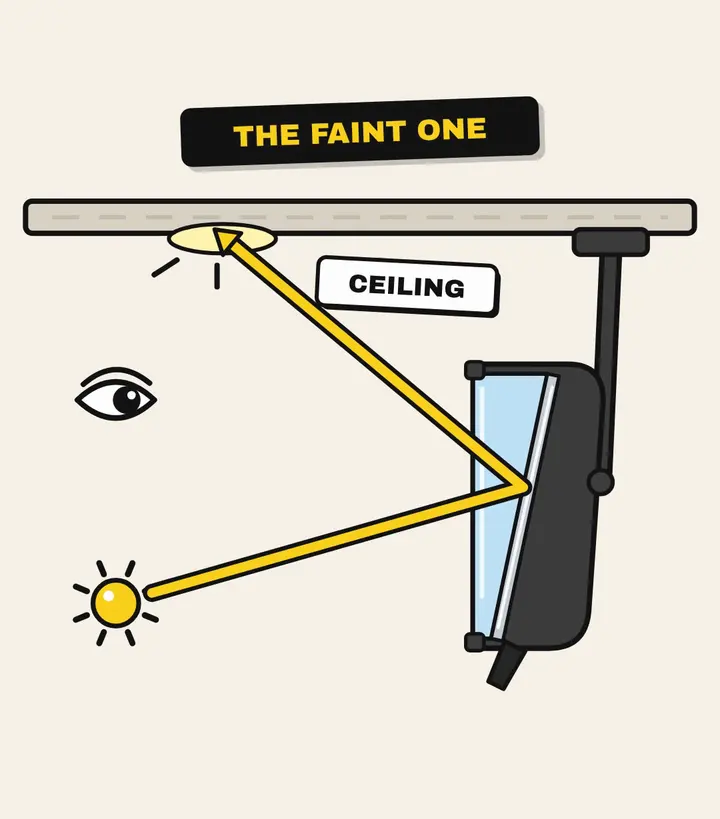
The tab is the handle of a spring mechanism, and it arrived with a GM patent filed in 1946. In the 1941 version the driver nudged small wings on the mirror's frame. US rules treat the night setting as optional but regulated: a mirror with two levels has to reflect at least 35 percent by day and at least 4 percent at night. The mirror article follows the patents back to 1928.
What is the button on a seat belt for?
First, the names. The metal part that slides on the belt is the latch plate, or tongue. The buckle is the receiver bolted to the car. When the belt reels in, nothing would stop the latch plate travelling down the webbing to the floor, under the seat cushion or into the gap by the door. The button is simply thicker than the slot the webbing runs through.
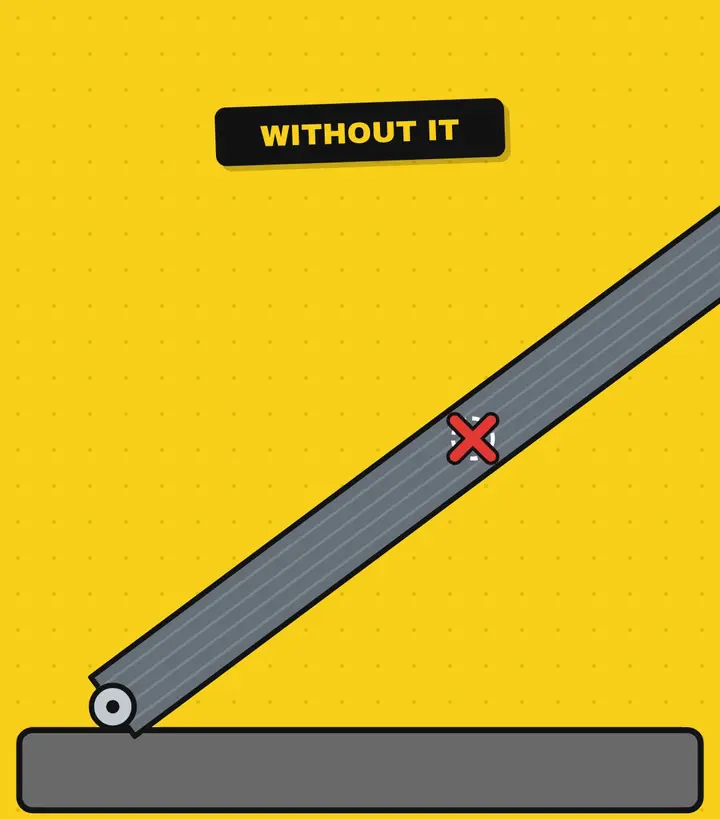
It isn't stitched on. A stop of this kind is two plastic halves joined through the webbing. Mitsubishi's repair bulletin has the technician push a spiked half through from the back of the belt and clamp the other half onto it until it clicks. The same bulletin gives the button's position to the millimetre, because a stop in the wrong place can leave slack in the lap belt. None of the three safety rules the article searched names the part. More in what the seat belt button is for.
Why do new tires have rubber hairs?
An uncured tire is pushed against a heated mold by a bladder inflating inside it. Air caught between the two would leave patches the rubber never filled, so the mold wall is drilled with small vents. The air leaves, a thread of rubber follows it into each hole, and in so narrow a space the rubber cures fast. That makes each hair the plug that sealed its own vent. It comes out of the mold still attached to the tire.
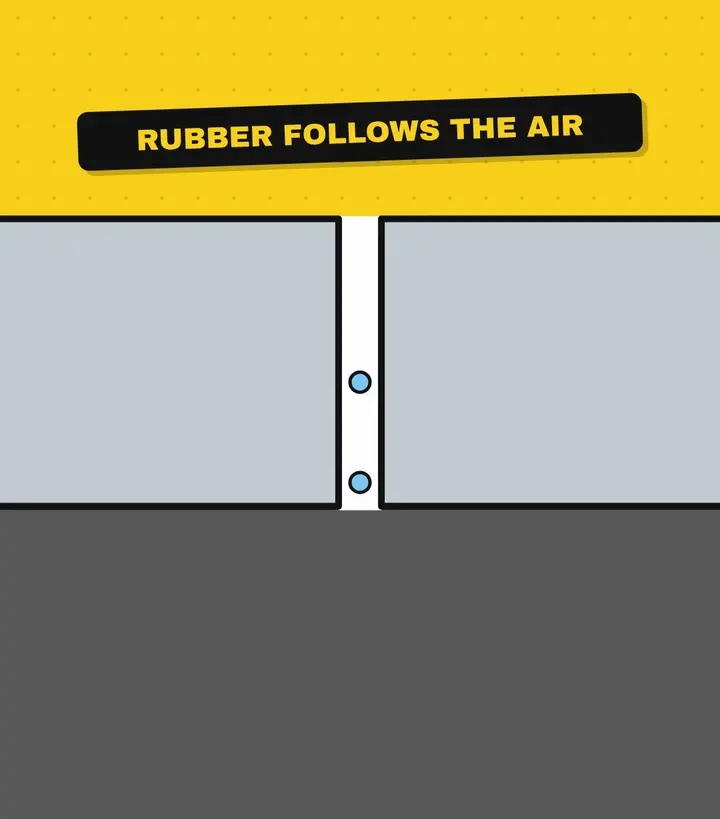
Tire makers call them vent spews. How long they last depends on where they are. On the tread they rub away against the road. On the sidewall they never touch it and can stay for months, so hairs say little about how old a tire is. The date code does: the last four digits of the identification number on the sidewall are the week and the year it was made. Why new tires have rubber hairs also covers the molds that leave no hairs at all.
Why do car doors have holes in the bottom?
A door is a hollow shell with a slot in the top for the glass, and nobody expected the seals on that slot to stop everything. A General Motors patent filed in 1956 already describes the opening as only partly sealed and admits that water can still get into the door. So the design accepts the water, gives it an exit at the lowest point, and puts a liner behind the trim panel to keep it off the cabin side.
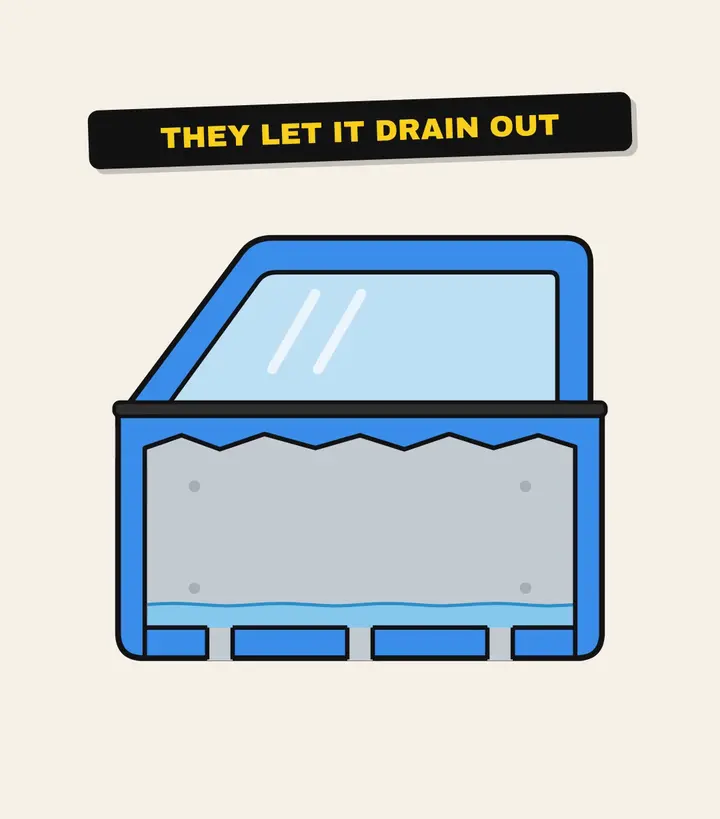
Blocked drains show themselves in three ways in the sources: a sloshing sound, which Toyota dealt with in a 2021 service bulletin for the RAV4; a soaked trim panel; and rust along the bottom of the door. Carmakers put the warning in the owner's manual. The door drain article explains how to clear the holes, and why they are often half covered on purpose.
Why does only one mirror say objects are closer than they appear?
A convex mirror can form only one kind of image: upright, behind the glass and smaller than the real thing. That is how it fits a wider strip of road into the same frame, and it is also why the car in it seems farther off than it is. Under the US standard the required outside mirror on the driver's side has to be flat. A convex mirror may be used to meet the passenger-side requirement, within a set range of curvature, and then it must carry the eight-word sentence along its lower edge, in letters 4.8 to 6.4 mm high.
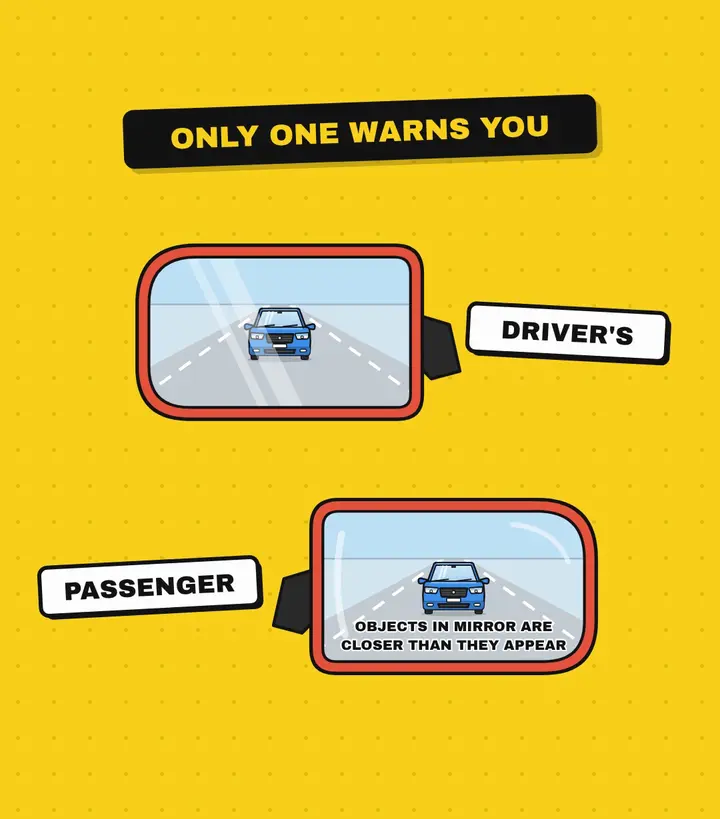
The rule doesn't make the passenger mirror curved, though. It may be flat or convex, and curved simply became the norm. The UN regulation used in Europe allows a convex mirror on either side and, in the 2014 text the article read, asks for no warning sentence. Why objects in the mirror are closer than they appear has the optics and the crash studies.
What is new car smell?
It is what a cabin smells like while its materials are still giving off gas: plastics, vinyl, leather where there is any, foam, carpet, adhesives and sealants. The gases are volatile organic compounds, and no single one of them is "the" new car chemical. A study that followed one new car in Japan identified 162 compounds in its air.
The 2023 study the video mentions measured 20 common VOCs in one new SUV parked in summer heat. Two of them, formaldehyde and acetaldehyde, went over the limits in China's guideline for cabin air. Levels are highest in the first weeks, fall over the following months, and climb again whenever the interior gets hot. Opening a window was the one remedy that study measured, and it worked quickly. What new car smell is gives the numbers and what they can and can't tell you.
Are headrests designed to break windows?
No. The US standard defines a head restraint as a device that limits how far the head moves backward relative to the torso, and gives its purpose as reducing neck injuries in rear-end and other collisions. When the regulator proposed banning front restraints that lift out by hand, carmakers objected with practical reasons: rear visibility, cargo, seats that fold flat, child restraints, fitting seat covers. Glass never came up.
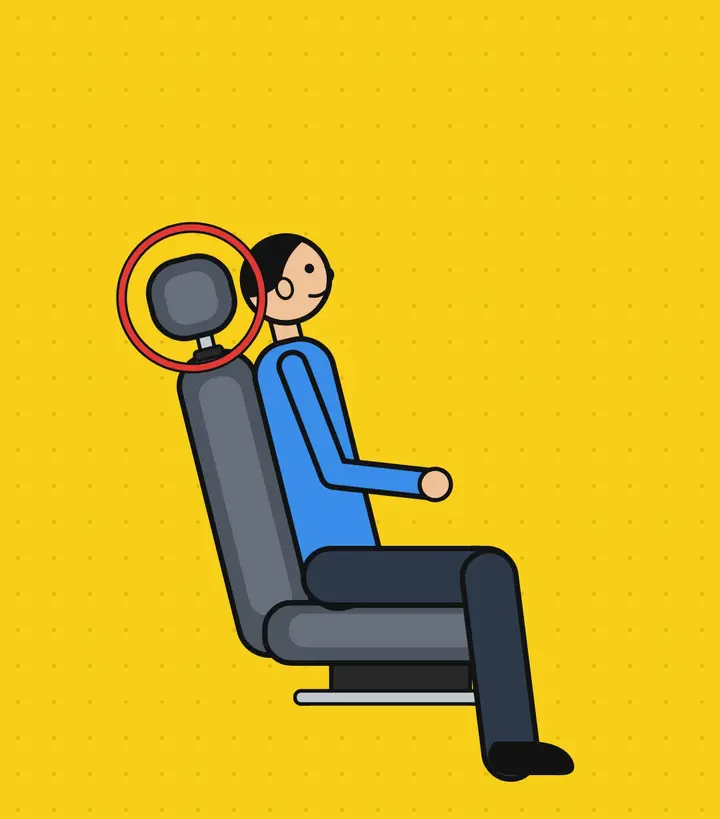
Can one break a window anyway? Sometimes. A researcher who tried it for an emergency dispatch body found that striking the glass with both posts failed almost every time, and called the headrest a poor choice of tool. Purpose-made tools have limits as well: in AAA's tests none of them broke laminated side glass, which about a third of 2018 models had. The headrest article covers what to keep in the car and what to try first.
Three holes, three directions
Three of the eight are holes, and it is tempting to file them together. Each one moves something different, in a different direction.
| Hole | What passes through | Which way | When it is blocked |
|---|---|---|---|
| Nozzle sensing port | Air | In, toward the body of the nozzle | The nozzle shuts off. Being blocked is the signal |
| Tire mold vent | Air, then a thread of rubber | Out of the mold | The rubber can't fill the mold and the tire comes out blemished |
| Door drain | Rainwater | Down and out | Water pools in the door: sloshing, wet trim, rust |
The nozzle port is the odd one out. The other two have failed when they are blocked. The port is meant to be blocked once per fill, and blocking is how it reports. Its weakness follows from that: it can't tell a full tank from a splash.
The tire vent is the only one that plugs itself in normal use, and the plug is the hair. The door drain is the only one of the three that the owner has to look after.
Each of them also lets through something nobody asked for. A few drops of fuel stay in the sensing port after the click. Rubber follows the air into the mold vent. And a door slot big enough to drain well also admits road noise and dust, which is why a Ford patent covers it with a plug that deliberately doesn't seal. In two of the three cases, engineers have spent decades trying to shrink the hole or do without it: tire makers with vents that close themselves and molds emptied by vacuum, carmakers with plugs and ribbed inserts. By the tire patents' own account those ideas were slow to catch on, which is why the hairs are still there.
Which of these does a rule require?
Fewer than you might think, and how closely a rule describes each one varies a lot.
- Spelled out. The mirror warning is the extreme case: the US standard fixes its wording, its place on the glass and the height of its letters. The head restraint is close behind, with minimum heights, a maximum gap to the back of the head, and a requirement that lifting it out takes a deliberate action separate from adjusting it.
- Allowed, with limits. The night setting on the inside mirror is optional, but if a mirror has one, the standard sets its minimum reflectance. A convex passenger mirror is optional too. The one US rule the nozzle article read lets a service station use a manual or an automatic nozzle, and allows a hold-open clip only on the automatic kind. For cabin air, China has a guideline with limits and Japan's carmakers set themselves a voluntary target.
- Named by no rule. The seat belt button appears in none of the rule texts the article searched, although the US crash standard does say where a stowed latch plate has to hang, which is the result the button delivers. Door drains live in owner's manuals and service bulletins. Tire hairs aren't required by anyone; they are what venting leaves behind.
The split is the same one the first long video ran into: rules tend to state a result and leave the method to the maker. The mirror sentence is the rare case where the method itself is the rule.
Where the sources correct the video
The script was written before the articles were researched, and a few of its lines don't hold up against the patents, standards and studies. For the record:
- Richard Corson and the toilet flush. The video credits the shut-off idea to Corson in 1939, hedged with "reportedly". The patent in his name was filed in 1942 and covers a float-operated filler for barrels. The suction-and-diaphragm principle that gas station nozzles use is in a patent applied for in 1924 by Amos Payne of Wichita. The toilet story could not be traced to an original source.
- General Motors in the early 1950s. GM applied for its wedge mirror in 1941 and for the version with the tab in 1946, and two independent inventors had applied for tilting two-surface mirrors in 1928 and 1929.
- "Sewn right into the webbing." The button is two halves clamped through the belt. And the part it stops is the latch plate, not the buckle.
- "They wear off after some driving." True of the hairs on the tread. The ones on the sidewall can last for months, and no source the article read puts a number on either.
- "It isn't leather", and "twenty of these compounds". Leather is one of the materials that off-gas, so the supportable claim is that the smell isn't only leather and doesn't need it. Twenty is how many compounds the 2023 team chose to measure, in one vehicle. It isn't a count of what is in the air.
- Why the headrest comes out, and since when. The reasons on record are visibility, cargo, folding seats, child restraints and seat covers, not adjusting or cleaning. The rule that removal must be a deliberate, separate action was published in December 2004 and applies to vehicles built from 1 September 2009.
Nothing on that list changes the main point of any chapter. The dates, the names and the wording are what moved, and the articles go with the sources.
Sources
Each oddity's full answer, linked above, lists the sources for that topic. Sources for anything said only on this page:
Last verified: . Spotted an error? See our editorial policy and corrections.
Video transcript
You've been in a car thousands of times. But your car is hiding things from you. A tab that switches your mirror into night mode. A button whose only job is to stay out of your way. Holes that are there on purpose. And one feature that the internet swears can save your life in an emergency. It can't. We'll get to that one at the end. Let's start at the gas station. Here's something strange. A gas pump has no idea how much fuel is in your tank. There's no sensor in the tank talking to it. No signal, no wire, no chip. And yet it stops at exactly the right moment, every time. The trick is a tiny hole near the tip of the nozzle. Inside the nozzle, fuel rushes through a narrow section. Fast-moving fuel creates suction, and that suction pulls air in through the little hole at the tip. As long as air can flow in, everything stays balanced. But when the fuel in your tank rises and covers that hole, air can't get in anymore. The suction jumps. A small diaphragm inside the handle gets pulled, a latch lets go, and a spring snaps the valve shut. Click. No electronics. Just air and pressure. The original idea for an automatic shut-off is credited to a man named Richard Corson. In 1939, he was reportedly inspired by the sound of a toilet flushing. A very humble origin for something you use every week. Now get back in the car and look up. Under your rearview mirror, there's a little tab. Flip it at night, and the blinding headlights behind you suddenly go dim. How can one mirror have two brightness levels? Because it isn't a normal mirror. The glass is shaped like a wedge, slightly thicker at one edge, with the shiny silver coating on the back. In day mode, you're looking at that silver backing. It reflects almost all the light, so you get a bright, clear image. Flip the tab, and the whole wedge tilts. Now that bright reflection is aimed up at the ceiling. What you see instead is the faint reflection from the front surface of the glass. About four percent of the light. Enough to see the cars behind you. Not enough to blind you. This trick was developed at General Motors in the early 1950s. Many newer cars now do it automatically, with a mirror that darkens on its own. Next, reach for your seatbelt. Somewhere on the strap, there's a small plastic button, sewn right into the webbing. You've probably never noticed it. And it has exactly one job. Without it, every time you unbuckle, the metal buckle would slide all the way down the belt. It would end up on the floor, or wedged in the gap between the seat and the door. And you'd be fishing for it every single time you got in. The button stops it right where your hand naturally reaches. Some belts even have a second one, higher up on the shoulder strap. It's a perfect example of good design: the better it works, the less you notice it. Quick thing. If you're enjoying this, there's a new video like it every week. Subscribing is the easiest way not to miss it. Now, let's get out of the car and look down. If you've ever seen a brand-new tire, you've seen this. It's covered in tiny rubber hairs. They're not for grip. They don't reduce noise. They don't do anything at all. They're leftovers. Tires are made by pressing soft rubber into a hot mold. But air gets trapped between the rubber and the mold, and trapped air would leave bubbles and weak spots. So the mold is full of tiny vent holes that let the air escape. As the air escapes, a little rubber follows it into the holes. When the tire cures, that rubber hardens into those little hairs. They're called vent spews. They wear off after some driving. And here's a useful bonus: don't use them to judge how new a tire is. Some makers trim them off just for looks. The real age is printed on the sidewall, in the DOT code. The last four digits tell you the week and the year it was made. While you're down there, look at the bottom edge of your doors. You'll find small holes or slots. They're there on purpose. Your car door isn't watertight. It was never meant to be. When it rains, or you go through a car wash, water slips past the window seals and runs down inside the door. Those holes let it drain out. The problem starts when they get clogged with dirt or leaves. Then the water has nowhere to go. It sits at the bottom of the door, and the door slowly rusts from the inside out. By the time you see rust on the outside, the damage is already done. One warning sign to look for: rusty streaks on the panel under your doors. So once in a while, take something thin and poke those holes clear. Thirty seconds that can save you an expensive repair. Now, the side mirrors. On American cars, the passenger mirror carries a warning: Objects in mirror are closer than they appear. But the driver's mirror doesn't. Why only one? Because only one of them is curved. The passenger mirror bulges outward, like the back of a spoon. That curve squeezes a much wider view into the same small glass, so you can see more of the lane next to you. The trade-off is that everything in it looks smaller. And smaller looks farther away. In the US, federal rules require the driver's mirror to be flat, so it shows true size and distance. A curved passenger mirror is allowed, but only with that warning printed on it. The rules even set the size of the letters. In Europe, the rules are different. Driver's mirrors can be curved too, and there's no warning text at all. Now open the door of a brand-new car and breathe in. That new car smell. People love it. Some even buy air fresheners that copy it. But it isn't leather, and it isn't anything you'd want to bottle. It's chemistry. The plastics, glues, foams, carpets and coatings inside a new car slowly release gases, called volatile organic compounds, or VOCs. That mix is the smell. In 2023, researchers measured the air inside new cars and found twenty of these compounds. Some, like formaldehyde, went above China's air quality limits. The smell fades with time, as the materials stop giving off gas. And interestingly, in China many buyers dislike the smell, so car makers there work to reduce it. Until it fades, the fix is easy. Open the windows, let fresh air in, and don't sit in a sealed new car longer than you need to. And finally, the one I promised. You've probably seen it in a viral video. If you're ever trapped in your car, pull out your headrest, jam the metal posts into the side window, and break your way out. The headrest comes off, the story says, because it was designed for exactly that. It wasn't. Fact-checkers have looked into this claim, and car makers don't describe headrests as escape tools. The headrest, properly called a head restraint, has one job: to stop your head from snapping backward in a rear-end crash. That's what causes whiplash. It comes out so it can be adjusted, cleaned, or replaced. Since 2004, US rules even require that removing it takes a deliberate action, so it doesn't come loose by accident. Could the posts break a window in an emergency? Maybe, sometimes. But that's not what they're for, and you shouldn't count on it. If you want a real escape plan, keep a proper window breaker within reach of the driver's seat. So, quick recap. A nozzle that stops itself with air. A mirror with a night mode. A button with one job. Hairs that are just leftovers. Holes that keep your doors from rusting. A mirror that warns you it's bending the truth. A smell that's really chemistry. And a headrest that was never meant to break glass. Which one did you already know? Tell me in the comments. Next week, we're going somewhere where every tiny detail has a reason: the inside of an airplane. Including the ashtray in a bathroom where smoking has been banned for decades. See you there.


