
Are car headrests designed to break windows?
Short answer
No. Car headrests, officially head restraints, are designed to limit how far your head snaps back in a crash and so reduce neck injuries. They are removable for practical reasons such as rear visibility, cargo space and fitting child seats. In tests a headrest proved a poor glass breaker, and laminated side windows resist even purpose-made escape tools.
Published · Last verified · 11 sources
Playing loads the video from YouTube (Google), which may set cookies. Cookie policy
 Also in the long video · 6:48Your Car Is Full of Hidden Features. Here's What They Actually Do
No. A headrest is crash-safety equipment, and regulators don't even call it a rest. The U.S. standard, FMVSS 202a, defines a head restraint as "a device that limits rearward displacement of a seated occupant's head relative to the occupant's torso" and gives its purpose as cutting "the frequency and severity of neck injury in rear-end and other collisions" [1]. It lifts out for everyday reasons that carmakers spelled out to the regulator, and when researchers tried one on a side window, they called it a poor tool for the job [4].
What is a headrest actually for?
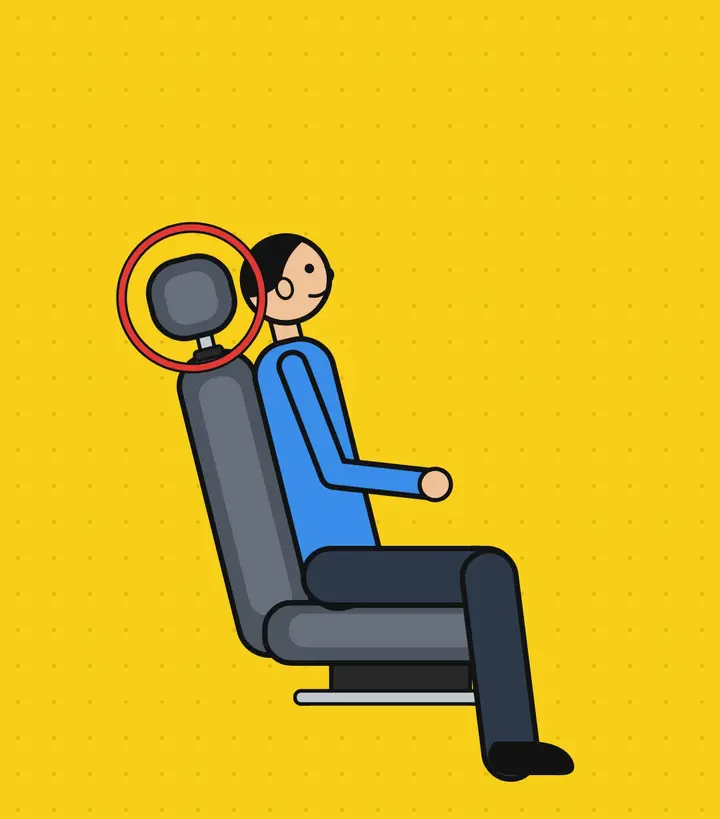
When a car is hit from behind, the seat shoves your torso forward. The U.S. road safety agency, NHTSA, describes what follows: the head "tends to lag behind", the neck bends into an S-shape and then backward, and the head is finally flung forward to catch up, a motion "like the lash of a whip" [2]. The Insurance Institute for Highway Safety (IIHS) gives the cure in one line: "The key to reducing whiplash injury risk is to move the head and torso together." For that, the restraint has to be "high enough and near the back of the head" [8].
The rule turns that into numbers. On a front seat, the top of the restraint must reach at least 800 mm above the seat's hip point in at least one position and never sit below 750 mm, and the gap to the back of the head can't be more than 55 mm [1]. (The hip point, or H-point, is NHTSA's reference for seat measurements, roughly where the hip joint sits [2].)
The injury is common. Working from 1988–1996 crash data, NHTSA estimated that rear impacts caused 272,464 whiplash injuries a year in the United States, costing about $2.7 billion annually [2]. IIHS found injury claim rates 11 percent lower in vehicles whose seats and head restraints it rated good than in those it rated poor [8]. And a restraint only works where you leave it: when NHTSA surveyed 282 vehicles in 1995, about half of the adjustable ones were in their lowest position [2].
So why does it lift out?
NHTSA asked the same thing. When it set out to tighten the standard, it proposed banning front head restraints that could be removed by hand, without tools. Carmakers objected, and their reasons are on the record. A manufacturers' association said hand removal helps rear vision and cargo carrying. Honda said a fixed restraint would rule out the "fully flat seat" in its CR-V. Ford pointed to folding rear seats and to clashes with child restraints. DaimlerChrysler wanted front ones to come off for jobs such as fitting seat covers. Nissan said getting a big seat with a fixed restraint into a small car on the production line "might be an arduous task" [2].
The agency agreed, with a condition. Its worry was that a restraint that comes off too easily gets left off, or put back wrong [2]. So the standard now says: "The head restraint must not be removable without a deliberate action distinct from any act necessary for upward adjustment" [1]. NHTSA's examples were "a special button" or a lever, so that restraints "are not accidentally removed when being adjusted" [2].
The rule also expects you to put it back. Owner's manuals must explain how to remove and reinstall the restraints and warn that they have to be reinstalled [1]. Mazda's CX-5 manual, for one, says to pull the restraint up while pressing a stop-catch, then warns: "Driving with the head restraints not installed is dangerous" [10].
Can a headrest break a car window anyway?
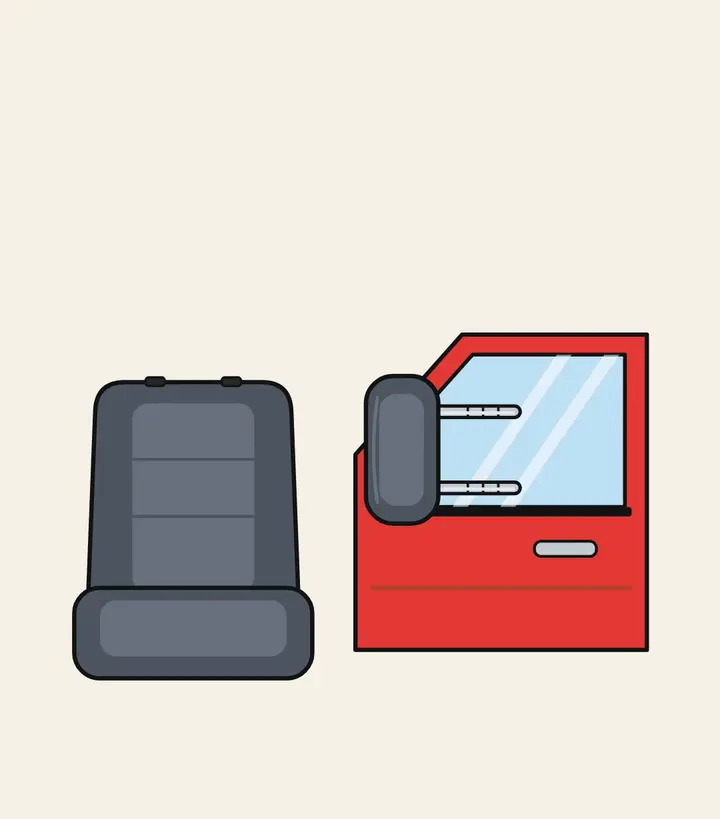
Sometimes, on some windows. That is why the fact-checkers did not throw out the whole claim.
The fullest account of a real test comes from the International Academies of Emergency Dispatch (IAED), which writes the instructions dispatchers give to callers trapped in sinking or burning vehicles. It asked Dr. Gordon Giesbrecht of the University of Manitoba, whose team has submerged several hundred vehicles to test escape methods, to try the headrest [4]. What he found:
- Getting it out eats the clock. Many people have never removed one and don't know how, least of all while sitting in the seat.
- It's the wrong shape. A headrest is light and its rods end in "a very blunt, rounded point". Both are by design.
- Two posts spread the blow. Struck with both rods, the window "fails to break virtually every time". Tilted to use one, the rods "skate" off the glass.
- It can work from outside. With room to swing, the team did break a side window, but "it took a significant number of tries".
IAED's conclusion: a headrest is "a poor choice for a tool to break a vehicle side window" [4].
Truth or Fiction describes a different technique: push one post down between the glass and the door, then pull, so the post works as a lever [11]. IAED's account covers striking the glass and doesn't say whether prying was tested, so these sources don't show how reliably that works from the driver's seat.
Why won't it work on every window?
Because side windows come in two kinds of glass, as AAA's 2019 research report explains [5]:
Tempered glass
Laminated glass
Laminated side glass is spreading because it helps keep people inside the car in a rollover. AAA counted 115 models with it in 2018, up from 69 in 2008 [5]. It is the same kind of glass as the windshield, the pane that is glued in behind a border of black dots.
AAA tried six consumer escape tools on both kinds. Four broke the tempered window. None got through the laminated one: four cracked it, and it stayed in one piece. Afterward a researcher hit that pane several times in the same spot with a ball-peen hammer, and it still could not be pulled from its frame [5].
Giesbrecht's headrest test was on tempered glass [4]. None of these sources tried a headrest on laminated glass, the kind that defeated every purpose-made tool AAA tested.
To find out what your car has, look for the label in a bottom corner of each side window, which should say tempered or laminated. One car can mix the two, for example laminated in front and tempered in the back [6].
What should you keep in the car instead?
A dedicated escape tool, kept somewhere easy to reach after a crash, and one you have tried. AAA suggests testing it on soft wood: it works if the tip leaves a small dent [6]. In its tests all three spring-loaded punches broke tempered glass, while two of the three hammers failed every attempt [5].
Even a good tool is the backup, since none of them broke laminated glass [5]. IAED's instructions start with the window switch, because a sinking car's electrics usually keep working for a while, and with leaving the ignition on so they do. In a burning car, a door that still opens comes first. Its data suggest about a minute to a minute and a half to get out before the odds of surviving become "extremely slim" [4].
IAED also names something already in every car that it says can reliably break a side window: the metal tongue of the seat belt, the part that a small button on the webbing keeps within reach. Pull the belt all the way out, grip the tongue in your fist and strike low on the window, toward its front edge. By IAED's account that works "virtually every time on the first or second try", because a hard object puts the force on a small area at the window's weakest point [4]. IAED doesn't say which glass it means. Its headrest tests were on tempered windows, and laminated glass is what AAA's tools could not break [5].
Where did the headrest come from?
Comfort came first. An early patent, signed by Benjamin Katz in Oakland, California, in February 1921, describes a "headrest for automobile seats and the like" that lets a driver on a long trip rest his head and relax tired neck muscles. It sat on springs so it would give with the head during "the usual jolting of the moving vehicle" [7]. Crash protection is not mentioned.
1921
Benjamin Katz files his headrest patent on 24 February. It is granted on 16 October 1923 [7].1967
A standard for vehicles bought by the U.S. government requires head restraints 700 mm high from 1 October [2].1969
The federal motor vehicle safety standard for head restraints, FMVSS 202, takes effect on 1 January [2].2004
NHTSA publishes the upgraded standard on 14 December, including the rule that removal must be a separate, deliberate action [2].2009
2019
AAA tests six escape tools. None breaks laminated side glass [6].2026
IIHS launches a new whiplash test. Four of the first 18 small SUVs earn a good rating [9].
Sources
- 1.49 CFR 571.202a, Standard No. 202a: Head restraints. U.S. National Highway Traffic Safety Administration, via eCFRPrimary. Accessed October 11, 2026.
- 2.Federal Motor Vehicle Safety Standards; Head Restraints: Final rule, 69 FR 74848 (December 14, 2004). U.S. National Highway Traffic Safety Administration, via the Federal RegisterPrimary. Accessed October 11, 2026.
- 3.Were Car Headrests Designed as Emergency Escape Tools?. Snopes (Dan Evon). Accessed October 11, 2026.
- 4.Vehicle Escape (Ask Doc, July 19, 2023). Journal of Emergency Dispatch, International Academies of Emergency Dispatch. Accessed October 11, 2026.
- 5.Vehicle Escape Tool Evaluation (research report, July 2019, PDF). American Automobile Association (AAA). Accessed October 11, 2026.
- 6.AAA: Vehicle Escape Tools are a Lifesaver – in the Right Situation. AAA Newsroom. Accessed October 11, 2026.
- 7.US Patent 1,471,168: Headrest for automobile seats and the like (Benjamin Katz, filed 1921). United States Patent Office, via Google PatentsPrimary. Accessed October 11, 2026.
- 8.Good head restraints reduce injuries by 11 percent. Insurance Institute for Highway Safety (IIHS). Accessed October 11, 2026.
- 9.IIHS launches new whiplash prevention test. Insurance Institute for Highway Safety (IIHS). Accessed October 11, 2026.
- 10.Mazda CX-5 Owner's Manual: Head Restraints, Removal/Installation. Mazda Motor CorporationPrimary. Accessed October 11, 2026.
- 11.Car Headrests Were Designed to Break Car Windows: Truth! & Fiction!. Truth or Fiction?. Accessed October 11, 2026.
Last verified: . Spotted an error? See our editorial policy and corrections.
Video transcript
Everyone thinks your headrest is a window breaker. It isn't. You've seen the videos: pull out the headrest, jam the metal posts into the side window, escape. Sounds clever. But car makers never designed it for that, and fact-checkers call it a myth. A headrest has one real job: stopping your head from snapping back in a crash. That's whiplash. It comes off so it can be adjusted and replaced. So keep a real window breaker in your car. Because right now,


