
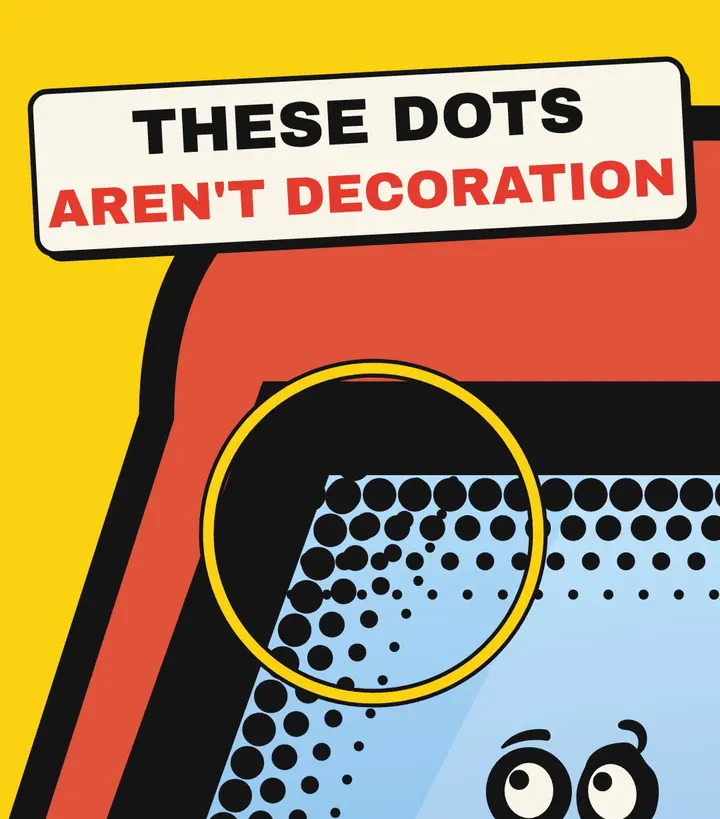
Why do windshields have black dots?
Short answer
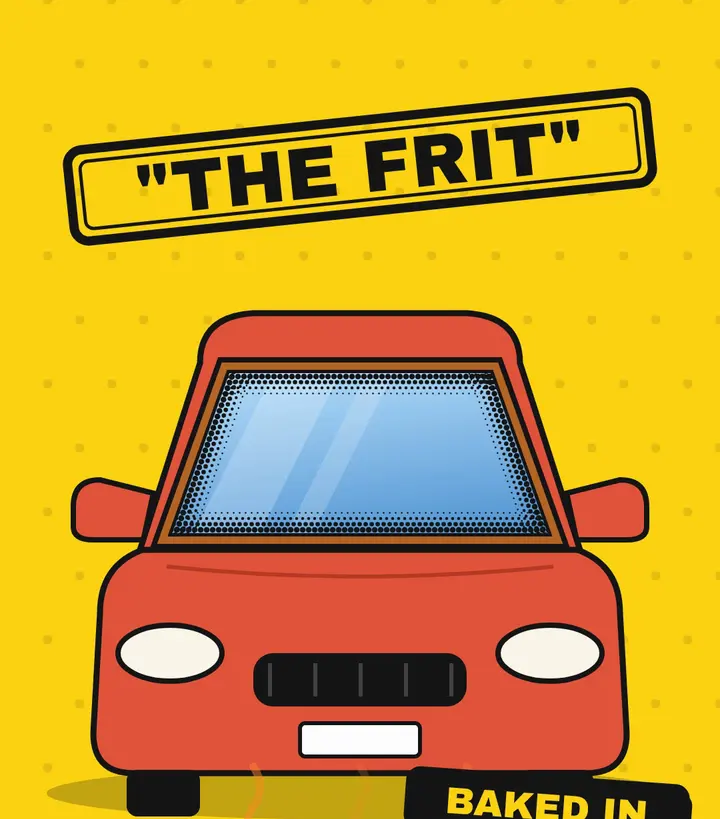
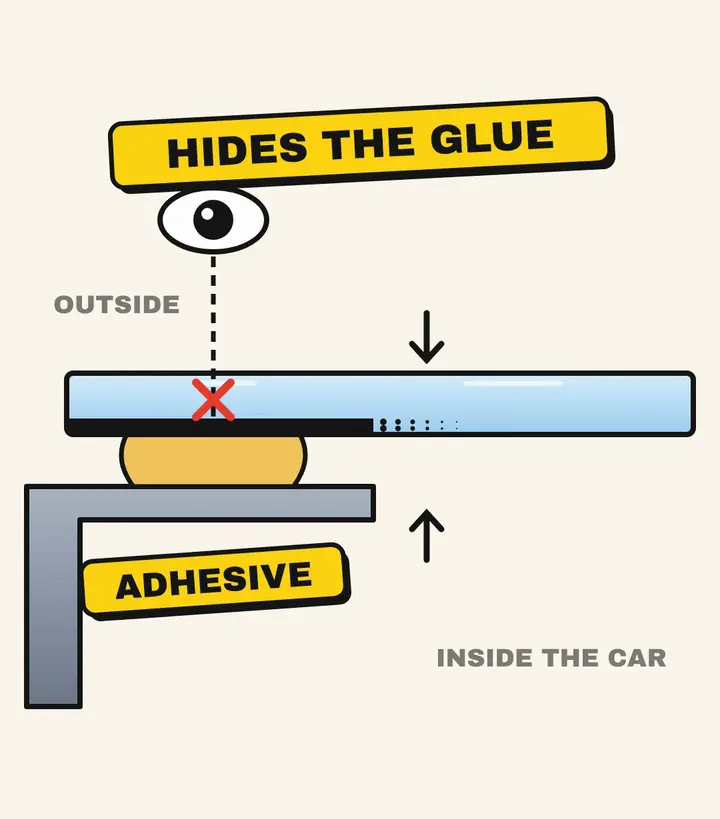
The black dots are the edge of the frit, a black ceramic enamel fused onto the windshield when it is heated and bent. The solid band hides the polyurethane glue holding the glass in and shields it from UV light. The shrinking dots soften the jump from black to clear, so the hotter band doesn't distort the glass.
Published · Last verified · 7 sources
Those dots are the ragged inner edge of the frit, a black ceramic enamel printed around the windshield and fused to it in the furnace that bends the glass. The solid part of the band hides the polyurethane adhesive that holds the windshield in the car and shields it from sunlight. The dots, which shrink toward the middle, soften the line where black meets clear, so the hotter band doesn't leave a strip of distorted glass along its edge [1].
What is the black band made of?
It looks like paint, but it is closer to glass. A 2017 windshield patent assigned to AGP America describes black enamel frit as "pigments, a carrier, binders and finely ground glass." It is screen printed or inkjet printed onto the flat glass before heating and bending. In the furnace, the ground glass softens and fuses with the surface of the windshield, which the industry calls "firing." The patent compares it to the enamel on bathroom fixtures and appliances [1].
The heat involved is serious. A Johnson Matthey patent on obscuration enamels puts the step where automotive glass is "fired and bent" at about 600 °C to 740 °C [2]. That is why a glass specialist at Pilkington told Jalopnik the band is "essentially impossible to scrape off" [6]: once fired, it is part of the glass surface.
Why does the glue need hiding and shading?
Modern windshields are bonded to the body with a bead of polyurethane. According to AGP's patent, black frit bands became commonplace in the 1980s, when the industry dropped rubber "H channel" gaskets and butyl adhesive strips. Windshields mounted the old way "were often dislodged on impact allowing the occupants to be ejected from the vehicle" [1].
Keeping the glass in place is also the law in the US. Federal safety standard FMVSS 212 exists to retain the windshield in a crash, "preventing the ejection of occupants from the vehicle." In a frontal barrier crash at up to 48 km/h, a vehicle with passive restraints such as airbags must keep at least 50% of the windshield's edge attached on each side of the centerline. One without them must keep 75% [4].
Polyurethane brought two new problems. To be strong enough, the bead had to be far wider than the old butyl strip, at least 19 mm, which is too wide to hide behind a trim strip. And it breaks down in ultraviolet light. The black band was the answer to both: it was added "to obscure the view of the polyurethane and to protect the polyurethane by blocking the UV" [1].
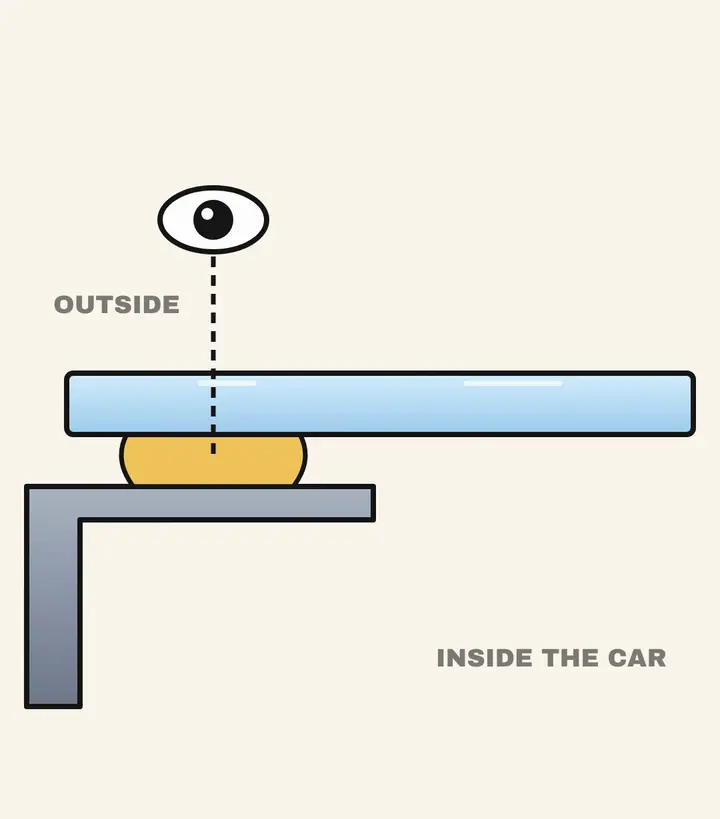
Johnson Matthey's patent is just as direct: without the enamel, the adhesive "can degrade with exposure to the sun thereby compromising the integrity of the bond" [2]. Vibrantz, which makes these enamels, lists "good opacity for obscuration" and "protection for adhesives against UV degradation" among the jobs of its automotive glass enamels [3]. The Pilkington specialist added one more: the fired enamel gives the adhesive "a rougher surface" to stick to [6].
Why does the band fade into dots?
Black absorbs heat. In the bending furnace, AGP's patent explains, the painted area "tends to run hotter than the adjacent clear areas," and the sudden temperature step from black to clear "results in optical distortion along the inner edge of the black band." The industry calls this flaw the "burn line" [1].
The standard fix is what the patent calls a dot fadeout: "Starting at the inner solid edge of the black paint, rows of increasingly smaller dots are painted on the glass. This is the same principle as used in grayscale printing." Thinning the black out gradually spreads the temperature change over a wider strip of glass, and the dots also help hide whatever distortion is left [1]. It is a halftone, the same trick a newspaper uses to print grey with only black ink.
There are limits to how fine the fade can be. Screen printing reaches about 200 dpi at best, and the smallest practical printed dot is around 0.3 to 0.5 mm, so the patent calls the usual fadeout "a low resolution grayscale." A wider fade isn't always an option either: it "may not be allowed depending upon the size of the opening and the regulatory requirements for driver vision" [1].
The dots have a cosmetic job too. A smooth gradient makes the band less noticeable from outside, and that was the first explanation Jalopnik got from Pilkington. The heat reason came later, from a Pittsburgh Glass Works engineer who got in touch after the article was published [6].
What about the dots behind the rearview mirror?
Many windshields have a second patch of dots hanging down from the top edge around the mirror. Jalopnik calls it the "third visor frit": it covers the gap between the two sun visors, where the sun can still get in [6].
The name makes sense once you see the patent. Mercedes-Benz was granted a US patent in 1994 for a dot pattern on the windshield "as a replacement for a swivellable third sun visor," a small hinged shade above the mirror. The patent notes that a real third shade could never close the gaps around the mirror and visors, and that folding it down made high-mounted road signs and traffic lights harder to see. Its printed version uses dots sized and spaced so that only about 10% of the patterned area stays see-through [5].
On newer cars that area is often a larger, mostly solid black patch, because it also hides the brackets and wiring for cameras, rain sensors and light sensors [7]. AGP's patent calls this an "equipment obscuration" and names the infrared rain sensor as one of the first devices to crowd into that spot, once "the province of just the rear-view mirror" [1]. Like the tiny hole in an airplane window, it is a detail in the glass that does a real job while most people look straight past it.
Sources
- 1.US Patent 9,623,634 B2: Obscuration Having Superior Strength and Optical Quality for a Laminated Automotive Windshield. AGP America S.A., via Google PatentsPrimary. Accessed October 8, 2026.
- 2.US Patent 7,560,401 B2: Frits and Obscuration Enamels for Automotive Applications. Johnson Matthey PLC, via Google PatentsPrimary. Accessed October 8, 2026.
- 3.Automotive Glass. Vibrantz TechnologiesPrimary. Accessed October 8, 2026.
- 4.49 CFR 571.212, Standard No. 212: Windshield Mounting (PDF). U.S. National Highway Traffic Safety Administration, via GovInfoPrimary. Accessed October 8, 2026.
- 5.US Patent 5,284,376 A: Motor Vehicle Windscreen Having Strip-Shaped Opaque Dot Pattern. Mercedes-Benz AG, via Google PatentsPrimary. Accessed October 8, 2026.
- 6.Here's What Those Black Dots at the Edge of Your Windshield Actually Do. Jalopnik. Accessed October 8, 2026.
- 7.Why Cars Have Tiny Black Dots Around the Windshield. Motor1. Accessed October 8, 2026.
Last verified: . Spotted an error? See our editorial policy and corrections.
Video transcript
Those black dots on your windshield aren't decoration. They're part of a ceramic band called the frit, baked right into the glass. The solid black edge hides the glue that holds your windshield in place. And it blocks UV light, which would slowly break that glue down. The dots fade the black band into clear glass, so it heats more evenly when the windshield is made. That helps prevent distortion at the edge. So next time you're stuck in traffic, look at those black dots on your windshield.


