
Why do car doors have holes in the bottom?
Short answer
The holes or slots along the bottom edge of a car door are drains. Window seals can't stop all the water, so rain and car-wash water runs down inside the hollow door, and the holes let it out. If dirt blocks them, water pools inside, where it can slosh, soak the trim and rust the door from within.
Published · Last verified · 10 sources
Playing loads the video from YouTube (Google), which may set cookies. Cookie policy
 Also in the long video · 4:09Your Car Is Full of Hidden Features. Here's What They Actually Do
They are drains. A car door is a hollow shell with a slot in the top for the glass, and the seals on that slot don't keep all the water out, so the door is built to take water in at the top and let it go at the bottom. Carmakers put this in the owner's manual. Mazda's manual for the 2022 CX-5 says: "The lower edges of doors, rocker panels, and frame members have drain holes that should not be clogged. Water trapped there will cause rusting" [1]. A Kia manual says almost the same [2].
How does water get inside a car door?

Through the gap the window moves in. A General Motors patent filed in 1956 describes the door as an inner and an outer panel joined along the sides and bottom to form a "door well", which holds the lock, the window regulator and the glass itself when the window is down. The opening at the top is "partially sealed by the usual weather strips" pressing on both faces of the glass, and yet, the patent admits, "it is still possible for water to pass into the door well" [3].
A Nissan patent from the 1980s names the two occasions: rain, and washing the car [4]. Hagerty's maintenance guide adds that water sneaks in "particularly at each end or when the seals are old", and that condensation forms inside the door as well [10].
Where does the water go?
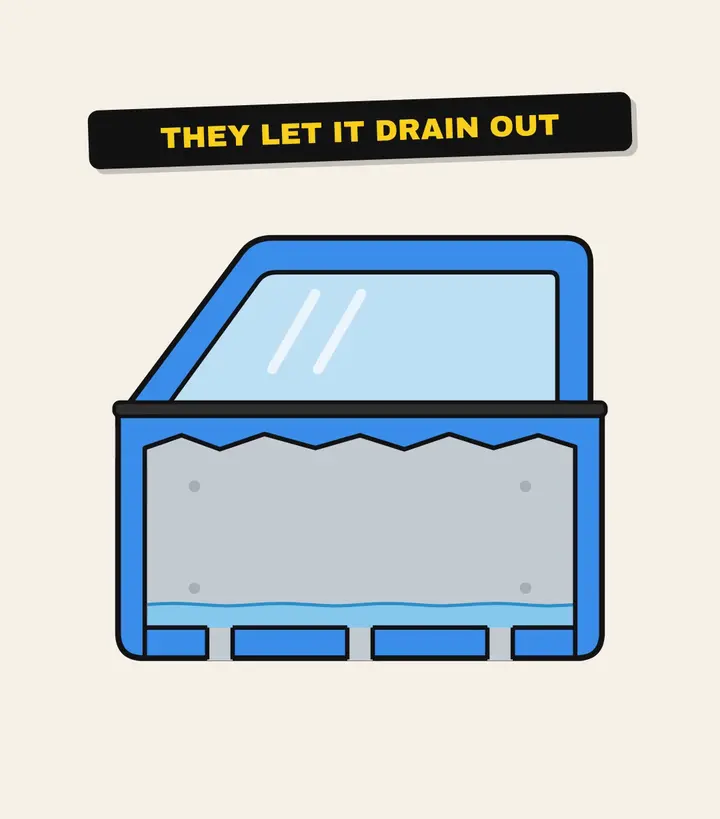
To the lowest point of the door. In GM's drawing, the floor of the door well slopes toward a channel next to the outer skin, and "a number of spaced openings" in that channel let the water fall out [3].
How many holes, and what shape, depends on the car. The typical door in a Ford patent has two drain slots [5]. The 2019–2022 Toyota RAV4 has three holes in each door, hidden behind a weatherstrip molding that runs along the bottom [7]. Hagerty lists the range: cowled holes, holes with fittings on them, holes behind the rubber weather seal, or "plain old holes" [10]. If you can't find yours, look behind the rubber strip on the door's lower edge.
The water also has to be kept away from the cabin side. The inner panel has access openings, needed to fit the lock and window mechanism, and water in the well can splash through them. GM's 1956 answer was a water-resistant paper liner taped over the inner panel, under the trim [3]. Nissan called that layer a sealing screen [4]. A 2016 GM bulletin calls the equivalent part a water deflector, and says that when it isn't sealed properly, water gets past it and the customer finds wet carpet in the footwell [8].
Why not just make the holes bigger?
Once the car is painted, Ford's engineers wrote, those large slots are "not desirable" [5]. A hole that lets water out lets other things in.
What goes out
What comes in
So the holes are often covered without being sealed. Ford's patent, granted in 1999, is for a snap-in plastic plug that sits over the slot on small feet "approximately one-half millimeter" high, leaving a gap for water to seep through. The slots, it says, must "be substantially covered without providing a seal" [5]. A Hyundai patent from 2002 goes after the noise: road and wind noise come up through the drain holes and on into the cabin, so it fits each hole with a ribbed insert that holds water between its ribs by capillary action. The held water blocks the noise, and the excess drips out underneath [6].
What happens when the holes clog?

You may hear it. In 2021 Toyota issued a service bulletin about RAV4s with a "sloshing or splashing noise" inside the doors when driving, braking, or opening and closing a door. The cause it gives is "cavity wax/debris/substance" blocking the drain holes, and its photos show a "wax-type substance" sitting in them [7].
The trim gets wet. GM wrote in 1956 that drain openings "often become clogged by debris", and that the water left behind can splash out through the access openings whenever the door or the car moves, spoiling the trim panel [3].
The door rusts. Cars.com describes rust forming at the bottoms of the doors, or "rusty trails running across a rocker panel", the body panel below the doors. It blames dirt, gravel and road debris, especially on cars that are rarely washed, and warns that aftermarket rustproofing "can clog drainage holes if applied improperly" [9]. Hagerty's advice is to look at the underside of the door: paint bubbles there are "a telling sign that rotting is in progress" [10].
How do you clear them?
Cars.com suggests getting down on your hands and knees, checking each drain, and poking it out with "a coat hanger, screwdriver or similar object", without scratching the paint around the hole, since the paint is what protects the metal. It recommends doing this whenever you wax the car, or at least once a year, for example after the autumn leaves have come down [9]. Hagerty prefers strimmer cord, the plastic line from a garden trimmer: "It's plastic so won't do any damage but fairly stiff" [10].
Water works too. A high-pressure car wash or a well-aimed hose clears some drains [9], and high pressure water is what Toyota tells its technicians to use. They also cut a notch 20 mm long and 10 mm high in the molding's inner lip, lined up with a drain hole, "to prevent debris buildup in the future". The final check is simple: pour water in at the base of the window and watch it run out of the bottom of the door [7].
Are doors the only part of a car with drains?
No. Mazda's sentence about drain holes covers rocker panels and frame members too [1], and Cars.com adds the rear quarter panels [9]. Hagerty goes around the whole car: drains below the windshield on each side, drain holes around a sunroof with tubes that carry the water away, and drainage points around the trunk lid seal [10].
The thinking is the same each time, and it's the same as the tiny hole in the bottom of a padlock: assume water will get in, and give it a way out.
How long have car doors had drain holes?
We couldn't find a source that says who first put a drain in a car door. By the 1950s they were routine: GM's 1956 patent says drain openings "are usually provided" [3].
1956
General Motors files a patent that takes door drain openings for granted and adds a water-resistant liner behind the trim. It is granted in 1959 [3].1984
Nissan is granted a patent for a door trim panel shaped to shed water on its own, so the separate sealing screen can be left out [4].1999
Ford is granted a patent for a snap-in plug that covers a drain slot and still lets it drain [5].2002
Hyundai is granted a patent for a drain-hole insert meant to keep road and wind noise out [6].
Sources
- 1.Mazda CX-5 2022 Owner's Manual: Appearance Care (Underbody Maintenance). Mazda North American OperationsPrimary. Accessed October 11, 2026.
- 2.Kia Owner's Manual (2024, U.S. edition): Underbody maintenance. Kia CorporationPrimary. Accessed October 11, 2026.
- 3.US Patent 2,867,473: Vehicle body panel sealing means (Frank M. Gibson, filed 1956, granted 1959). General Motors Corporation, via Google PatentsPrimary. Accessed October 11, 2026.
- 4.US Patent 4,445,721: Draining mechanism for automotive door (filed 1981, granted 1984). Nissan Motor Co. and Kato Hatsujo, via Google PatentsPrimary. Accessed October 11, 2026.
- 5.US Patent 5,873,623: Vehicle door drain slot plug (filed 1996, granted 1999). Ford Global Technologies, via Google PatentsPrimary. Accessed October 11, 2026.
- 6.US Patent 6,450,563: Noise shut-off device for doors of automotive vehicle (filed 2000, granted 2002). Hyundai Motor Company, via Google PatentsPrimary. Accessed October 11, 2026.
- 7.Technical Service Bulletin T-SB-0084-21 Rev1: Sloshing or Splashing Noise From Inside One or More Door Panels (PDF). Toyota Motor Sales, USA, filed with the U.S. National Highway Traffic Safety AdministrationPrimary. Accessed October 11, 2026.
- 8.Bulletin PI0916D: Floor/Carpet Wet at Front Passenger Side Under Dash, or at Any Front/Rear Footwell Area (PDF). General Motors, filed with the U.S. National Highway Traffic Safety AdministrationPrimary. Accessed October 11, 2026.
- 9.Why Do I Need to Check the Drain Holes in My Doors? (2018), archived copy. Cars.com (Rick Popely), via the Internet Archive. Accessed October 11, 2026.
- 10.Socket Set: How to clear drainage channels and stop your car leaking and rusting (2021). Hagerty UK (Jesse Crosse). Accessed October 11, 2026.
Last verified: . Spotted an error? See our editorial policy and corrections.
Video transcript
If these holes under your car door get clogged, your door rusts from the inside. They're there on purpose. Here's why. Your door isn't sealed. Every time it rains, or you go through a car wash, water slips past the window seals and runs down inside the door. Those holes let it drain out. But dirt and leaves can block them. Then the water stays trapped, and the rust starts where you can't see it. So once in a while, poke them clear. Because


