
Why do padlocks have a tiny hole at the bottom?
Short answer
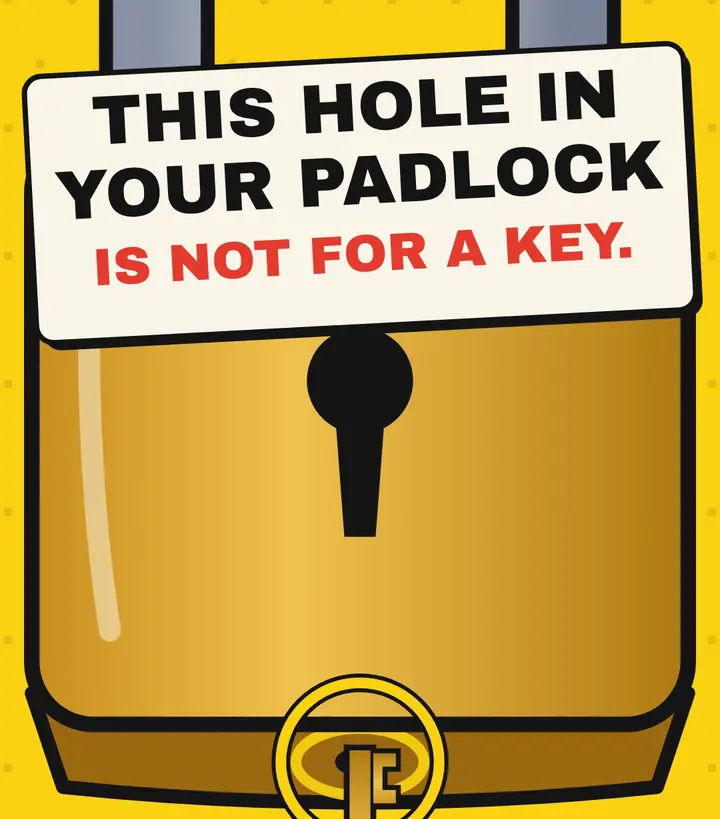
The tiny hole at the bottom of a padlock is a drain. Rain gets in around the shackle and through the keyhole, and the hole lets that water, and grit with it, run out instead of pooling inside, where it can rust the parts or freeze and jam the lock. It is not a keyhole and opens nothing.
Published · Last verified · 10 sources
The little hole on the underside of a padlock is a drain. A padlock usually hangs with its shackle pointing up, so rain that gets into the body runs down, and the hole at the bottom gives it a way out. One padlock patent spells out the job in a single line: a "drain passage communicated with the lower end of the long shackle hole for the drainage of rainwater" [1]. Water that leaves the lock can't rust it or freeze inside it.
How does water get inside a padlock?
A padlock body isn't a sealed box. It has a keyway on the front and two holes on top where the legs of the shackle go in. A 1991 patent for a weatherproof lock cover names both entry points: "Water that invades the lock through the keyhole or through the shackle interface with a padlock body, can freeze within the lock, rendering it virtually useless until the water has thawed" [2].
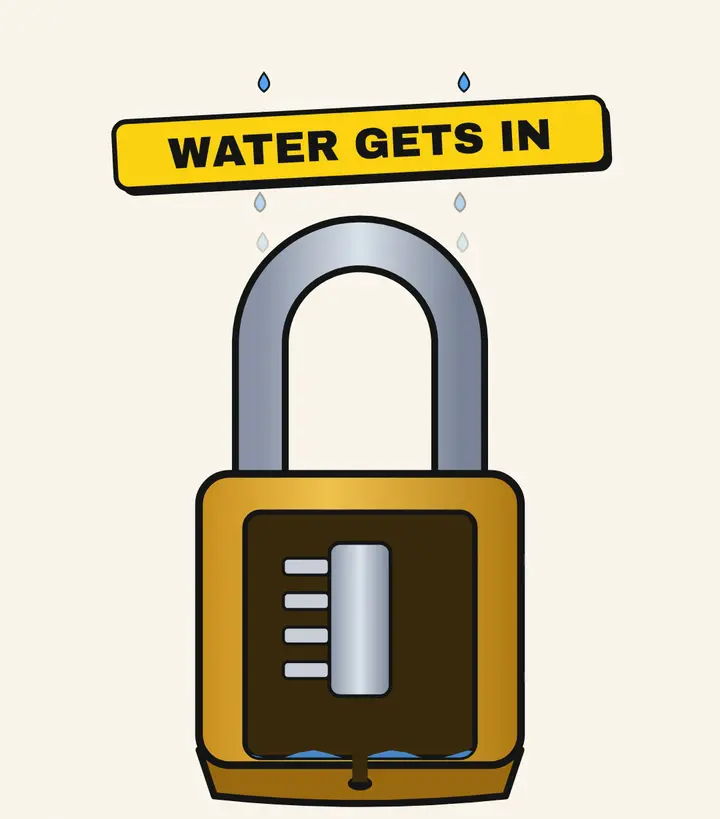
The shackle holes are where water tends to collect. On many padlocks the two legs of the shackle differ in length, so the body has a short shackle hole and a long, deep one with a dead end at the bottom [1]. Patent designs put the drain right there. US 4,838,051 (1989) connects its drain passage to "the lower end of the long shackle hole" [1]. US 5,174,136 (1992) describes "a drain aperture … bored from the bottom of the deep shackle bore … to the outside of the body," and says it "provides an outlet for debris and liquids to exit the body" [3].
That last word matters. Dirt is the other enemy. Master Lock says that over time "dust, particles and chemicals in the air settle on and in the lock" and create friction in the parts that do the locking [4]. A hole at the lowest point lets some of that wash out with the water.
What happens to water that stays inside?
In cold weather, it freezes. A 2012 patent for a battery-heated padlock starts from exactly this problem: "moisture that has accumulated around internal components of a lock has a tendency to become frozen, thereby preventing the lock from being opened" [5]. Even with heaters, that design still has three drain holes, running from both shackle shafts and the key sleeve down to the bottom of the body, so the melted ice can drain away [5].
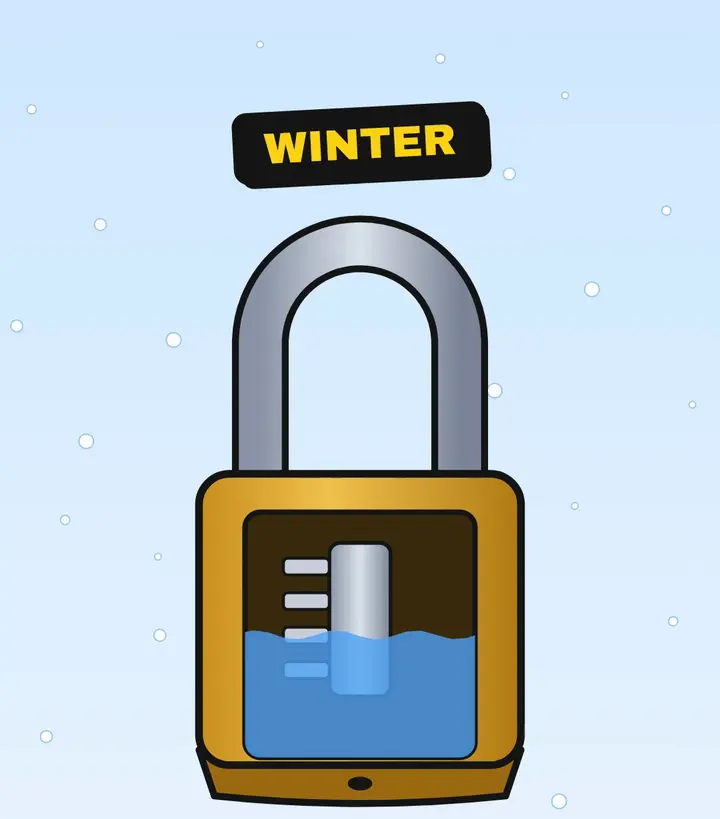
In any weather, it corrodes. The padlock maker Squire calls water "a lock's worst enemy" and warns that once moisture is inside an unprotected lock, it "can quickly cause some corrosion. This will make it difficult to open and close, or even prevent it from locking at all" [6]. Locks built for salt spray name the feature outright: Viro lists an "internal boring and discharge hole created to avoid moisture stagnation" on its Marine padlocks [7].
Small holes in sealed-looking objects often do a different job from the one people guess. The tiny hole in an airplane window is there for pressure, not drainage, and its manufacturers say it actually lets humid cabin air into the gap between the panes.
How do weatherproof padlocks handle water?
Most combine three approaches. They keep water out, use metals that resist it, and still let it drain.
- Covers and caps. Burg-Wächter's Splash 470 has its aluminium body and shackle wrapped in a plastic jacket, and "a plastic cap protects the keyhole from penetrating moisture" [9]. Master Lock's covers for its safety padlocks seal both the shackle and the keyway [8].
- Corrosion-resistant metals. Viro's Marine range pairs a nickel- and chrome-plated solid brass body with a stainless steel shackle [7].
- A drain anyway. The same Marine padlocks keep their discharge hole [7], and the sealed Master Lock covers have their own drain holes [8].
Should you put lubricant in the hole?
The video suggests the hole is a handy place to add lubricant. None of the manufacturer instructions we found mention the bottom hole at all. Here is what they do say:
- Master Lock: blow dust out of the keyway and shackle openings with compressed air, then "lubricate both the keyway and the shackle." Use a very light spray or a few drops, "allow lubricant to drain deep into the lock," and tap the lock on a table to spread it and loosen frozen or sticking parts. Do this every 3 to 6 months, or every three months in extremely dusty or corrosive places. Regular lubrication "will also help minimize freezing in cold weather environments" [4].
- Burg-Wächter: maintain the lock roughly every six months. Let the lubricant run into the lock, then lay the lock on its side and turn it over after a minute or so to spread it inside [10].
- Squire: with Teflon-based (PTFE) lubricants, treat locks every 1 to 3 months, and twice a month during heavy rain or freezing weather [6].

Can the hole be used to open the lock?
Sources
- 1.US Patent 4,838,051: Padlock and Key Assembly with Transversely Movable Tumbler Units and Vertically Movable Tumbler Units. U.S. Patent Office, via Google PatentsPrimary. Accessed October 8, 2026.
- 2.US Patent 5,003,795: Lock Protector. U.S. Patent Office, via Google PatentsPrimary. Accessed October 8, 2026.
- 3.US Patent 5,174,136: Dual Function Padlock with Removable Cylinder Mechanism. U.S. Patent Office, via Google PatentsPrimary. Accessed October 8, 2026.
- 4.Care & Service of Master Lock Padlocks. Master Lock CompanyPrimary. Accessed October 8, 2026.
- 5.US Patent 8,253,070: Heated Lock Devices. U.S. Patent Office, via Google PatentsPrimary. Accessed October 8, 2026.
- 6.Lock Maintenance & How to Lubricate Locks. SquirePrimary. Accessed October 8, 2026.
- 7.MARINE Padlocks. ViroPrimary. Accessed October 8, 2026.
- 8.Cover: S30COVERS (technical literature). Master Lock CompanyPrimary. Accessed October 8, 2026.
- 9.Splash 470 45 Padlock. Burg-WächterPrimary. Accessed October 8, 2026.
- 10.Maintaining Your Padlocks. Burg-Wächter UKPrimary. Accessed October 8, 2026.
Last verified: . Spotted an error? See our editorial policy and corrections.
Video transcript
This hole in your padlock is not for a key. Padlocks often live outside, in the rain. Water gets inside, and that hole lets it drain out. In winter, trapped water could freeze and jam the lock. It's also the perfect spot for a drop of lubricant. It's a drain. So no matter what anyone tells you,


