
What do the squares on toothpaste tubes mean?
Short answer
The small square at the sealed end of a toothpaste tube is an eye mark, a printed target for a light sensor on the production line. The filling machine uses it to line the tube up before sealing and trimming it. It says nothing about the ingredients. Its color just needs to stand out from the background.
Published · Last verified · 9 sources
The little square on the flat, sealed end of a toothpaste tube is an eye mark: a printed spot that an optical sensor on the filling line looks for, so the machine knows how the tube is turned before it closes it. Colgate puts it plainly: "the toothpaste color-coding system simply doesn't exist," and the squares are there to tell "light sensors where the end of the tube is so that it can be cut and sealed properly" [1]. The classic eye mark isn't green at all. A patent filing on tube manufacturing describes them as "typically opaque, visible, black marks" [4], which is the one color the viral chart files under "pure chemical."
Where did the toothpaste color code come from?
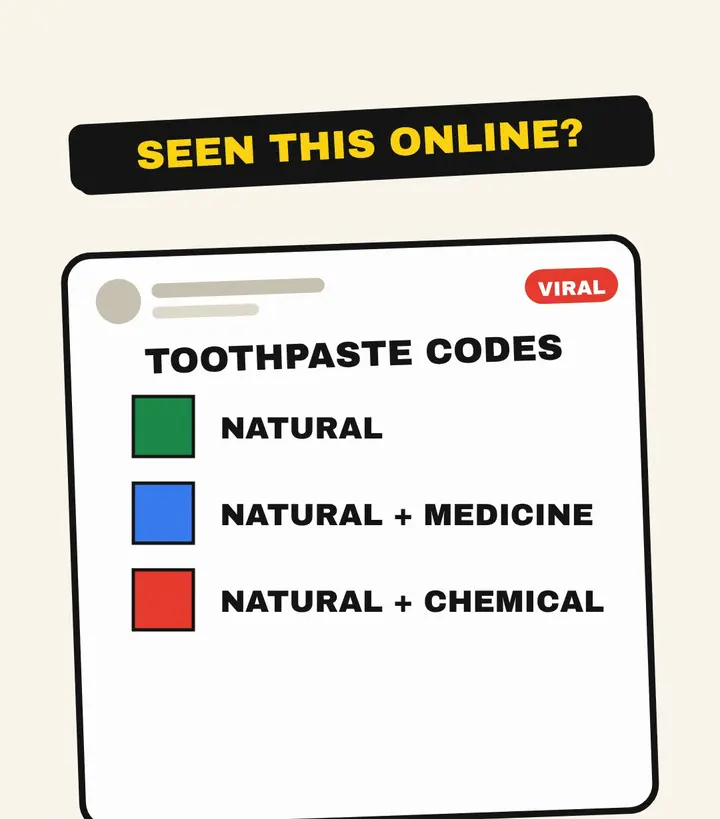
The rumor is a chain message. Snopes rated it false in July 2013 and quoted the version going around: "Pay attention when buying toothpaste, at the bottom of the toothpaste tube there is a color bar," followed by a four-color key and "please share to all" [2]. Colgate's own page repeats the same key in order to debunk it [1].
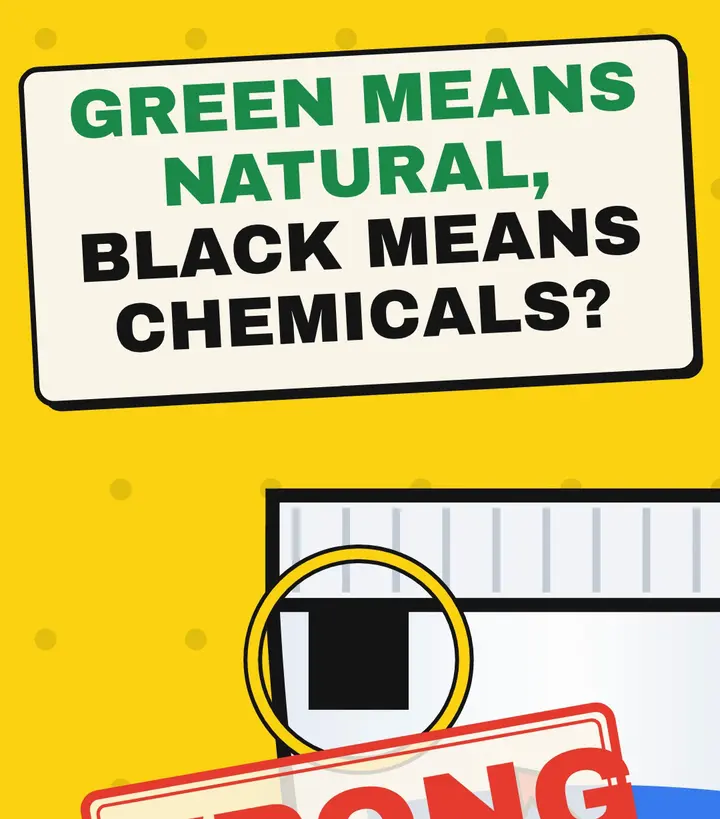
What the chart says
What the square actually does
What exactly is an eye mark?
In packaging, an eye mark is "a small rectangular printing area usually located near the edge of a web," used to trigger "an automatic electronic position regulator" during manufacturing [4]. A web is the long continuous sheet of material, such as printed film or laminate, that runs through a machine before it is cut into individual packages. The same patent filing separates an eye mark from a printer's registration mark, the small crosshairs used to line up the colors of a print job [4]. Sensor and machine makers often call the packaging marks registration marks anyway [6] [7].
On a toothpaste tube, the mark is printed on the end that will be sealed, typically at the center of the seal on the back panel [4]. That is why you only ever see it on the flat crimp, never on the front of the tube.
How does the filling machine use the mark?
Toothpaste tubes reach the filler already printed, closed at the nozzle end and open at the other, and they are filled through that open end [4]. A 1993 patent for an automatic tube filler lays out the sequence: load each empty tube upside down with its open end facing up, orient it, reject any tube that couldn't be oriented, clean it, fill it, then seal, trim and eject it [5].
The orienting step is where the eye mark earns its place. A motor spins the tube in its holder while an electronic eye watches for the mark. When the eye sees it, the spinning stops. If the mark doesn't turn up within a set time, the machine flags that tube and a later station throws it out [5]. The invisible-eyemark filing describes the same thing from the tube's side: the machine "rotates the tube to place the eyemark at a predetermined location in the area to be sealed, and subsequently seals the tube" [4].
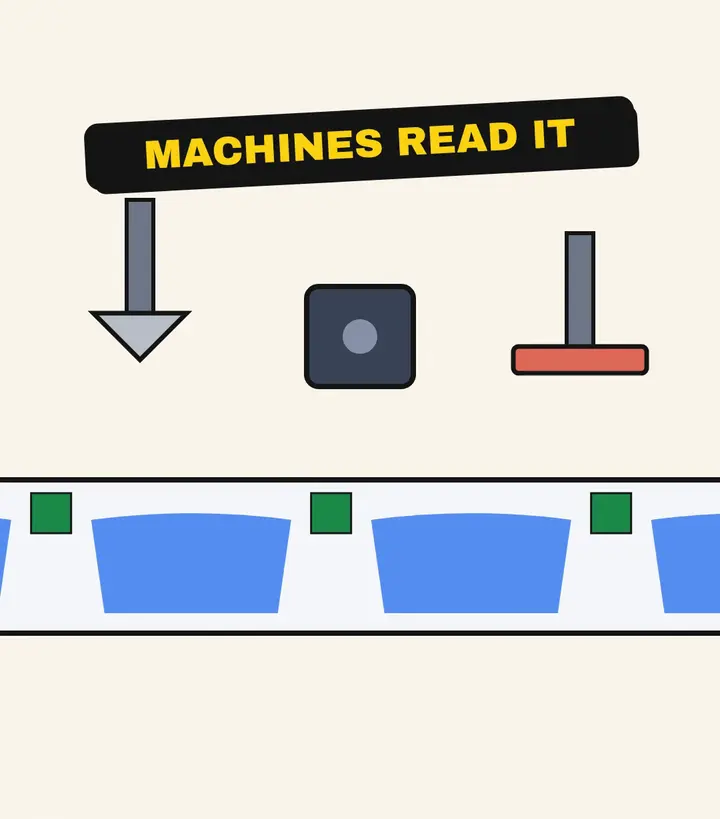
Why go to that trouble? Because the seal is a flat line, and it has to land in the same place relative to the artwork on every tube. A 1967 Colgate-Palmolive patent says exact alignment "is mandatory in order that the containers can be sealed with a great degree of accuracy and uniformity allowing for proper location of the logo as is necessary for a branded, well-known commodity" [3]. Without the mark, the crimp would land at whatever angle the tube happened to be sitting in its holder.
Why aren't the squares all the same color?
Because the sensor doesn't care about color as such. It cares about contrast. Banner Engineering, which makes these sensors, explains that a color mark sensor detects "a grayscale change": it "distinguishes the target color based on how it contrasts with the background color" [6]. Its RGB model checks the mark with red, green and blue light and keeps whichever gives "the best contrast between the registration mark and the background," which lets it read "virtually any registration mark/background combination" [6].
So black on a white tube is the textbook case, but a dark green or blue square works just as well if it stands out from the print around it. Packaging machine maker Viking Masek describes how operators teach a sensor what to look for: hold the mark under it and press a button, then show it the plain background and press again [7]. When reading fails, the usual suspects are a dirty lens, a badly placed sensor, film that is too shiny, or "the color contrast between the eye mark and the background is not strong enough" [7].
Where else do eye marks show up?
Almost anywhere a package is made from a printed roll. Banner says registration marks "are used for position control and to coordinate the separation and cutting of webs of packaging material" [6]. On machines that form, fill and seal bags from a roll of film, Viking Masek says the marks sit along the edge of the film, "provide contrast against the film's background color," and "primarily tell the packaging machine where to cut the bags." They also keep the film in position and tell the machine how long each bag is [7].
Like the arrow next to your fuel gauge, it's a mark most people never notice that carries one specific instruction. The only difference is that this one was printed for a machine to read, not for you.
How do you find out what's actually in your toothpaste?
Read the label, not the crimp. Colgate says the ingredients are usually printed on the tube itself or on the box [1]. In the United States, a fluoride toothpaste that also claims to freshen breath and clean teeth counts as both a cosmetic and a drug. The FDA gives "fluoride in toothpaste" as its example of an ingredient that makes a product a drug [8]. That's why many tubes carry a Drug Facts panel. It lists the active ingredient, the substance that has the intended effect, with its amount and purpose, and then the inactive ingredients, "such as binders, colors or flavorings" [9]. Everything the color code claims to reveal is already on the box, in writing.
Sources
- 1.What Is a Toothpaste Color Code?. Colgate-Palmolive (Colgate Oral Care Center)Primary. Accessed October 8, 2026.
- 2.Do Color Codes on Toothpaste Tubes Identify Their Ingredients?. Snopes (David Mikkelson). Accessed October 8, 2026.
- 3.US Patent 3,522,432: Scanning Apparatus for Registration Marks Using Ultra-Violet Light. U.S. Patent Office (assigned to Colgate-Palmolive Co.), via Google PatentsPrimary. Accessed October 8, 2026.
- 4.US Patent Application 2007/0085026: Invisible Eyemark and Method for Orienting Squeeze Tube. U.S. Patent and Trademark Office, via Google PatentsPrimary. Accessed October 8, 2026.
- 5.US Patent 5,209,044: Automatic Tube Filling Device and Process. U.S. Patent and Trademark Office, via Google PatentsPrimary. Accessed October 8, 2026.
- 6.Registration Mark Detection: Why Use a Color Mark Sensor with RGB Technology. Banner EngineeringPrimary. Accessed October 8, 2026.
- 7.VFFS Machine Maintenance: How to Set Up Film Registration & Photo-Eye Sensor. Viking MasekPrimary. Accessed October 8, 2026.
- 8.Is It a Cosmetic, a Drug, or Both? (Or Is It Soap?). U.S. Food and Drug AdministrationPrimary. Accessed October 8, 2026.
- 9.The Over-the-Counter Drug Facts Label. U.S. Food and Drug AdministrationPrimary. Accessed October 8, 2026.
Last verified: . Spotted an error? See our editorial policy and corrections.
Video transcript
Green means natural, black means chemicals? Wrong. You've probably seen this toothpaste color code online. It's a myth. That colored square is called an eye mark. Machines read it with a light sensor to know exactly where to cut and seal the tube. The color just has to contrast with the packaging. So next time someone tells you:


