
What does the arrow next to the fuel gauge mean?
Short answer
The small arrow or triangle beside the fuel pump icon points to the side of the car where the fuel door is. If it points left, the filler is on the left; if it points right, it is on the right. Ignore which side the pump's hose is drawn on: only the arrow is meant to show the side.
Published · Last verified · 8 sources
That little triangle next to the fuel pump symbol is a fuel door indicator. It points toward the side of the car where you fill up. Carmakers spell this out in their manuals: Mazda writes that "the direction of the arrow indicates that the fuel-filler flap is on the left side of the vehicle" [1], and Nissan's manual for the 2024 X-Trail says "the arrow indicates the fuel-filler lid is located on the right side of the vehicle" [2].
How do you read it?
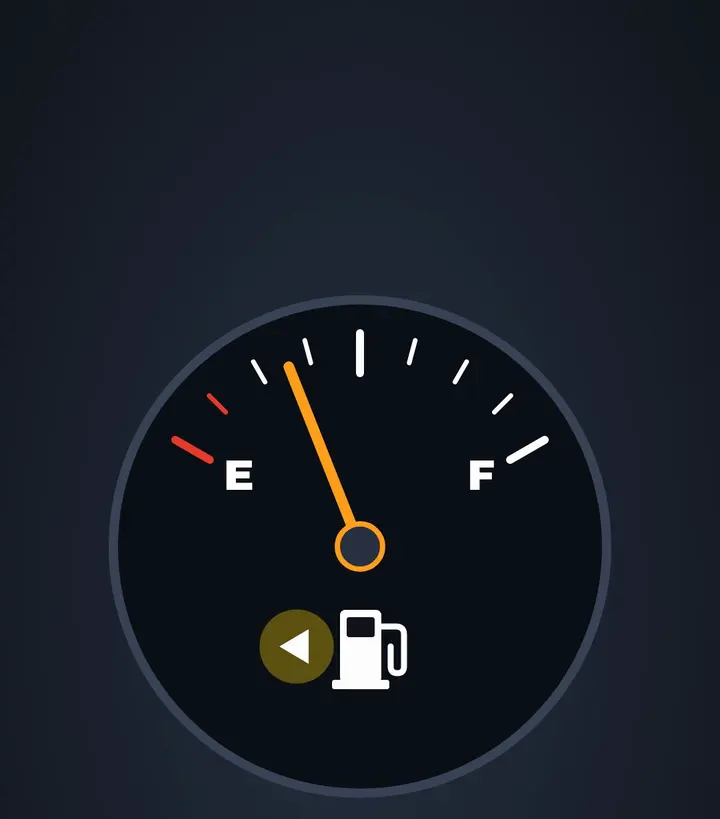
Look for the fuel gauge, then for the pump icon next to it. A small arrow or triangle sits on one side of the pump. Whichever way it points is the side of the car with the fuel door. AAA Mid-Atlantic describes it the same way: "it may look like an arrow or a triangle pointing to the left or to the right" [7].
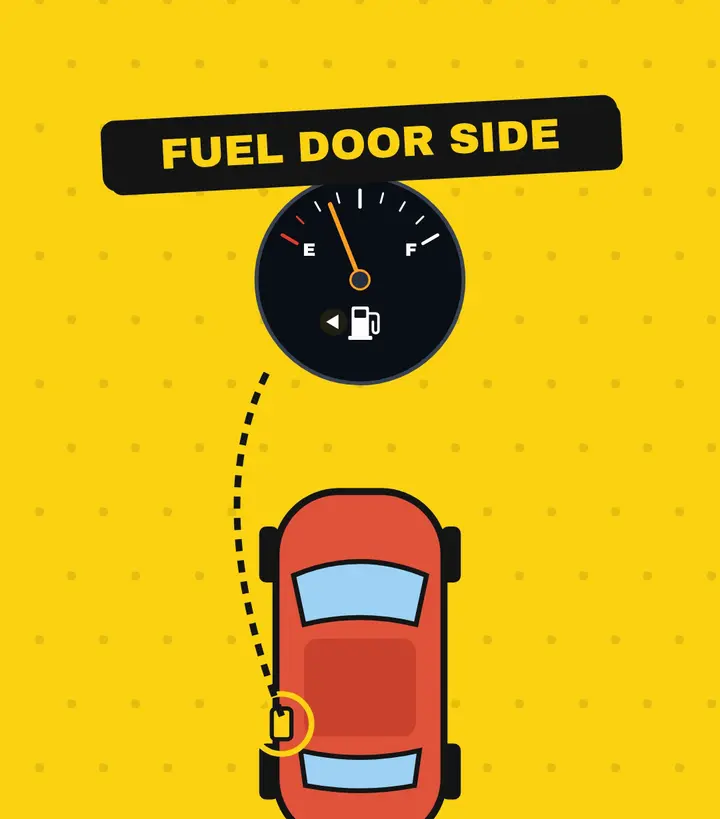
Think of it as left and right of the car, not driver and passenger. In a country that drives on the right, a left arrow means the driver's side. In the UK, Japan or Australia, where the steering wheel is on the right, the same left arrow means the passenger side.
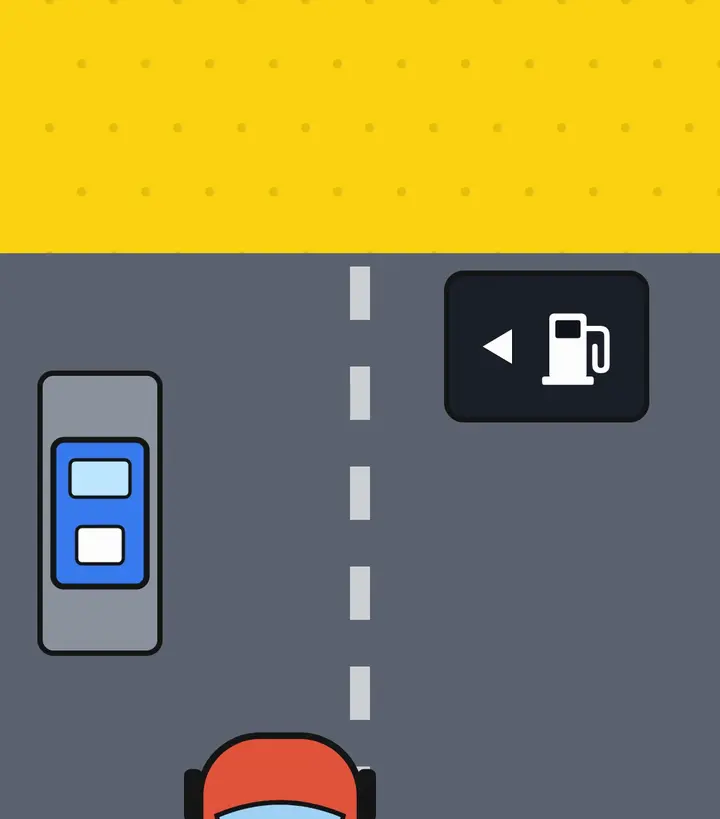
Doesn't the pump's hose show the side too?
You can see why in the official drawings. In the U.S. safety standard for dashboard controls and displays, FMVSS 101, the symbol for fuel level is a pump with the hose on its right, in both the solid and the outline version [3]. That symbol identifies the gauge. It wasn't drawn to show a side. Mazda's own manual shows the result: its icon has the hose on the right and the arrow pointing left, and the text says the flap is on the left [1]. The same standard has no entry for a fuel door arrow at all [3], so the arrow is something carmakers add on their own.
Who came up with the arrow?
The person usually credited is Jim Moylan, a designer at Ford. In April 1986 he took a company car to fill up in the rain, pulled in on the wrong side of the pump and got soaked [4]. He wrote a suggestion memo that same day: "I would like to propose a small addition to future I/P cluster graphics in all passenger car and truck lines. The indicator or symbol I have in mind would be located near the fuel gauge and simply describe to the driver which side of the vehicle the fuel fill door is located" [5].
1976
The Mercedes-Benz W123 has a red low-fuel warning light shaped like a small triangle that points right, toward its fuel filler [4].April 1986
Jim Moylan fills a Ford company car on the wrong side in the rain and writes his proposal [4].1989
The Ford Escort and Mercury Tracer are the first cars with the printed arrow [4].2018
The podcast Every Little Thing identifies Moylan as the arrow's inventor [4].2022
Ford's archivists digitize the memo and Ford CEO Jim Farley shares it online [5].2025
Moylan dies in December at the age of 80 [5].
According to the Wall Street Journal, as reported by The Drive, Moylan never asked Ford to credit him for the idea [5].
Why isn't the fuel door always on the same side?
No rule says where the filler has to go. Motor1 describes it as a packaging decision: the filler neck has to run from the door to a tank under the rear of the car, past suspension parts, exhaust routing and crash structures, and engineers put it on whichever side gives the cleanest path [8]. Brands have habits too. Many Japanese models put it on the left, which is the driver's side in Japan, while many German models put it on the right in left-hand-drive markets [8].
Why not put a door on both sides? A General Motors spokesman, Rick Asher, told Snopes that the cost "would far exceed the value of the added convenience for the vast majority of people" [6]. A printed arrow costs almost nothing, which is why it spread.
Like the black dots around a windshield, it's one of those parts of a car that nobody explains when you buy it. AAA Mid-Atlantic, citing industry experts, says only about one in ten drivers know about the arrow [7].
Sources
- 1.Mazda CX-9 Owner's Manual: Fuel Gauge. Mazda Motor CorporationPrimary. Accessed October 8, 2026.
- 2.Nissan X-Trail 2024 Owner's Manual: Fuel gauge. NissanPrimary. Accessed October 8, 2026.
- 3.49 CFR 571.101, Standard No. 101: Controls and displays. U.S. National Highway Traffic Safety Administration, via eCFRPrimary. Accessed October 8, 2026.
- 4.The Inventor Of The Little Arrow That Tells You What Side The Fuel Filler Is On Has Finally Been Found. Jalopnik (Jason Torchinsky). Accessed October 8, 2026.
- 5.The 'Moylan Arrow' Is One of Ford's Best Contributions to Car Design. The Drive (Adam Ismail). Accessed October 8, 2026.
- 6.Gas Pump Icon and Fuel Doors. Snopes. Accessed October 8, 2026.
- 7.Gas tank indicator arrow: A car's best secret. 6abc Action News (WPVI), quoting AAA Mid-Atlantic. Accessed October 8, 2026.
- 8.Why Your Gas Tank Is On The Left—Or Right. Motor1. Accessed October 8, 2026.
Last verified: . Spotted an error? See our editorial policy and corrections.
Video transcript
That tiny arrow next to your fuel gauge is not decoration. It tells you which side your fuel door is on. Arrow pointing left? Pull up with the pump on your left. Pointing right? Fuel door's on the right. Most cars have it, and most drivers never notice it. It's perfect when you're driving a rental, or a friend's car. So next time you pull up to a pump, check that tiny arrow next to your fuel gauge.


