
What does the tab under the rearview mirror do?
Short answer
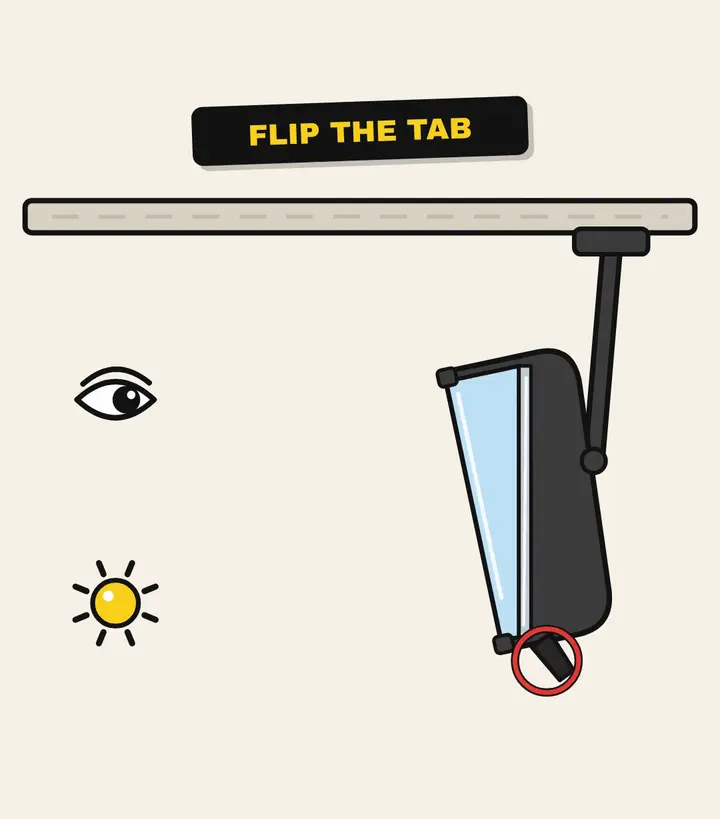
The tab switches a manual rearview mirror between day and night positions. The glass is a wedge with a reflective coating on its back. Flipping the tab tilts it slightly, so the bright reflection from the coating misses your eyes and you see the faint reflection from the bare front surface, roughly 4 percent of the light.
Published · Last verified · 12 sources
Playing loads the video from YouTube (Google), which may set cookies. Cookie policy
 Also in the long video · 1:29Your Car Is Full of Hidden Features. Here's What They Actually Do
The tab is a day/night switch. A manual rearview mirror is a wedge of glass with a reflective coating on the back, and the tab tips that wedge slightly. In one position the coating sends you a bright view of the road behind. In the other, the coating's reflection misses your eyes and you are left with the weak reflection from the bare front face of the glass, about 4 percent of the incoming light [1]. The U.S. safety standard for mirrors happens to set the same figure as its legal minimum: a mirror with more than one reflectance level must reflect at least 35 percent in day mode and at least 4 percent in night mode [8].
How does the mirror dim without any electricity?
Glass lets most light through, but a little always bounces off its surface. You only notice it when the surroundings are dark [1]. In an ordinary mirror the glass is parallel to the metal layer behind it, so the weak front reflection sits on top of the strong one. In a day/night mirror the two are at an angle [1].
General Motors' 1941 patent describes the glass as a plate whose flat front and rear surfaces sit at about 3.5 degrees to each other, enough to separate the two images so that from the driver's seat only one can be seen at a time. The front is polished and left bare. The rear is coated with silver or another highly reflective material [2].
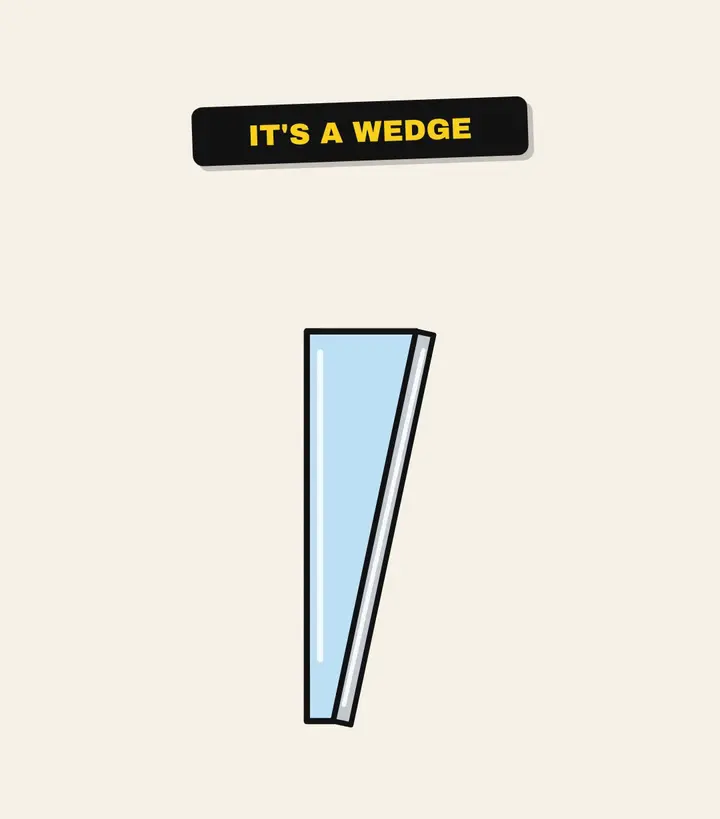
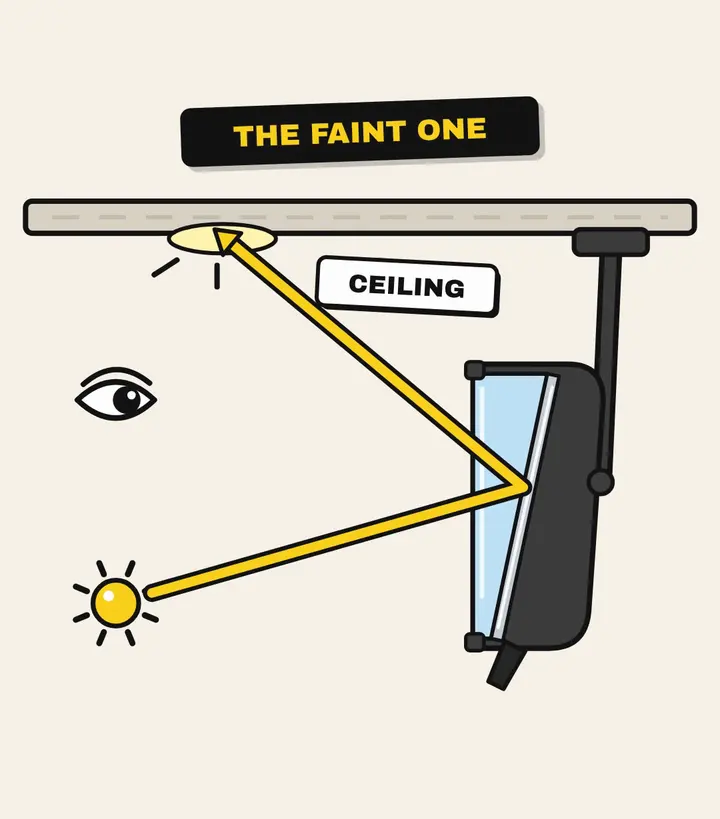
The thick edge is at the top [10]. In the day position, the coated back surface is the one aimed out of the rear window. The bare front surface is reflecting too, but it shows a faint picture of your lap, and the bright image drowns it out [1].
Flip the tab and the two surfaces swap jobs. The front surface now shows the road behind, dimly. The coated surface is aimed at the ceiling of the car, which is almost black at night, so it has next to nothing to show you [10]. The headlights still hit the coating, but they bounce away from your eyes [1].
Why is it about 4 percent?
For light arriving straight on, the share that a transparent surface reflects depends on the refractive indices of the two materials. Georgia State University's HyperPhysics page has a calculator for it: with air (1.0) on one side and glass (1.5) on the other, it returns 4 percent [9].
Real mirror glass comes out slightly higher. A 1943 patent from the glassmaker Libbey-Owens-Ford gives the front-surface reflection of a wedge mirror as 4.5 percent [6], and a 1949 GM patent says one-piece wedge mirrors made of ordinary mirror glass, with a refractive index of about 1.55, reflect about 5 percent [7].
What is the tab itself?
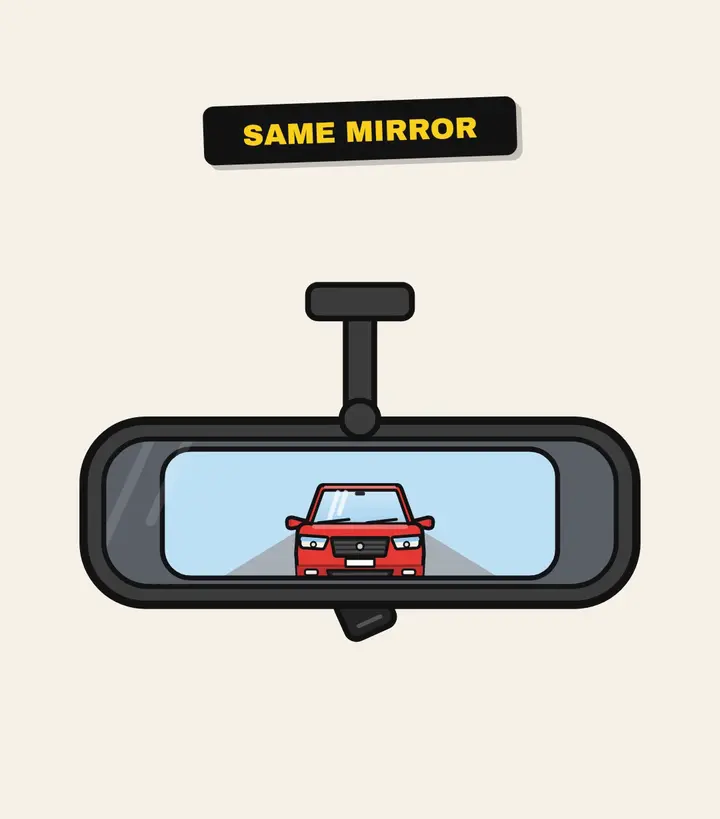
It is a handle on a spring. In the 1941 design, the driver nudged small wings on the top and bottom of the mirror's frame. A hinge, a toggle piece and a coiled spring did the rest, so the driver only had to start the movement and the spring finished it and held the glass there. Stops limited the swing to exactly the angle needed to swap one image for the other [2].
The tab arrived with GM's next patent, filed in 1946. The glass pivots along its top edge inside the housing. A small metal cradle hooks under the bottom edge and pokes out through an opening in the underside of the housing "to provide a handle", and a C-shaped wire spring snaps the glass into either position. In that design, the dim position is the one with the bottom of the glass pushed forward [3].
Who invented the day/night mirror?
No single person did, and the patent record starts well before General Motors.
1928
Herbert E. Wetherbee of Cleveland Heights, Ohio, applies for a patent on a "duplex" mirror: a silvered mirror with a sheet of clear glass in front of it at an acute angle. Tilting the unit swaps the bright reflection for the glass's dull one. He writes that most drivers of the day dealt with glare by tilting the mirror out of use [4].1929
Walter Joel Bell of Los Angeles applies for a "prismoidal" mirror: a wedge of tinted glass, green for preference, with a mirror coat on the back. For daytime, an ordinary mirror was fixed to its back and the whole unit was turned around. The patent was granted in 1934, after his death [5].1941
Gordon E. Roedding applies, for General Motors, for a clear glass wedge in a housing with a snap-action tilt [2].1946
Roedding's second application adds the handle under the housing [3].1949
Edgar D. Springer applies, for GM, for a version that uses two thin flat plates in place of a wedge [7].1982
Gentex introduces an electro-mechanical automatic-dimming mirror "as an alternative to the manual day/night rearview mirrors" [12].1987
Gentex introduces an electrochromic automatic-dimming interior mirror [12].
Before the flip mirror caught on, carmakers used a compromise. According to the Libbey-Owens-Ford patent, the first car mirrors were ordinary silver ones, which glared badly at night, and for years the industry settled on mirrors with a lead sulfide layer that reflected only 30 percent of the light, day and night. Brighter headlights made things worse: sealed-beam lamps and stronger bulbs had more than tripled the light thrown into the mirror [6].
Does the law require a night setting?
Not in the United States. Federal Motor Vehicle Safety Standard 111 requires every passenger car to have an inside mirror "of unit magnification", meaning a flat mirror that shows things at their true size. It adds that a "prismatic day-night adjustment" mirror counts, as long as one of its positions gives unit magnification [8]. The night setting is allowed and regulated, but it is optional.
The same standard is where the curved mirror on the passenger's side gets its warning. A convex mirror fitted there must be permanently marked "Objects in Mirror Are Closer Than They Appear" [8].
What if your mirror has no tab?
Then it most likely dims itself. Gentex, which makes these mirrors, describes electrochromics as "the science of darkening a material using electricity". Its mirrors use light sensors, a proprietary gel and a microprocessor to detect glare and darken to the level needed [11]. A wedge mirror has two fixed settings, while an electrochromic one can stop anywhere in between.
The safety standard has a rule for these too. If the electricity fails, the mirror must go back to at least 35 percent reflectance, either on its own or through a control the driver can use [8].
Glare from the front is handled by other parts of the car, including the dotted patch on the windshield behind the mirror, which fills the gap between the two sun visors.
Sources
- 1.How does the rearview mirror antiglare work? (2011). Science World (Vancouver). Accessed October 11, 2026.
- 2.US Patent 2,356,432: Prismoidal rearview mirror (G. E. Roedding, filed 1941, granted 1944). General Motors Corporation, via Google PatentsPrimary. Accessed October 11, 2026.
- 3.US Patent 2,469,207: Spring mounted two-position prismoidal rear-view mirror (G. E. Roedding, filed 1946, granted 1949). General Motors Corporation, via Google PatentsPrimary. Accessed October 11, 2026.
- 4.US Patent 1,808,740: Duplex rear-view mirror (H. E. Wetherbee, filed 1928, granted 1931). United States Patent Office, via Google PatentsPrimary. Accessed October 11, 2026.
- 5.US Patent 1,949,138: Transparent, prismoidal mirror (W. J. Bell, filed 1929, granted 1934). United States Patent Office, via Google PatentsPrimary. Accessed October 11, 2026.
- 6.US Patent 2,397,947: Rearview mirror (W. H. Colbert, filed 1943, granted 1946). Libbey-Owens-Ford Glass Company, via Google PatentsPrimary. Accessed October 11, 2026.
- 7.US Patent 2,691,919: Prismoidal rearview mirror (E. D. Springer, filed 1949, granted 1954). General Motors Corporation, via Google PatentsPrimary. Accessed October 11, 2026.
- 8.49 CFR 571.111, Standard No. 111: Rear visibility. U.S. National Highway Traffic Safety Administration, via eCFRPrimary. Accessed October 11, 2026.
- 9.Normal Reflection Coefficient (HyperPhysics). Georgia State University, Department of Physics and Astronomy. Accessed October 11, 2026.
- 10.How a Car's Rear-View Mirror Works (2011). Today I Found Out. Accessed October 11, 2026.
- 11.Dimmable Glass: Interior + Exterior Auto-Dimming Mirrors. Gentex CorporationPrimary. Accessed October 11, 2026.
- 12.Gentex Corporation annual report (Form 10-K) for fiscal year 2015. Gentex Corporation, via U.S. Securities and Exchange Commission (EDGAR)Primary. Accessed October 11, 2026.
Last verified: . Spotted an error? See our editorial policy and corrections.
Video transcript
Flip the little tab under your rearview mirror, and the blinding headlights behind you almost disappear. How? That mirror isn't flat glass. It's a wedge, thicker at one edge. In day mode, you see the bright silver coating on the back. Flip the tab, and the wedge tilts. Now that bright reflection points at the ceiling, and you only see the faint one from the front of the glass. About four percent of the light. Same mirror, two reflections. So tonight, when someone's high beams hit you,


