
How does a gas pump know when your tank is full?
Short answer
The pump doesn't know; the nozzle does. Fuel flowing through the nozzle creates suction that draws air in through a small hole near the tip of the spout. When rising fuel covers that hole, the air stops, the suction builds, a diaphragm moves and releases a latch, and a spring closes the valve. The shut-off is purely mechanical.
Published · Last verified · 13 sources
Playing loads the video from YouTube (Google), which may set cookies. Cookie policy
 Also in the long video · 0:24Your Car Is Full of Hidden Features. Here's What They Actually Do
The pump never finds out how full your tank is. The part that stops the fuel is the nozzle in your hand, and it works with air. Fuel moving through the nozzle creates a vacuum that sucks air in through a small port at the end of the spout. When the fuel in the filler neck reaches that port, the suction "builds up rapidly until it lifts the diaphragm" and trips the valve shut [1]. The idea is about a century old: a patent application describing the same diaphragm, tube and Venturi was filed by an inventor from Wichita, Kansas, in October 1924 [3].
Where is the hole, and what is it connected to?
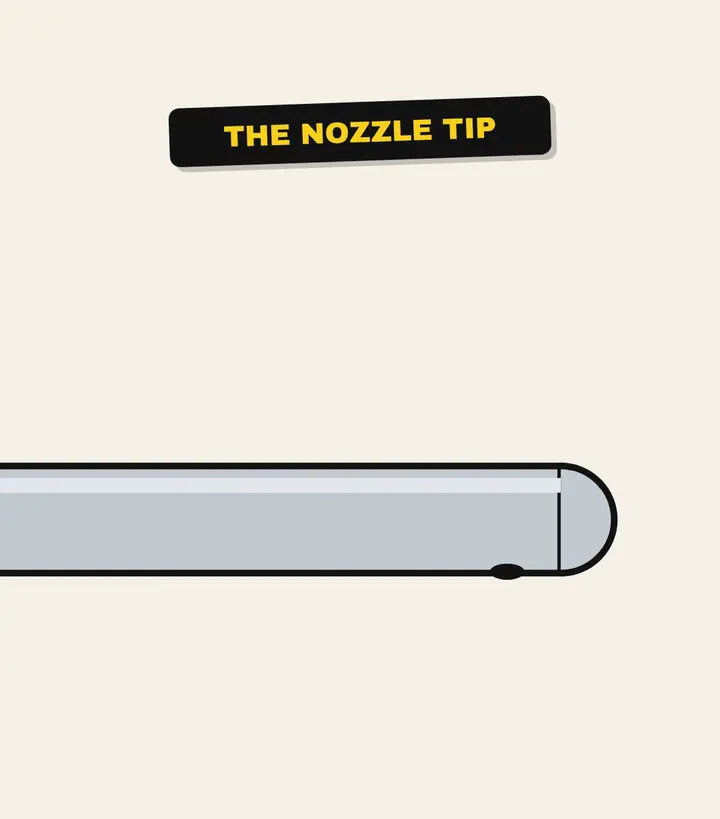
Nozzle maker Elaflex calls it the sensing port and puts it "at the tip of the spout" [1]. The U.S. Environmental Protection Agency describes "a sensing hole located at the tip of the nozzle" [9]. In the patent OPW applied for in 1950, the opening goes through the side wall of the spout next to the outlet, where it is "removed from the flow stream" [2]. Unlike the drain hole in a padlock, it isn't there to let anything out. It is there to let air in.
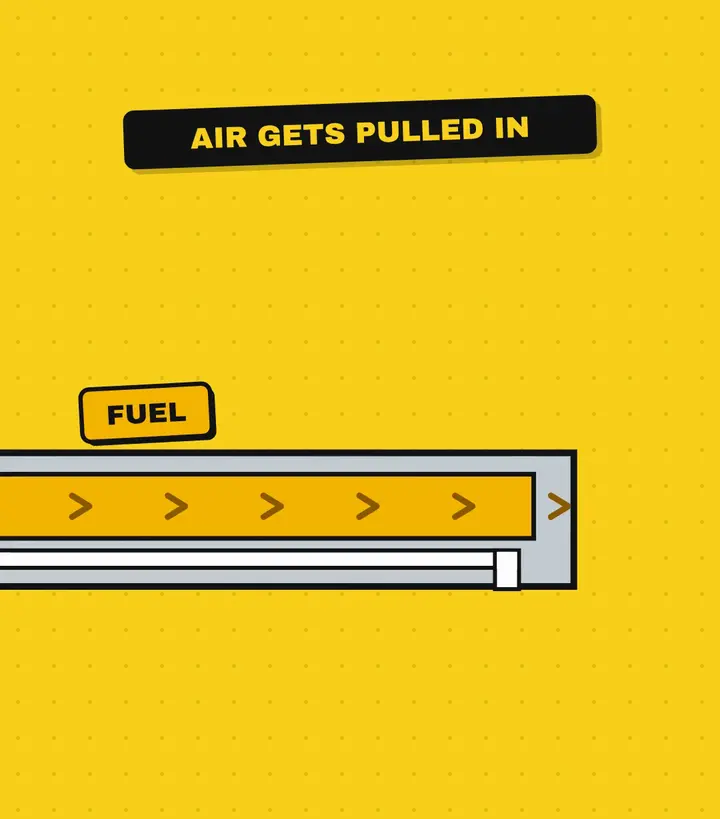
From the hole, a thin tube runs back up the spout to a small chamber in the body of the nozzle. One wall of that chamber is a flexible diaphragm [2].
What creates the suction?
The fuel does. Just below the main valve, the passage narrows into a throat, and the patent says the passage is "designed to provide a Venturi effect" [2]. Gasoline squeezing through the narrow part produces a pressure lower than the air outside [6], and a second small passage connects that low-pressure spot to the diaphragm chamber [2].
So the chamber has two openings. One leads to the throat, which pulls air out. The other leads to the end of the spout, which lets air in. As long as the tank is still filling, air makes the whole trip: in at the sensing port, past the diaphragm and out into the fuel [1]. With air arriving as fast as it leaves, the pressure in the chamber never drops far enough to move the diaphragm [2].
What happens when the tank is full?
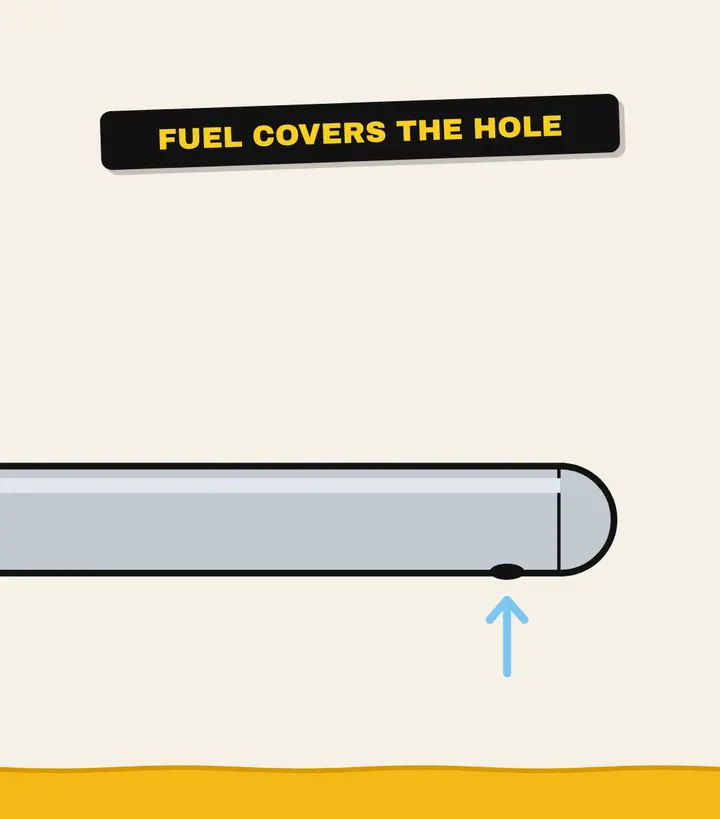
The fuel level climbs until it covers the hole. The throat is still pulling, but liquid is much harder to drag up the thin tube than air, so the chamber is emptied of air instead and the diaphragm gets pulled over [3].
Tank still filling
Fuel reaches the spout
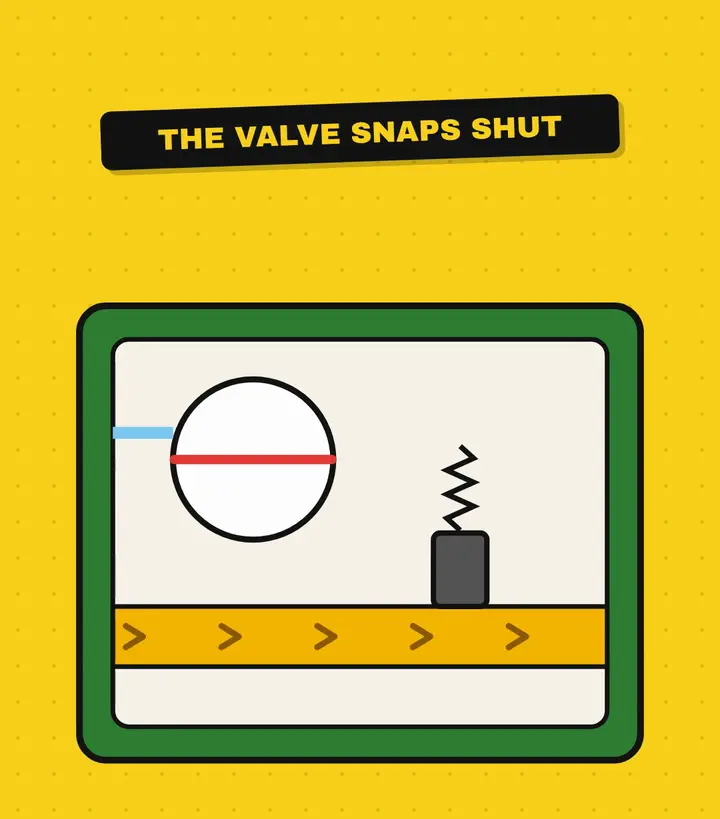
The diaphragm doesn't close the valve. It only releases a latch. In the design Leonard Duerr patented for OPW, the diaphragm carries a pin, the pin holds a set of balls in place, and the balls lock a spring-loaded plunger. That plunger carries the pivot of the hand lever. When the diaphragm lifts the pin, the balls slip out of the way, the plunger drops, and the lever is no longer pressing on the valve stem. The main spring pushes the valve back onto its seat [2]. That is why the flow stops even though you are still squeezing [6]. Let go of the lever and the parts reset themselves for the next car [2].
Duerr wrote that the diaphragm's spring was chosen so that "only a slight suction" would trip it [2]. OPW calls the arrangement its three-ball mechanism and said in 2011 that it "has remained the basic technology in automatic shut-off nozzles" [7].
The valve doesn't have to bang shut, either. Elaflex's closes against the flow, for what the company calls a "'soft' shockless closure" [1].
Who invented the automatic shut-off nozzle?
Going by the patents, no single person did.
1924
Amos O. Payne of Wichita, Kansas, applies for a patent on a "filler spout" with a diaphragm chamber, a small pipe open near the end of the spout, a Venturi and a latch. It is granted on 25 August 1925 [3].1939
On 24 April, Archibald H. Davis Jr. of Rock Island, Illinois, files for a "filling nozzle with automatic shut-off". It is granted in 1943 and assigned to American Machine and Metals [4].1942
Richard C. Corson of Olean, New York, files for a float-operated "barrel filler", granted in 1943 and assigned to the Socony-Vacuum Oil Company [5].1948
Clarence Paul Gravelle of Philadelphia files for a latch that holds the lever open, so that a station attendant can leave the nozzle and go and clean the windshield. It is granted in 1950 [6].1949
OPW says its engineer Leonard H. Duerr invents the three-ball mechanism, and that the company releases the 1811 "Fil-O-Matic", which it calls the first production nozzle with automatic shut-off [7].1950
Duerr's patent application is filed on 8 March. It is granted on 8 January 1952 and names Payne's and Davis's patents as examples of the type [2].
Payne's reason for wanting one will sound familiar. Fuel gauges, he wrote, "are often inaccurate", so tanks overflowed and gasoline spattered over the paint or spilled on the ground, where it was a fire risk [3]. (The gauge has picked up some help since, including the little arrow that shows which side the fuel door is on.)
By 1939 the principle was no longer new. Davis wrote that shutting a nozzle by vacuum on a diaphragm "has frequently been attempted", and that the hard part was making it dependable. His answer was more suction: over 25 inches of gasoline, he claimed, where 6 had been available before [4].
What took longer was getting it onto forecourts. OPW says that "until the early 1950s there were no automatic fuel nozzles in use at gas stations", and that an attendant had to hold the nozzle open until the tank was full [7].
Why does the nozzle click off before the tank is full?
Because it can't tell a full tank from anything else that blocks its air supply. Elaflex's manual lists the usual causes [1]:
- Splashing. "Splashing fuel can trip the nozzle before the tank is full." The advice is to fill more slowly. The lever latch on this nozzle has two positions: fully open for "well vented, straight and near vertical fill pipes", and reduced output for "poorly vented pipes".
- A filler pipe that runs almost flat. The ball described above rolls back, blocks the sensing path, and the nozzle trips again and again. Lifting the nozzle so the ball rolls forward lets fuelling continue.
- A blocked air passage. If a nozzle keeps tripping off permanently, the manual says, its air passage is blocked.
None of this is new. In 1948 Gravelle described gasoline blowing back "when air is compressed in the tank by too rapid filling", and noted that many tanks had to be filled at a slower rate to prevent it [6].
Speed has a legal ceiling as well. In the United States, a nozzle that dispenses gasoline into motor vehicles may not deliver more than 10 gallons per minute, and the end of its spout may not be more than 21.3 mm across [11]. Duerr shaped his valve so that the suction would be strong enough at flows as low as 2 gallons per minute and as high as 15 [2].
Is it bad to keep squeezing after the click?
The nozzle won't stop you. Elaflex's manual notes that after the automatic cut-off, "Topping up is possible" [1]. Regulators and carmakers ask you not to:
- The EPA's mid-Atlantic office said in 2004 that extra gasoline "will either be sucked into the vapor recovery tube or overflow", so "you will end up paying for gas that you don't get", and that overfilling "can actually damage your car's vapor recovery system" [9].
- An earlier EPA piece, from 1999, explains what happens at pumps with a vapor-return hose: topping off fills the hose with liquid gasoline, and it stays blocked until someone drains it [10].
- Mazda's owner's manual says: "Do not continue refueling after the fuel pump nozzle shuts off automatically." Its reason is that overfilling may cause fuel to overflow or leak [13].
One more habit worth having: a few drops of fuel stay in the sensing port after the click. Elaflex suggests tilting the nozzle forward into the tank for a few moments before you hang it up, so that "the next user will not be surprised by drips" [1].
Do gas pumps have to shut off automatically?
The one U.S. rule we read doesn't insist on it. The federal workplace safety rule for service stations allows either "a listed manual or automatic-closing type hose nozzle valve". A manual one "shall be held open manually during dispensing". Only the automatic kind may be used with an approved latch-open device. At marine service stations the rule is stricter: nozzles must be automatic-closing and have no hold-open latch at all [12]. In other words, the clip that holds the lever for you is allowed only on a nozzle that can stop itself.
In Europe, Elaflex says its nozzle meets the standard EN 13012, and that in line with it the automatic shut-off also works when the lever is held open by hand [1]. We have not read the standard itself, so that is the manufacturer's summary of it.
Sources
- 1.ZVA Slimline 2 automatic safety nozzle: installation and operating instructions (PDF). ElaflexPrimary. Accessed October 11, 2026.
- 2.US Patent 2,582,195: Automatic shutoff dispensing nozzle valve (Leonard H. Duerr, filed 1950). United States Patent Office, via Google PatentsPrimary. Accessed October 11, 2026.
- 3.US Patent 1,550,738: Filler spout (Amos O. Payne, filed 1924). United States Patent Office, via Google PatentsPrimary. Accessed October 11, 2026.
- 4.US Patent 2,320,033: Filling nozzle with automatic shutoff (Archibald H. Davis Jr., filed 1939). United States Patent Office, via Google PatentsPrimary. Accessed October 11, 2026.
- 5.US Patent 2,316,934: Barrel filler (Richard C. Corson, filed 1942). United States Patent Office, via Google PatentsPrimary. Accessed October 11, 2026.
- 6.US Patent 2,528,747: Automatic filling nozzle (Clarence Paul Gravelle, filed 1948). United States Patent Office, via Google PatentsPrimary. Accessed October 11, 2026.
- 7.Evolution of the Fuel Nozzle (2011). OPW (Dover Corporation)Primary. Accessed October 11, 2026.
- 8.How the Gas Pump Knows When to Shut Off (2011). Mental Floss (Stacy Conradt). Accessed October 11, 2026.
- 9.Don't Top off Your Gas Tank: Save Money at the Gas Pump and Help Protect the Environment (news release, 28 June 2004). U.S. Environmental Protection Agency, mid-Atlantic region (archived)Primary. Accessed October 11, 2026.
- 10.Want to Save at the Pump? Don't Top Off! (26 July 1999). U.S. Environmental Protection Agency (archived)Primary. Accessed October 11, 2026.
- 11.40 CFR 1090.1550: Requirements for gasoline dispensing nozzles used with motor vehicles. U.S. Environmental Protection Agency, via eCFRPrimary. Accessed October 11, 2026.
- 12.29 CFR 1910.106: Flammable liquids, paragraph (g) Service stations. U.S. Occupational Safety and Health Administration, via eCFRPrimary. Accessed October 11, 2026.
- 13.2025 Mazda CX-5 Owner's Manual: Fuel-Filler Lid and Cap. Mazda North American OperationsPrimary. Accessed October 11, 2026.
Last verified: . Spotted an error? See our editorial policy and corrections.
Video transcript
A gas pump has no idea how much fuel is in your tank. No sensor. No signal. Nothing. So how does it know exactly when to stop? Look at the tip of the nozzle. There's a tiny hole. While you pump, the fuel rushing through pulls air in through that hole. The moment the fuel rises and covers it, the air is cut off. The suction spikes, a small diaphragm snaps, and the valve slams shut. That click is pure physics. Because remember,


