
Why do crackers have holes?
Short answer
Crackers have holes, called docking holes, so they bake flat and crisp. Before baking, pins press into the thin dough, pinning its layers together and giving steam a way out. Without them, steam trapped between the layers would inflate the cracker into a hollow, uneven pillow. Bakers prick pie crusts with a fork for the same reason.
Published · Last verified · 8 sources
The holes are docking holes, and they are how a baker keeps a thin sheet of dough from ballooning in the oven. New Zealand's Baking Industry Research Trust says they are put into the dough "to stop overly large air pockets from forming in the cracker while baking" [1]. The less obvious part is how they do it: each pin fastens the top of the dough to the bottom, so the layers can't pull apart, and that matters at least as much as the little vent it leaves behind [2].
What happens to cracker dough in the oven?
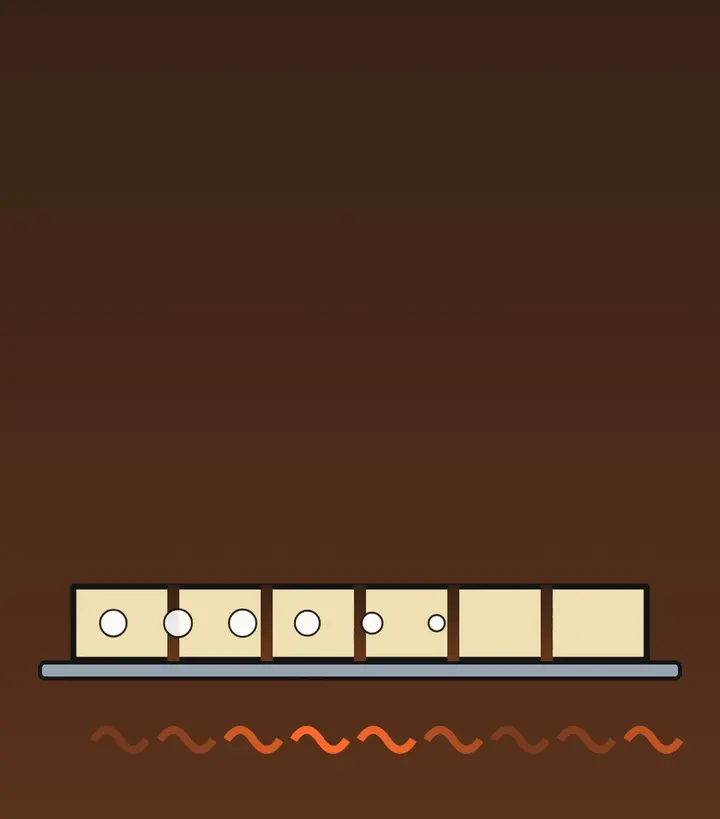
Crackers are made from a stiff, lean dough that is rolled into a thin sheet and cut into shapes [1]. As soon as that sheet meets the heat, the water in it starts turning into steam. A Frito-Lay patent on snack dough describes what comes next: the surface loses moisture faster than the middle and dries into a skin, which "prevents the steam from escaping." The trapped steam pushes the two faces of the dough apart, "forming a hollow void." Bakers call this "pillowing" or "blistering" [4].
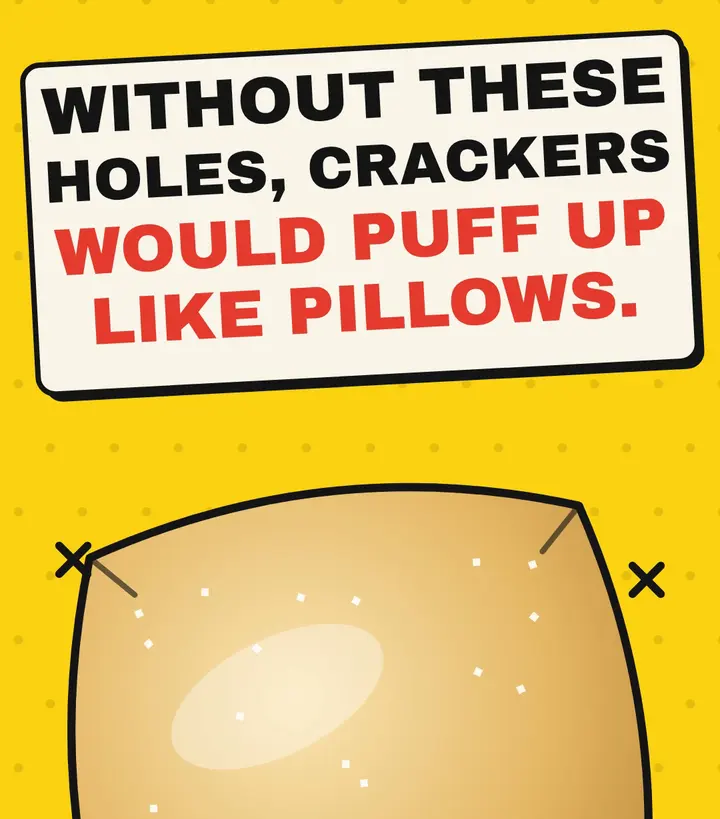
Many crackers are especially prone to it because they are built in layers on purpose. The classic soda cracker is sheeted to about 4 mm and then laminated, folded over on itself, 6 to 8 times before it is cut [1]. Every one of those layers is a place where steam could push the dough apart.
How do the holes stop a cracker from puffing up?
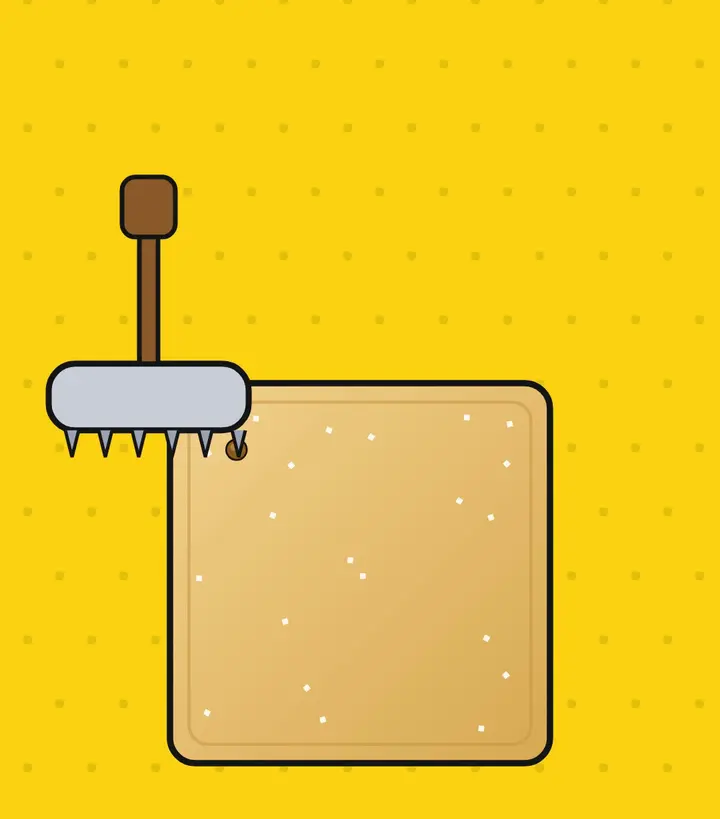
Tom Lehmann, who spent nearly 50 years at the American Institute of Baking and became its director of bakery assistance [7], described docking as "the process of sealing or crimping the top and bottom layers of the dough together, much like spot welding is used to hold two pieces of steel together." A blunt pin works better than a sharp one, he explained, because it pushes dough ahead of it and creates "a larger contact area for tighter bonding," while a pointed tip "just pierce[s] the dough, making a small hole in it" [2].
So the holes work more like rivets than chimneys. The dough between them can still rise and blister a little, which is why a saltine's bottom is covered in small blisters rather than one big bubble [1].
Why do different crackers have different hole patterns?
The pattern is part of the recipe, because it decides how much each cracker is allowed to rise and blister. The Baking Industry Research Trust describes a few standard types [1]:
Soda crackers and saltines
Cream crackers
Round snack crackers, the kind sprayed with hot oil as they leave the oven, are docked too, so they get "an even lift during baking" [1]. None of these crackers is meant to come out perfectly flat. The holes don't stop the dough from rising. They decide where it rises and by how much.
Lehmann's pizza advice shows what happens when you add more holes. One or two passes of a docker are usually enough to control bubbling. Four or five take away the rise and give a thinner, crisper crust, which is why heavily docked cracker-style pizza crusts are so crunchy [2].
Who started docking crackers?
By the 1870s docking was already being built into cracker machines. In 1872 William Cairns of Jersey City patented a cracker machine in which the shaped dough passed under "docker or pricking and marking pins" before it was "passed off from the machine ready for baking" [5]. A year later Lucius A. Rockwell of New York patented another, in which flattened dough pieces were "pricked with points or 'docked'" on their way to the baking plate [6]. The word and the step were already part of cracker making 150 years ago.
Are the holes just decoration?
The look works both ways. The 2001 patent found that docking holes made its crackers seem less healthy, because shoppers linked them with ordinary crackers. Its fix was to press small nut pieces into the dough before baking, which it says "accomplishes the same effect on the structure as docking holes" [3]. Like the square on a toothpaste tube, the holes are a production-line detail that people end up reading as part of the design.
Why do bakers prick pie crusts?
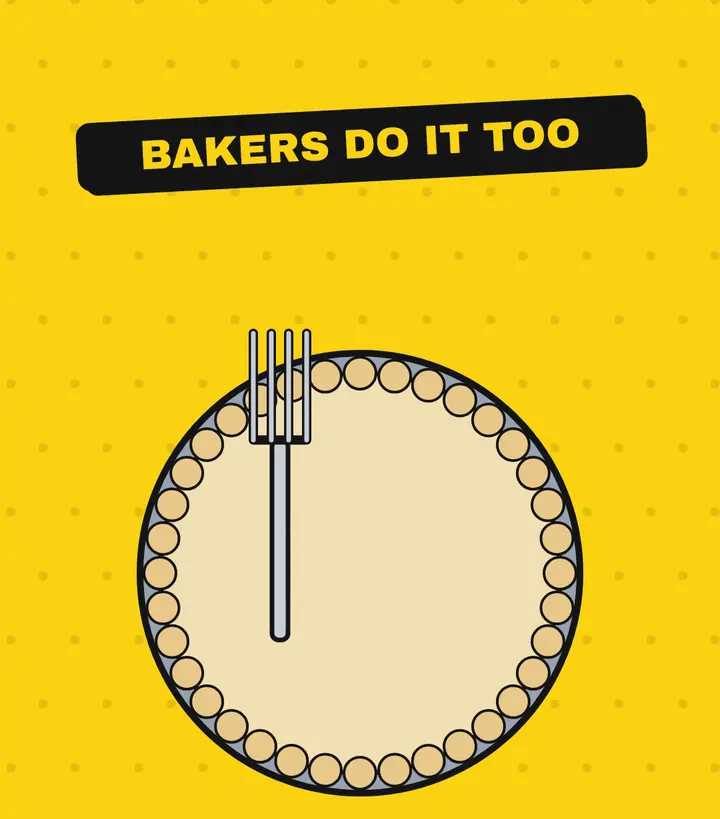
Same problem, different dough. When a pie shell is baked before it is filled, steam puffs the pastry up into bubbles and pockets, so parts of it cook too fast and the base ends up uneven for the filling. Pricking the dough all over with a fork, sides included, stops that, and does the same job as filling the shell with pie weights. The exception is a very runny filling such as quiche, where some bakers skip docking because the liquid can seep into the holes and make the crust soggy [8].
Sources
- 1.Crackers: Information Sheet (BakeInfo). Baking Industry Research Trust (New Zealand)Primary. Accessed October 8, 2026.
- 2.The Secrets of Effective Dough Docking. PMQ Pizza Magazine (Tom Lehmann). Accessed October 8, 2026.
- 3.US Patent 6,846,501 B2: Traditional snacks having balanced nutritional profiles. U.S. Patent and Trademark Office, via Google PatentsPrimary. Accessed October 8, 2026.
- 4.US Patent 9,554,580 B2: System and apparatus for controlling blistering. Frito-Lay North America, via Google PatentsPrimary. Accessed October 8, 2026.
- 5.US Patent 133,014: Improvement in Cracker-Machines (William Cairns, 1872). U.S. Patent Office, via Google PatentsPrimary. Accessed October 8, 2026.
- 6.US Patent 139,920: Improvement in Cracker-Machines (Lucius A. Rockwell, 1873). U.S. Patent Office, via Google PatentsPrimary. Accessed October 8, 2026.
- 7.Tom Lehmann Tribute. PMQ Pizza Magazine. Accessed October 8, 2026.
- 8.How and When to Dock a Pie Crust. The Kitchn. Accessed October 8, 2026.
Last verified: . Spotted an error? See our editorial policy and corrections.
Video transcript
Without these holes, crackers would puff up like pillows. They're called docking holes. When crackers bake, steam builds up inside the dough. With nowhere to go, it forms big bubbles, and the crackers bake unevenly. The holes let the steam escape, so every cracker comes out flat and crispy. Bakers poke holes in pie crusts for the same reason. So remember:


