
Why do pen caps have a hole?
Short answer
The hole in a pen cap is a safety feature. If a cap is inhaled and lodges in the airway, the hole lets some air through so the person can keep breathing until doctors remove it. The ISO 11540 safety standard covers caps on pens likely to be used by children up to age 14.
Published · Last verified · 12 sources
That hole is there so a person can keep breathing if the cap ends up in their windpipe. An inhaled cap can lodge in the airway like a cork. With an open channel through its closed end, some air still gets past while doctors work to remove it. The rule behind it is ISO 11540, an international standard for caps on writing and marking instruments "likely to be used by children up to the age of 14 years" [1].
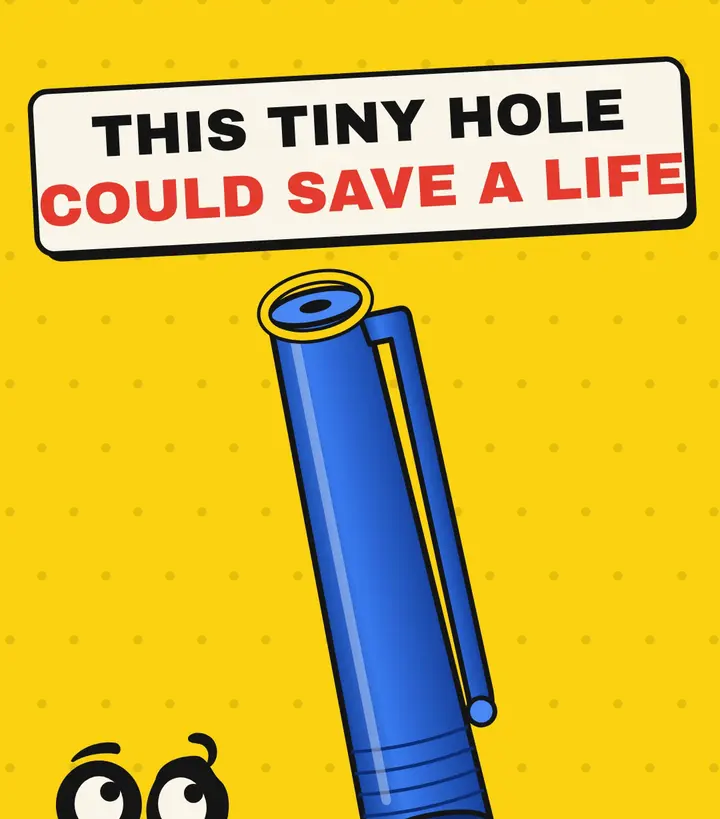
How does a hole help if the cap is stuck?
A pen cap is a tapered plastic tube, narrow and closed at one end, wide and open at the other. That shape is what makes it dangerous. Surgeons in India who treated a 5-year-old boy described how the narrow end "had abducted the vocal cords and allowed the cap to slide in but the base end being wide, prevented it from being taken out", and the plastic was too slippery to grip [11]. A solid cap wedged like that would seal the airway.
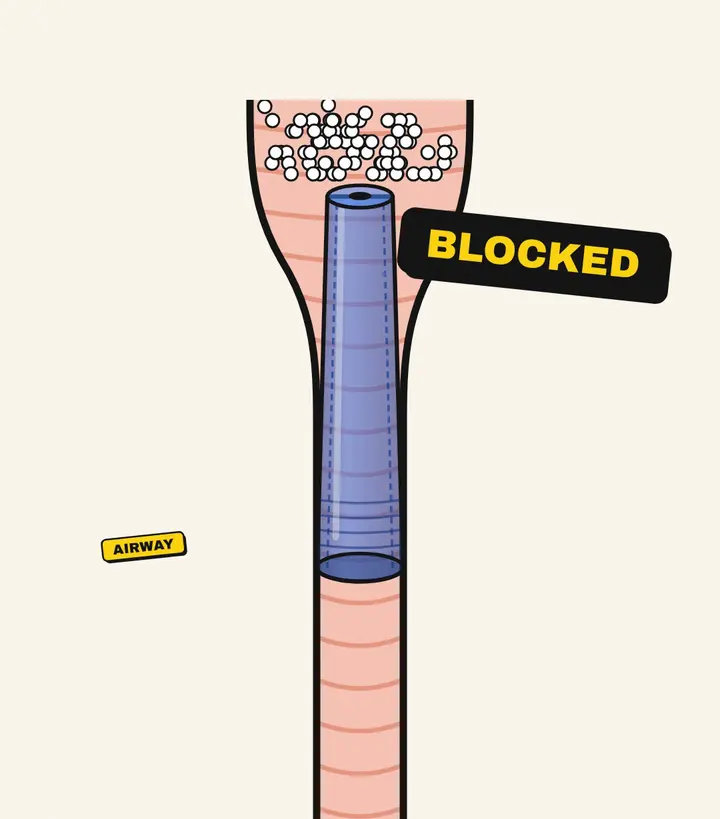
Put a hole in the closed end and the cap becomes a short pipe. In that same case the authors noted that "ventilation was maintained in this case due to the central lumen in the cap". The cap still had to come out through an opening made in the boy's windpipe, but air could pass while the team worked [11].
How big does the opening need to be? A UK patent application filed by Biro Bic in May 1988 cites "reports of research" suggesting that an air passage "as small as 5 mm2 cross section" left in the throat lets breathing continue "whilst medical help is sought" [5]. Its own design used an aperture with a minimum diameter of 3.0 mm, giving roughly 7 mm² [5]. The standards check caps with a formal air flow test, set out in Annex A of the 1993 ISO edition and of the British standard BS 7272-1 [2] [3]. The pass figures are in the paid text of those standards, so we don't quote numbers for them here.
What does ISO 11540 actually require?
The current edition, from 2021, "specifies requirements to reduce the risk of asphyxiation from caps for writing and marking instruments" [1]. ISO's summary of the first edition, from 1993, lists what those requirements cover: "cap size, ventilated caps (vent area, air flow) and marking". Caps that didn't comply were to carry a warning on the pen or its packaging about "the dangers of asphyxiation from pen caps" [2].
A hole in the tip isn't the only way to vent a cap. BIC Corp's 1991 patent for a vented cap, for example, lets air through "at least one generally arcuately shaped opening" arranged around a central hub [8]. Patent offices even give these designs their own category: in the Cooperative Patent Classification, pen caps "with means for preventing choking" are code B43K 23/122, and the subgroup "comprising an air passage" is B43K 23/124 [12].
The standard's age limit lines up with hospital data. A Beijing hospital that reviewed its cases from 1997 to 2007 found 34 children treated for an inhaled pen cap, 2.65% of the 1,280 airway foreign bodies it handled in that time. They were aged 6 to 14, and the authors concluded that "pen cap inhalation mostly occurs in school-aged children" [10]. These aren't toddlers. They're children old enough to be in school, with a pen in hand all day.
When did pen caps get holes?
1988
Biro Bic files a UK patent application for a ballpoint cap whose end is "pierced by an aperture" so that "respiration can continue should the cap be swallowed and become lodged in the throat" [5].1990
The British standard BS 7272 is first published, in January [3].1993
ISO publishes the first edition of ISO 11540, for caps on instruments "intended for use by children up to 14 years of age" [2].2008
2014
A second edition replaces the 1993 text of ISO 11540 [2].2021
The third and current edition is published [1].2026
In July, ISO puts the 2021 edition under its scheduled five-year review [1].
We found secondary sources giving a specific year for when the BIC Cristal cap got its hole, but no BIC or other primary record of it, so we've left that date out.
Doesn't the hole dry out the ink?
Ballpoints get away with a plain hole because of their ink. Biro Bic's application points out that ballpoint ink is "a viscous paste which does not dry out under normal atmospheric conditions", so the aperture "does not usually give rise to problems" [5]. Markers and liquid-ink pens need a cleverer cap, one that lets air flow through "while engaging the nib or writing portion of the implement to prevent the evaporation of ink" [8].
Ballpoint cap
Marker or liquid-ink cap
The hole does have a side job. BIC says its cap holes help in "preventing pen leakage" as well as meeting safety standards [7]. Berol's patent explains how: when you push a cap on, a vent lets the trapped air escape instead of pressing on the ink, "reducing the likelihood that ink will leak from the pen" [9].
What's the other hole, in the pen barrel?
That one is about ink, not safety. On the Cristal, BIC says the barrel hole "balances the pressure inside and outside the pen, pushes the ink towards the tip, prevents leakage" [6]. It's the same idea as the tiny breather hole in airplane windows: keep the air pressure on both sides equal. BIC's FAQ adds that "approximately 90 percent of all pens are vented to prevent leakage", and that pens without a vented barrel "contain sealed ink systems and are pressurized" [7].
The plug at the far end of the barrel is a choking risk too. In the UK it has its own standard, BS 7272-2, which covers "end closures" on pens likely to be used by children up to 14 [4].
Does the hole make an inhaled cap harmless?
No. It buys time and nothing more. Every cap in the Beijing series still had to be removed in hospital by rigid bronchoscopy [10], and the 5-year-old in India needed an opening cut in his windpipe [11]. If you think someone has inhaled a pen cap, call emergency services right away.
Sources
- 1.ISO 11540:2021 Writing and marking instruments — Specification for caps to reduce the risk of asphyxiation. International Organization for Standardization (ISO)Primary. Accessed October 8, 2026.
- 2.ISO 11540:1993 Caps for writing and marking instruments intended for use by children up to 14 years of age — Safety requirements. International Organization for Standardization (ISO)Primary. Accessed October 8, 2026.
- 3.BS 7272-1:2008 Writing and marking instruments — Specification for caps to reduce the risk of asphyxiation. British Standards Institution (BSI)Primary. Accessed October 8, 2026.
- 4.BS 7272-2:2008+A1:2014 Writing and marking instruments — Specification for end closures to reduce the risk of asphyxiation. British Standards Institution (BSI)Primary. Accessed October 8, 2026.
- 5.GB 2218381A: Safety cap for a ball point pen. UK patent application by Biro Bic, via Google PatentsPrimary. Accessed October 8, 2026.
- 6.BIC Cristal: 75 years of inspiration (press kit, PDF). BICPrimary. Accessed October 8, 2026.
- 7.FAQ: Why is there a hole in the barrel of BIC Cristal pens? (archived 2017). BIC Australia, via the Internet ArchivePrimary. Accessed October 8, 2026.
- 8.US Patent 5,186,564: Vented removable cap. U.S. Patent Office (BIC Corp), via Google PatentsPrimary. Accessed October 8, 2026.
- 9.US Patent 6,309,127: Caps for writing instruments. U.S. Patent Office (Berol Corp), via Google PatentsPrimary. Accessed October 8, 2026.
- 10.Rigid bronchoscopy for inhaled pen caps in children (J Pediatr Surg, 2009). Journal of Pediatric Surgery, via PubMedPrimary. Accessed October 8, 2026.
- 11.Beyond the Norm: Tracheostomy's Vital Role in Unconventional Foreign Body Removal (2023). Indian Journal of Otolaryngology and Head & Neck Surgery, via PubMed CentralPrimary. Accessed October 8, 2026.
- 12.Cooperative Patent Classification, subclass B43K (implements for writing or drawing). United States Patent and Trademark OfficePrimary. Accessed October 8, 2026.
Last verified: . Spotted an error? See our editorial policy and corrections.
Video transcript
This tiny hole in your pen cap could save a life. If someone accidentally inhales a cap, it can get stuck in their airway. That little hole lets some air through, buying precious time. It's even part of an international safety standard: ISO 11540. It still doesn't make chewing on pen caps safe. But now you know why your pen cap has this tiny hole.


